Top Posts
Cusco Tour: 3 differences between Machu Picchu, Mountain...
Quechua Travel Words: Useful words for a great...
Tour Arequipa: The fascinating stone city of Choqolaqa
Tour Arequipa: Stunning Salinas and Aguada Blanca N.R....
Protecting Our Planet Starts with You – 9...
8 highlights of Arequipa – Tips to enjoy...
FOOD in Arequipa: 8 delicious Dishes that Are...
Embroidery in the Colca Valley a Cultural Heritage...
The interdimensional gate Aramu Muru. Fascination & mystery.
Pacaya Samiria Reserve: A world destination not to...
  • Go to Giardino Tours
  • English
  • Español
Giardino Tours Blog
TRANSFORMING TRAVELS INTO MEMORABLE STORIES
Tag:

Nature

Peru Great Destinations

Amazing Tour Maras Salt ponds in Cusco (Virtual)

by Giardino Tours February 15, 2021

Salineras of Maras is among the most spectacular sights in Cusco area, with thousands of salt pans that have been used for salt extraction since Inca times.

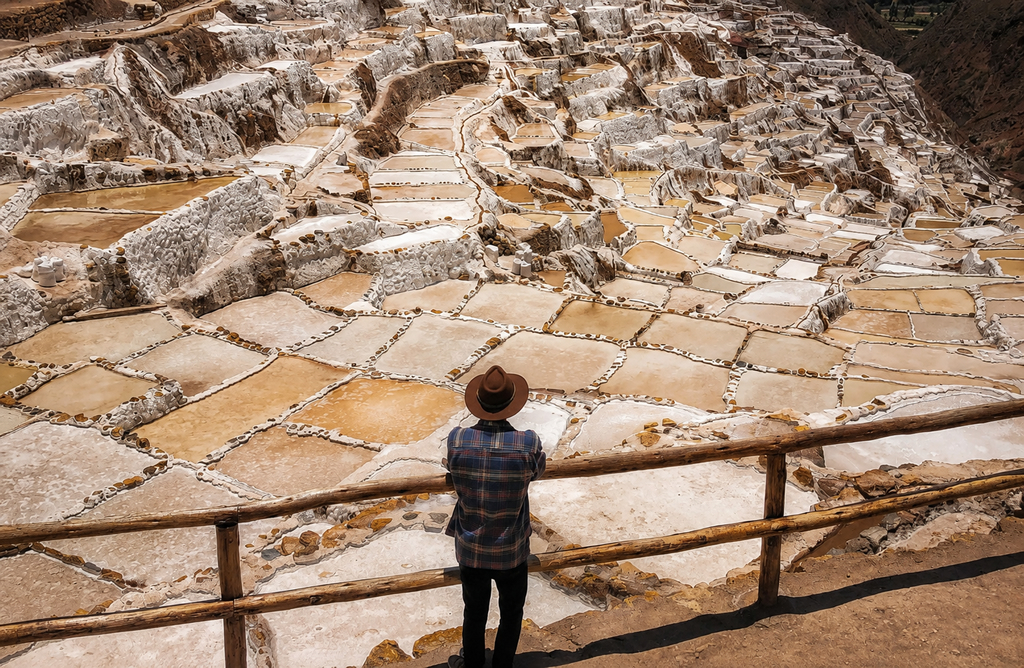
Since pre-Inca times, salt has been obtained in Maras by evaporating salty water from a local subterranean stream. The highly salty water emerges at a spring, a natural outlet of the underground stream. The flow is directed into an intricate system of tiny channels constructed so that the water runs gradually down onto the several hundred ancient terraced ponds.

Almost all the ponds are less than four meters square in area, and none exceeds thirty centimeters in depth.

All are necessarily shaped into polygons with the flow of water carefully controlled and monitored by the local workers.

Maras Salt Ponds

The Salt Mines of Maras are located 50 km in the northeast of Cusco city, at an altitude of 3,200 m.a.s.l.  The salt mines themselves are constituted by a set of approximately 4,500 salt wells placed in the form of stepped terraces in the middle slope of the hill Qaqawiñay.

This hill has slopes of 20 degrees of inclination to the bottom of the gorge on the left bank of the Salineras stream, with dimensions that vary around 5 linear meters, occupying a total area of approximately 1.5 to 2 hectares (Silva Guerra, 2006:).The terraces are formed by retaining walls of irregular stone seated with mud mortar, forming dikes that delimit the wells as small reservoirs of approximately 5m2. The conduction system of the saltwater from its catchment, is done through a main irrigation channel, which branches out into several small channels that feed the wells. The conduction and maintenance of the saltwater channel is associated with a path that is assumed to be of prehispanic origin due to its layout and characteristics.

This technology is similar to that of irrigation in prehispanic agricultural terraces characterized by the conduction and equitable distribution of water. The upper part of the salt mines crosses a road, from the prehispanic time, in the direction of the K’arachaka (Half Moon) bridge. From this road, there are several branches for the circulation between the wells. The set of wells and canals is in perfect continuous operation from the pre-Inca period to the present (Silva, 2007:18).

It is notorious the very particular effect and its great landscape value that the set of stepped wells produces, being perceived as the total of numerous white, creams or browns squares, arranged with particular order.They followed the topography of a slope of the Qaqawiñay hill, most of them looks flooded with water and other dry with salt on its surface, where the particular configuration of the set and the chromatic contrast with the natural environment provided with low shrub vegetation stand out.The salt production takes place once a month and is marked by the calendar of the seasons of the year. Thus, in the dry season (from May to October) the accumulation of salt is fast, there is greater production, and a better quality of salt is obtained with a “white or pink color that characterizes commercially this salt”.
In the salt extraction and elaboration process predominate the traditional social relationships of communitarian type, keeping till the present its traditional way.

When and how to book Salinas de Maras

The best time to visit in in the dry Season (from March to October) and is the most recommended.  If you prefer  an organized tour,  in every Cusco travel agency you will find offers for a Day Tour of the Sacred Valley, that include a visit to the Salineras de Maras or organized Tours to visit Maras and Moray (Group tours).

The area of Maras is located near to the Sacred Valley of the Incas; which makes it perfect for personalized activities in private Tours from Cusco or from Sacred valley such and Full day  bikes excursions, hikings and customized tours with visit to Moray remains and then keep traveling to Machu Picchu.

The entrance fee to Maras is S/. 7 soles per persons (USD2,5) :)Curious about this magnificent destination?

Come to Perú!

Giardino Team!@Giardinotoursperu

#ItravelwithGiardino ‘OnetripManyExperiences[vc_gmaps link=”#E-8_JTNDaWZyYW1lJTIwd2lkdGglM0QlMjIxMDAlMjUlMjIlMjBoZWlnaHQlM0QlMjI0ODBweCUyMiUyMHNyYyUzRCUyMmh0dHBzJTNBJTJGJTJGcG9seS5nb29nbGUuY29tJTJGdmlldyUyRjJ4eE0wNllDdGQtJTJGZW1iZWQlM0ZjaHJvbWUlM0RtaW4lMjIlMjBmcmFtZWJvcmRlciUzRCUyMjAlMjIlMjBzdHlsZSUzRCUyMmJvcmRlciUzQW5vbmUlM0IlMjIlMjBhbGxvd3ZyJTNEJTIyeWVzJTIyJTIwYWxsb3clM0QlMjJ2ciUzQiUyMHhyJTNCJTIwYWNjZWxlcm9tZXRlciUzQiUyMG1hZ25ldG9tZXRlciUzQiUyMGd5cm9zY29wZSUzQiUyMGF1dG9wbGF5JTNCJTIyJTIwYWxsb3dmdWxsc2NyZWVuJTIwbW96YWxsb3dmdWxsc2NyZWVuJTNEJTIydHJ1ZSUyMiUyMHdlYmtpdGFsbG93ZnVsbHNjcmVlbiUzRCUyMnRydWUlMjIlMjBvbm1vdXNld2hlZWwlM0QlMjIlMjIlMjAlM0UlM0MlMkZpZnJhbWUlM0U=” title=”Maras Virtual”]
2 FacebookTwitterPinterestEmail
Peru Great Destinations

Enigmatic Sillustani & best way to book a Tour

by Giardino Tours February 15, 2021


Walking and exploring among the imposing Chulpas of Sillustani is undoubtedly one of the most fascinating experiences on the region of Puno close to Lake Titicaca .

The stillness and beauty of Lake Umayo and the rugged landscape at almost 4000 meters above sea level, contribute to creating this enigmatic atmosphere that is part of the environment where an ancient culture also developed.


Chullpas de Sillustani

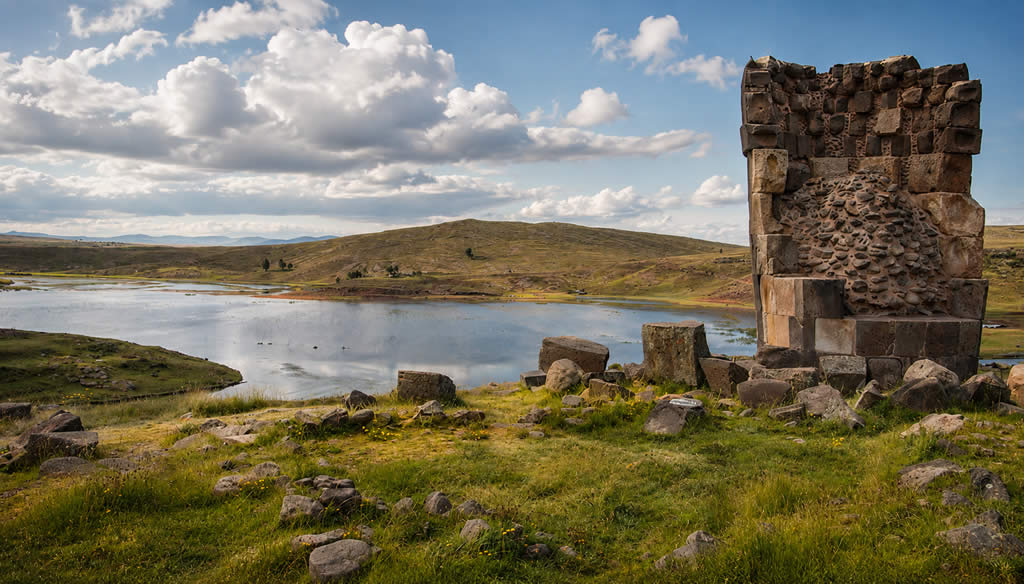
About 34 km from the city of Puno are these fascinating pre-Inca funerary monuments. In them the ancient Peruvians of this area buried their nobles to give them eternal rest. The so-called “Chullpas” are volcanic stone towers that resemble an inverted cone. The stone material was brought from nearby quarries and even today, there are around 90 of these chulpas or “ayawasis” in this archaeological complex that is scattered on a large hill, from where you can see the landscape next to the icy lake.

These monuments not only served to preserve the body of a “great lord”, but also showed the respect that inspired his memory or the “ayllu” to which he belonged. The corpse of the “noble”, belonged to an authority, curaca or priest, was previously mummified and placed in a fetal position. Next to it, gold and silver artifacts, utensils and ceramics were frequently buried. The tallest tower in the archaeological complex is the so-called “chullpa del lagarto”, 12 meters high. This complex was declared a cultural heritage of the nation in 2003.

Within the same area of ​​the archaeological complex you can visit the site museum. Where you can learn more about the ancient cultures that inhabited the area, among which the Kollas, Tiahuanacos and Incas stand out. In a few minutes the inhabitants of the town of Atuncolla also offer boat rides across the lake.


How to get to Sillustani?

It is recommended to depart from Puno by land. The archaeological complex is open from Monday to Sunday from 8:30 a.m. at 5:30 p.m. (referential) and the entrance costs approximately S / 5.50 soles, (approximately 2.00 US dollars). You can also start from Juliaca, which is about 40 km away. It is advisable and essential to have the tourist guide service since this service does not exist on site.


The best way to visit and used for many of the travelers visiting Peru is to drive to Sillustani and Puno city  after visiting the city of Arequipa and the Colca Canyon. Currently there is an excellent road that runs Arequipa – the Colca valley – to Sillustani – Puno.

The journey  offers a beautiful Andean landscapes, where you can take excellent photographs crossing the highlands by transport. On the route you can make stops to appreciate more the Andean lagoons and a variety of birds.
From Colca valley you will need about 5 hours of driving to reach the Sillustani complex. After the visit, the travelers are transferred to Puno city to rest at their hotel and continue their journey.

This option is ideal for those travelers who are traveling through southern Peru, as it optimizes their travel time (at least one day) by going directly from Colca to Sullustani and then to Puno.


But also you will find daily Tours to Sillustani leaving from Puno city at around 2:30pm and cost from S30 per peson (With  a Group). The round-trip takes about 3½ hours and allows you about 1½ hours at the ruins.

It is recommended to take the service also in private in order to enjoy more time exploring the ruins and surroundings.

TIPS: The chullpas are well preserved. The afternoon light is the best for photography.


Curious about this magnificent destination?

Come to Perú!

Giardino Team!


@Giardinotoursperu

#ItravelwithGiardino ‘OnetripManyExperiences


2 FacebookTwitterPinterestEmail
Culture & Traditions

Peru 2 love’s story tellings and myths

by Giardino Tours February 12, 2021

Love always contains a great mystery, because for each person, people and time love has been interpreted and manifested in different forms.

But today we are going to tell you about 2 romantic peruvian love’s story tellings related to ancient Peruvian traditions. These are popular stories in which fantastic or supernatural events are related, as if they were real events. Many of them are created by the community and are transmitted from parents to children, from generation to generation, that is why they are part of our culture and to the memory of Peruvians and are usually related to the beliefs and folklore of a certain region in Peru.

Love’s story tellings of Huascarán and Huandoy mountains.

This romantic love’s story telling takes place in time of the Inca Empire, when the people of Cusco expanded their dominions through the Callejón de Huaylas. In this region (located in Ancash) there are more than 20 snow-capped peaks that exceed 6000 m.a.s.l. and the highest mountain in Peru and the intertropical zone is the Huascarán.
The legend said that there was a laborious and peaceful tribe in “Callejon de Huaylas” where one day a very badly wounded soldier arrived with a message to the Great chief. The man informed that some warriors from Cusco had sacked his town without mercy and that they were heading towards the village.
Looking at the situation the great chief ordered his warriors to go in search of the leader of the Cusco army, proposing a peaceful negotiation. And so it happened. Days later, the soldiers returned to the tribe with a Cusqueño warrior “Huáscar”, the most recognized warrior of the invading tribe of Cusco.Shortly afterwards, someday the strong Huáscar met on his path a beautiful young woman with long black hair, big eyes and a beautiful smile; she was the daughter of the great chief of the tribe; her name was Huandy.


As in every romantic story, the warrior Huascar and the beautiful girl fell in love, but this was a “forbidden” love. So the lovers decided to run away together.

Furious for the offense realized by Huascar and his daughter, the Great Chief ordered their capture. Once in prison, the great Chief humiliated them in public and then tied them to wooden logs, placed in such a way that they could see each other as they died.

The warrior Huascar hoped that his people (the Incas) would arrive and rescue them. However, when the Cusco army arrived, they supported the decision of the Great chief.
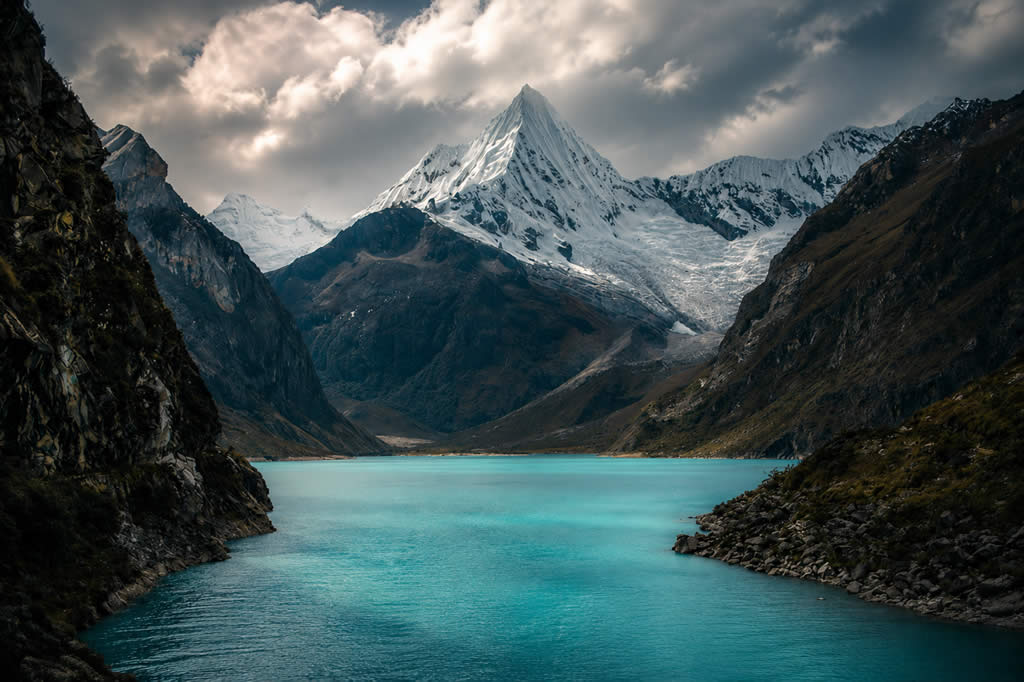
Without hope and prisoner of great impotence, Huascar swore revenge on all of them and thus both lovers began to cry full of pain. The legend said that both lovers cried until they were completely dry. From the tears of Princess Huandy, Lake Chinancocha was formed, also known as “the female lagoon” and from the tears of Huáscar, Lake Orcococha, also known as “the male lagoon”. (Also known as Lagunas Llanganuco)
The god “Inti” (the Sun) observing what happened and in pain also, sent a lot of rain, thunder, lightning and hailstorm to all the area. The legend said that it was so much and for so long time that the bodies of the lovers were covered, thus forming the snow-covered mountain Huascarán (for Huáscar) and the snow-covered mountain Huandoy (for Huandy) .

This love’s story tellings said specially among the local people of the Callejón de Huaylas, that in 100 or 200 years the snow-capped mountains will remain without snow and Huáscar and Huandy will resurrect and meet again to live their love forever. (Cardenas, 2020)

Love’s story tellings of the Huacachina oasis – Ica

In the middle of the coastal desert of the Pacific Ocean, in the Ica region, there is a beautiful oasis “La Huacachina”. A Oasis of green waters and around which there is abundant vegetation composed of palm trees, eucalyptus and huarangos, the same that are used for migrant birds that usually pass through This region.  That makes it one of the most beautiful and striking tourist spots in Peru, however, its beauty also contains a myth related to unconditional and infinite love.
Huacachina,means the “crying woman” in the Quechua language. The legend said that in this lagoon an Inca princess named Huacca China was born (Her name means “the one who makes people cry.”).They said that the princess fell in love with a young warrior of the empire who died shortly after they met. It is said that when the princess was informed of the tragedy, she went to the place where they had met for the first and c and cried intensely; then, while crying, she looked through her hand mirror and saw young man who was looking at her; the young man tried to get closer to her, but she got scare and began to run through the desert.According to legend, her clothes shaped the dunes that surround the oasis and the mirror got broken, giving shape to the lagoon.

After that the princess enters the lagoon and becomes a mermaid and the tradition tells that this mermaid appears every night on full moon to sing old songs to her lover.

Apart for knowing now these love’s story tellings, for sure now when you travel to Huaraz (Ancash) or to the Huacachina Oasis, you will look at every detail with different eyes …

And perhaps through the eyes of those “lovers”.


GIARDINO TEAM@GiardinoToursperu

#ItravelwithGiardino #OneTripManyExperiences

2 FacebookTwitterPinterestEmail
Peru Great Destinations

Colca Canyon Tour: Introducing the awesome Colca Canyon

by Giardino Tours February 4, 2021

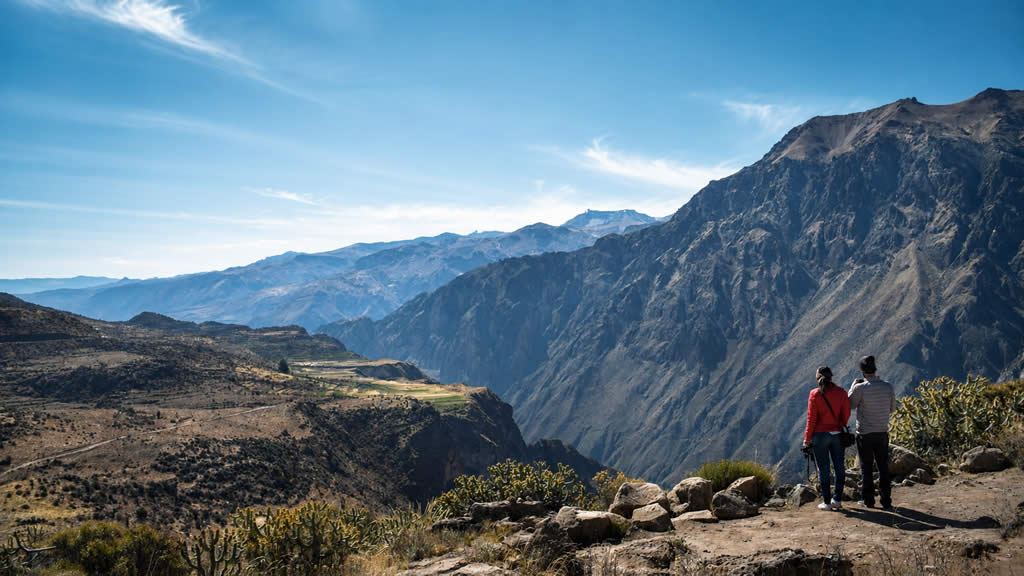
The Colca Canyon is one of the most scenic regions in Peru, a land of imposing snowcapped volcanoes, narrow gorges, artistically terraced agricultural slopes that predate the Incas, arid desert landscapes and vegetation, and remote traditional villages.

Some of Peru’s most recognizable wildlife, including llamas, alpacas, vicuñas are easy to find here. Also the canyon is home to the Andean condor (Vultur gryphus); here you will have the best chance to get of them amazing pictures!

The 120km-long “Cañón del Colca” is set among high volcanoes (6613m-high Coropuna and 6310m-high Ampato are the tallest) and ranges from 1000 mts. to more than 4160 mts. depth. For years there was raging controversy over whether or not this was the world’s deepest canyon with 4,160mts, but recently it ranked as the third one after Kali Gandaki in Nepal with 4,375 mts.Despite its depth, the Colca canyon is geologically young. The Colca river has cut into beds of mainly volcanic rocks, which were deposited less than 100 million years ago along the line of a major fault in the earth’s crust.

The climate is cool and dry on the plateau and slopes high above the Colca river.

The Colca Canyon is also synonym for extensive biodiversity, with an incredible flora and fauna. This special characteristic of the canyon occurs because Peru is located in the subtropical area of South America and it has a rugged geography, in addition, ocean currents and the air mass movements, create an incomparable ecological, climatic and geological variety.

This is a the reason of the importance of conserving the ecosystems that keep alive the variety of animals and plants that this canyon has, a true natural wonder.


The condors are best seen in the early morning and late afternoon when they are hunting. At this point the canyon floor is 3,960 feet (1,200 m). Also Viscachas (burrowing rodents closely related to chinchillas) are also common around the canyon rim, darting furtively among the rocks.

Cacti dot many slopes and, if they’re in flower, you may be lucky enough to see tiny nectar-eating birds braving the spines to feed. In the depths of the canyon it can be almost tropical, with palm trees, ferns and even orchids in some isolated areas.The La Calera natural hot springs are located at Chivay, the biggest town in the Colca Canyon. But you can also enjoy others hots springs with less visitors in other towns such as Yanque and Coporaque.
Festivals throughout the year, including the Wititi festival in Chivay, (December 8–) are a high light. The Wititi has been declared the dance most representative of the Arequipa region, and named as a “cultural heritage” of Peru.The Colca canyon is also well known for two forms of crafts: goods knitted from 100% baby alpaca fiber (hats, gloves, etc.), and a unique form of embroidery that adorns skirts (polleras), hats, vests, and other items of daily wear and use.

The local people (especially the women) are known for their highly decorative traditional clothing. The women’s dresses and jackets are intricately embroidered, and their hats are distinctive.
In the Chivay area at the east end of the canyon, the white hats are usually woven from straw and are embellished with lace, sequins and medallions. At the west end of the canyon, the hats are of cotton and are painstakingly embroidered.

The women don’t particularly enjoy being photographed, so always ask permission. And those who pose for photographs expect a tip.

Colca canyon Activities:

Fauna and Flora observations, Hiking, short walks, mountain biking, trekking, rafting, horseback riding, fishing, and sightseeing.

Organized tours to this destination have daily departures.

It is a destination for all type of travelers, from those who are looking for some relaxing days with luxury service (hotels 4* and 5 *), adventure lovers (because of the many activities that here can be done); classic travelers and family tours (organized tours with visit to all highlights, and family experiences with locals) to low budget travelers.Sources: Wikipedia, Lonely Travel, Promperu.

2 FacebookTwitterPinterestEmail
Newer Posts
Older Posts

More Articles/Más Artículos

  • Colca Canyon Tour: Introducing the awesome Colca Canyon
  • Peru Trip: Altitude mountain sickness and 6 easy tips to avoid it
  • Peruvian Carnivals: Magic, culture & celebration
  • Arequipa Tour: 2 surprising curiosities about this destination!
  • Colca Sour: An unique Cactus cocktail
  • Peru 2 love’s story tellings and myths
  • Enigmatic Sillustani & best way to book a Tour
  • Amazing Tour Maras Salt ponds in Cusco (Virtual)
  • Tips for a Responsible Peru Travel Experience!
  • Colca canyon Travel Guide: 7 Questions about Colca Tours
  • Facebook
  • Twitter

@2021 - All Right Reserved. Designed and Developed by PenciDesign


Back To Top
Giardino Tours Blog
  • Go to Giardino Tours
  • English
  • Español