Top Posts
Cusco Tour: 3 differences between Machu Picchu, Mountain...
Quechua Travel Words: Useful words for a great...
Tour Arequipa: The fascinating stone city of Choqolaqa
Tour Arequipa: Stunning Salinas and Aguada Blanca N.R....
Protecting Our Planet Starts with You – 9...
8 highlights of Arequipa – Tips to enjoy...
FOOD in Arequipa: 8 delicious Dishes that Are...
Embroidery in the Colca Valley a Cultural Heritage...
The interdimensional gate Aramu Muru. Fascination & mystery.
Pacaya Samiria Reserve: A world destination not to...
  • Go to Giardino Tours
  • English
  • Español
Giardino Tours Blog
TRANSFORMING TRAVELS INTO MEMORABLE STORIES
Category:

Peru Great Destinations

Peru Great Destinations

Taquile Island: Details and great Tips for your Tour

by Giardino Tours March 1, 2021

Taquile Island, another jewel of Titicaca Lake

Set within Lake Titicaca, Taquile Island has a colorful history and a distinct culture.

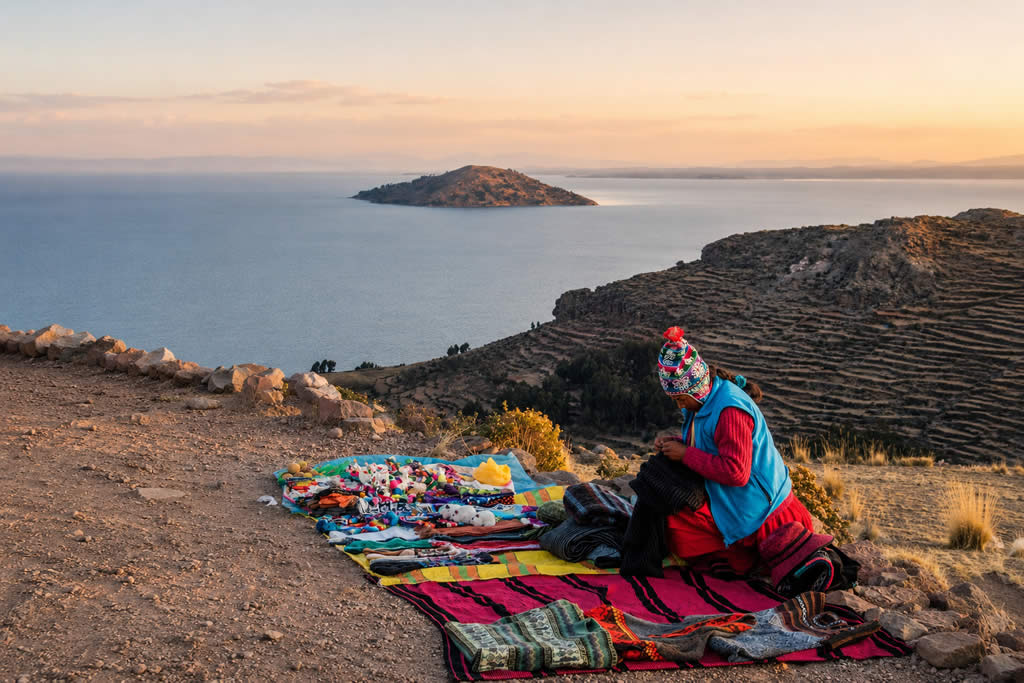
Taquileans are so well-known for intricate and well-made handwoven textiles that in 2005 the United Nations Educational, Scientific and Cultural Organization (UNESCO) declared them to be a “Masterpiece of Oral and Intangible Heritage.” These textiles are a character-defining element of their culture .

Taquile: Nature, culture and knitters

Taquile island is home of a Quechua population of about 2,000 people who are mainly farmers, fishermen and above all renowned weavers.

By the age of seven, boys are proficient knitters. In fact, the entire family is involved in knitting or weaving. Children knit “chullos” (hats), gloves and finger puppets of condors and llamas, common animals of the Andes. Women hand-spin the soft fleece of the sheep and alpaca into fine yarn for sweaters and blankets.

The island offers beautiful landscapes of hills, stone archways and, of course, the blue water of lake Titicaca around it.

The locals grow crops like corn, beans and quinoa on the pre-Incan terraces that cover its hilly terrain. Thanks to a largely vegetarian diet, the locals are said to live an average of 90-100 years.

The island is largely untouched by modernity with not even a bicycle to be seen in the island.

In July, villagers observe the Feast of Santiago Apostol with music and dancing. Whether celebrating weddings or religious holidays, there is always a reason to enjoy the folk music and dance that is an important part of island life.

Taquileños run their society based on community collectivism and on the Inca moral code „ama sua, ama llulla, ama qhilla“ (Quechua for “do not steal, do not lie, do not be lazy”).

The island has a radio station and is equipped with generators. Islanders have elected to use solar panels to generate energy.

Location:

Taquile Island is located 36 Km (22 miles) away from the city of Puno. It takes a 2 and half-hour boat ride to arrive in the island’s main dock.

The island highest elevation is 4100 m (13451 feet); it has a length of 5 Km (3.10 miles) and a width of 1.5 Km (0.93 miles). To walk across the island takes about two hours.

Tours to Taquile island

You can enjoy Taquile in 2 forms:

A full day Excursion:

These tours has a departure in Puno and begin with a visit to the floating island Uros before continuing to Taquile.

During the visit to Taquile visitors follow enjoyable paths that gradually take them to the main village or to other more remote sectors of Taquile. These other paths of access to the main village allow you to catch spectacular views of Lake Titicaca.

Many tours try to avoid climbing up the 535 stairs that take the visitors to the main village, but it is unavoidable to walk the stairs down to go back to the main dock.  So it is very important you have a good physical condition and good boots to walk.

Also a demonstration of traditional Andean weaving is the highlight of this visit.

A 2 days Excursion with a Overnight in Taquile:

If you decide for an overnight experience in Taquile Island,  (Normally with a previous visit to Uros floating islands) you can take your time and visit interesting sights with a host family, such as monuments to Pachamama (Mother Earth) , which are especially fascinating during Taquile’s wild festivals.

Enjoy the sunset and sunrise. 😉

Staying with a family gives you the chance that a local family will open its doors to you and you’ll get a glimpse into the Taquile lifestyle and the family’s dynamics, all topped off with a delicious homemade meal.

Additionally, you must know that the island’s tourism is operated exclusively by its inhabitants, so you’ll get first-hand knowledge from locals who know the area.

We highly recommend that you book your tours with a serious and formal travel agency. Please get informed about the company where you are going to take your tour in order to ensure that the tours are realized in a sustainable way and if handling is in accordance with the respect of the local rules and activities of the island.

@GiardinoTours

#ITravelwithGiardino #OneTripManyExperiences
3 FacebookTwitterPinterestEmail
FeaturedPeru Great Destinations

Discover Uros, the floating islands on lake Titicaca and how to book a Tour

by Giardino Tours February 24, 2021
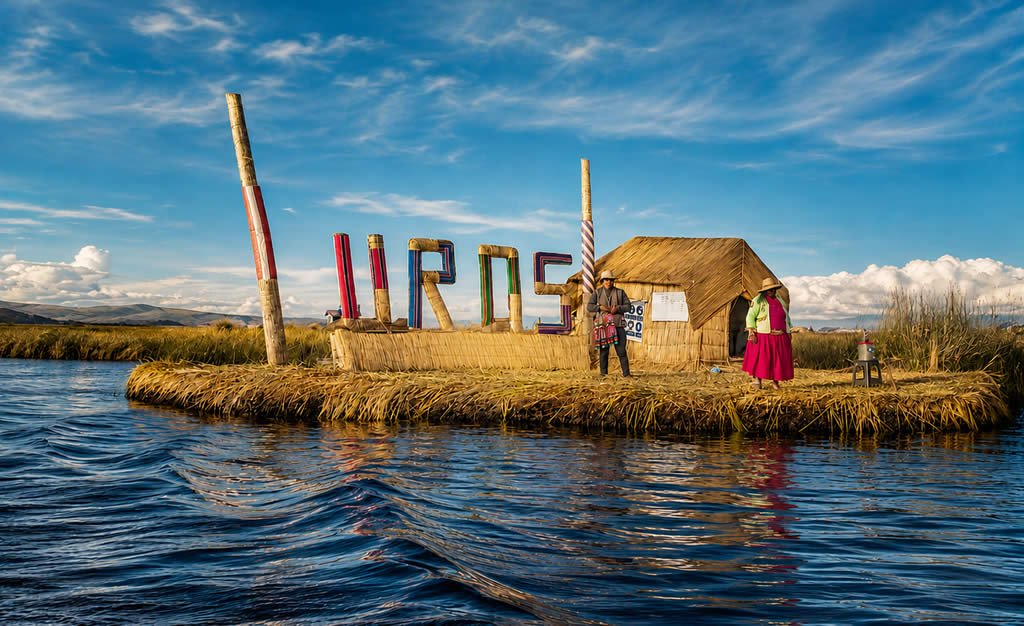
The floating islands of UROS are located inside the bay of Lake Titicaca only 14 Km. (about 9 miles) away from the city of Puno (20 to 30 minutes of navigation time). These human-made islands constructed from reeds are without doubt one of the fascinating half-day Tours from Puno on Lake Titicaca. – Perú.
How the islands are made?

The floating islands are constructed from many layers of the totora reeds, which are constantly replenished from the top as they rot from the bottom, so the ground is always soft and dry as much as possible. (When you visit the islands please be careful not to put your foot through any rotten sections!)

Nowadays, the reeds are still very important material for the Uros. They eat the reeds, build boats and houses with them, feed their few animals with reeds, and they use the reeds to make fire and cook.

We can say that the Totora are the backbone of Uros’ life.

Each islet is home to between one and ten Uros families. Also in some islets children are able to attend kindergarten and elementary school . However, older children must continuing their education in Puno city.

That make the future of Uros, their traditions and way of life uncertain.

Origen of the name

“URU” was the name of a very particular ethnic group that co-existed in lake Titicaca with the Inkas, Aymaras and possibly with older civilizations.

Today some theories claim that in the name “Uru” derives from the Pukina language; (also spelled Puquina) and it is already mentioned that this may have been the native and secret language of the Incas, and has remained hidden for hundreds of years.

The first clue to this language is given by the Inca Garcilaso de la Vega in his Royal Comments. In this work, the author tells us the following:

“The Incas had another particular language that spoke between them, that the other Indians did not understand it nor was it lawful for them to learn it, as divine language,”

He also adds that according to information from their sources, this language “had been totally lost, because, The particular republic of the Incas perisched and their language perished too.“

According to documents it is known that the Spanish Empire decreed in 1575 as the official languages of the kingdom of Peru, three languages: Quechua, ayumara and puquina. Languages that were to be learned primarily by Spanish priests for evangelizing purposes.

Rodolfo Cerrón Palomino, Peruvian linguist, explains that the Spanish people had a quite pragmatic approach. So, seeing that the mayority of people already spoke Quechua or Aymara, they did not see the use in creating documents in Pukina language. “We lost a great opportunity to have materials for this language,” laments Palomino.

The Uros People

In fact, it is believed that the Uros people were one of the first ethnic groups populating the Andean region. Contrary to the claim by many authors that the Uros’ ethnic group is extinguished; a recent study of the genetic structure of the Quechua and Aymara groups of lake Titicaca has found that today’s UROS people preserve part of the original gene of ancient Uros.

These people were simple fishermen, bird hunters and recoletc eggs from the reeds and preferred to remain isolated from the other civilizations. Their search for isolation may be one reason why they decided to live in mobile boats on the lake.

When the Spanish chroniclers encountered the UROS by the end of the XVI century, the UROS people were still living on the lake in small reed-boats that they used as floating houses. Only in the early 60s, the Uros started to build small artificial islands with reeds for bigger homes.Today the Uros Islands are floating on the Peruvian side of Lake Titicaca, a few miles from Puno city. On the past the islands used to be closer to the middle of the lake Titicaca, but they moved or rebuilt the islands closer to the shore after a devastating storm in 1986.

Uros is a gem on Titicaca lake; thanks to existing Uros people, we can still imagine and appreciate the way of life of an ancient ethnic group on the Andean area of Lake Titicaca.

How to book the Tour to Uros Islands
  • The best way to visit the Uros Islands is a guided tour from Puno city. All guided tours depart to Uros every day specially during dry season.
  • Most boats depart in the morning between 7 and 8 AM. The ride take about 20 minutes to the islands.
  • The city of Puno is easily accessible from Cusco, Arequipa, and La Paz, Bolivia.
  • Cusco and Puno are well connected with transportation options. From Arequipa, Colca Canyon tours can continue onto Puno by van. Buses run daily to and from La Paz.
  • Each tour of Uros begins with a demonstration on how the islands are made. After that, the islanders invite their guests to visit a home built from the same Totora reeds.

The islanders always present their handicrafts to tourists towards the end of each tour. While some visitors find this annoying, it is important to keep in mind that a large percentage of their income comes from selling souvenirs to tourists.

Travel Tips

  • The best time to visit the Uros Islands is during the dry season from April to November.
  • Bring your passport for a souvenir stamp on one of the main islands (additional cost of 1 sol per stamp).
  • Each tour to Uros Islands visits two islands. IN the tour you will have the option to take a handmade reed boat from first island to the second island (15-20 minute ride). This boat ride costs an additional 10 soles per person. This payment goes directly to the family that owns the boat.
  • Important: Remember that Uros Islands and Lake Titicaca sit at 12,500 feet (3,810 meters) above sea level. It is best to acclimatize by first visiting cities in lower altitudes such as Arequipa or Cusco before heading to Lake Titicaca.
  • Fort he Tour to Uros and specially for tours in the andean area; bring sun protection, warm layers, comfy shoes.
  • The best time to depart on Tours to Lake Titicaca is in the morning. Therefore, we recommend staying in a Puno hotel one night before visiting the lake.

Giardino Tours

Fuentes:

Wikipedia / www.pucp.edu.pe / Lonely Planet@GiardinoToursPeru

#ItravelwithGiardino #OneTripManyExperiences
3 FacebookTwitterPinterestEmail
Peru Great Destinations

Tour to Nazca lines: 6 real facts about the mysterious lines

by Giardino Tours February 22, 2021
The Nazca lines are found in a region of Peru just over 200 miles southeast of Lima, near the modern town of Nazca.
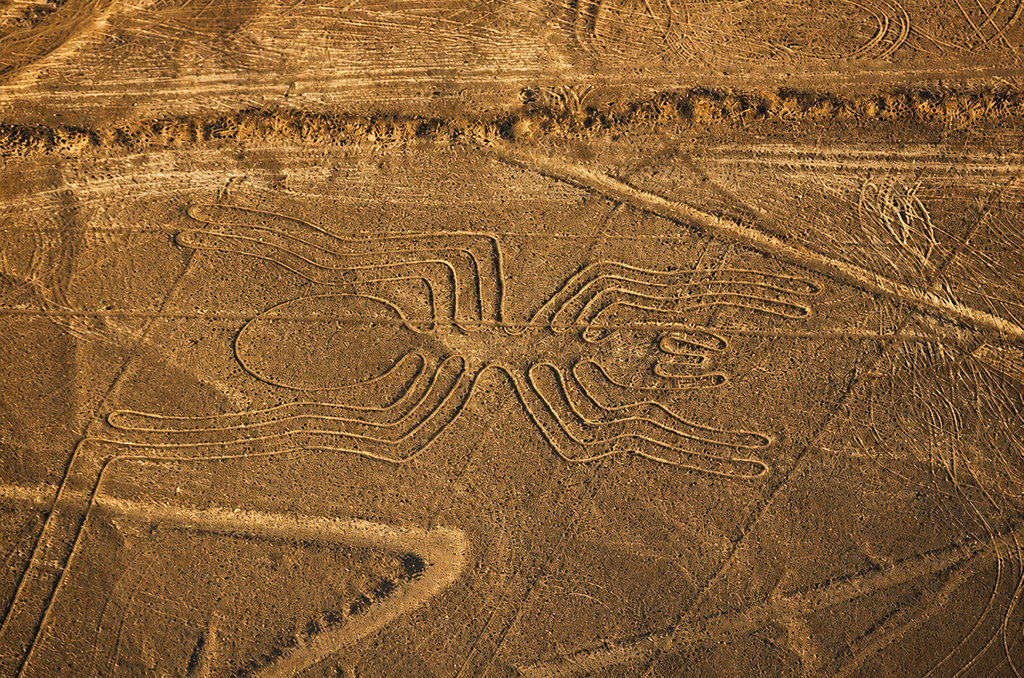
In total, there are over 800 straight lines, 300 geometric figures and 70 animal and plant designs, also called biomorphs.
Some of the straight lines run up to 30 miles, while the biomorphs range from 50 to 1200 feet in length (as large as the Empire State Building).

Interesting 6  facts that you should know about the Nazca Lines

  1. More than 1,500 geoglyphs are known in Nazca so far. The lines and geometrical figures extend over 500 square kilometers in southern of Peru. The figures are up to 1.9 kilometers, the lines up to 10 kilometers.
  2. They were made in the period of 800 BC. to 650 AC and probably go back to the Paracas and Nazca people, lost cultures of Peru before Inca period.
  3. Actually, new drawings continues appearing. A cat drawing was only discovered on a slope in October 2020.
  4. A more recent hypothesis about the meaning of the lines assumes that the figures illustrate the request for rain. Argument: They show many animals that would not survive in the desert, but need jungle and water.
  5. The Nazca Lines are a major tourist attraction in Peru. The airport in Nazca was named in honor to Maria Reiche; a  German mathematician (Dresdren) who saved and studied the lines . Her small mud hut now houses the Maria Reiche museum.
  6. Joe Nickell, an American investigator, reproduced the figures in the early 21st century by using the same tools and technology that would have been available to the Nasca people. In so doing, he refuted the 1969 hypothesis of Erich von Däniken, who suggested that “ancient astronauts” had constructed the Lines.

[vc_gallery interval=”3″ images=”2103,2101,2105,2108,2107,1944,2106,2102,2104″ img_size=”large” css_animation=”fadeIn”]

How were Nazca’s lines made?

The lines are known as geoglyphs – drawings on the ground made by removing rocks and earth to create a “negative” image. The rocks which cover the desert have oxidized and weathered to a deep rust color, and when the top 12-15 inches of rock is removed, a light-colored, high contrasting sand is exposed.

Because there’s so little rain, wind and erosion, the exposed designs have stayed largely intact for 500 to 2000 years.

Scientists believe that the majority of lines were made by the Nazca people, who flourished from around A.D. 1 to 700.

Brief discovery details of Nazca Lines:

Toribio Mejia Xesspe, a Peruvian archaeologist, began a systematic study of the lines in 1926, but the geoglyphs only gained widespread attention when pilots flew over them in the 1930s. Experts have debated the purpose of the Nazca Lines since then.

In the late 1930s and early 1940s, American historian Paul Kosok studied the geoglyphs from the ground and air. On June 22, 1941, the American professor Paul Kosok was investigating one of the lines – just one day after the winter solstice – when at the end of the day he found himself at the foot of one of the lines.  Kosok looked up and realized that the sunset was in direct alignment with the line.

Kosok called the 310 square mile stretch of high desert “the largest astronomy book in the world”.

Kosok was followed by the German Maria Reiche, who became known as the “Lady of the Lines”. Reiche studied the lines for 40 years and fought unyieldingly for her theories on the lines’ astronomical and calendrical purpose (she received a National Geographic grant in 1974 for her work).

Reiche battled single-handedly to protect the site; she even lived in a small house near the desert so she could personally protect the lines.

New huge cat geoglyph was discovered on 2020

This particular geoglyph is a gigantic cat.  It measures at 37 metres long, and the lines are 10 inches wide! The enormous feline was found when workers were improving an access point for visitors to look out onto the hills.

The figure is actually older than some of the other geoglyphs in the area. It was discovered by a drone exploration covering the land.

How to visit Nazca?

To Nazca city you must arrive by bus. Buses depart from Lima every hour or so, take around seven hours (Depending oft he company) and the cost is about  US$35 to US$ 40 per person.[vc_gmaps link=”#E-8_JTNDaWZyYW1lJTIwc3JjJTNEJTIyaHR0cHMlM0ElMkYlMkZ3d3cuZ29vZ2xlLmNvbSUyRm1hcHMlMkZlbWJlZCUzRnBiJTNEJTIxMW0yOCUyMTFtMTIlMjExbTMlMjExZDE5ODY5MjUuNTM4NDE5MDc2MiUyMTJkLTc3LjEwODc2NTI3MTE1Nzk2JTIxM2QtMTMuNDMwMDI1MzUyNzc0MTQ4JTIxMm0zJTIxMWYwJTIxMmYwJTIxM2YwJTIxM20yJTIxMWkxMDI0JTIxMmk3NjglMjE0ZjEzLjElMjE0bTEzJTIxM2UwJTIxNG01JTIxMXMweDkxMDVjNWY2MTllZTNlYzclMjUzQTB4MTQyMDZjYjljYzQ1MmU0YSUyMTJzTGltYSUyNTJDJTI1MjBQZXJ1JTIxM20yJTIxMWQtMTIuMDQ2MzczMSUyMTJkLTc3LjA0Mjc1NCUyMTRtNSUyMTFzMHg5MTE0MWU0M2EwNjc2MmUzJTI1M0EweDY0ZTA4MzY0ZTg5MGVjMDIlMjEyc05hemNhJTI1MkMlMjUyMFBlcnUlMjEzbTIlMjExZC0xNC44MzU4Njg2OTk5OTk5OTklMjEyZC03NC45MzI3NTgzJTIxNWUwJTIxM20yJTIxMXNkZSUyMTJzdXMlMjE0djE2MTQyNjQzMTI4ODklMjE1bTIlMjExc2RlJTIxMnN1cyUyMiUyMHdpZHRoJTNEJTIyNjAwJTIyJTIwaGVpZ2h0JTNEJTIyNDUwJTIyJTIwc3R5bGUlM0QlMjJib3JkZXIlM0EwJTNCJTIyJTIwYWxsb3dmdWxsc2NyZWVuJTNEJTIyJTIyJTIwbG9hZGluZyUzRCUyMmxhenklMjIlM0UlM0MlMkZpZnJhbWUlM0U=”]Taking to the skies to see the lines:

Once in Nazca, there are only two options for viewing the amazing lines:

1.-  To climb the nearby observation tower.

2.- To take a fly over the lines. Flying is undoubtedly preferable as it offers a bird’s eye view of the most important etchings. (Attention: 30-minute flight consists of numerous sharp turns which leave most travelers feeling seriously nauseous). Take an anti-nausea tablet from a local pharmacy and try not to eat any big meals within a few hours of take off.

Early morning departures are best as there tends to be less turbulence and better visibility. The price is between 80 and 100 US $ for 30‘ minutes overflight, to which must be added a Airport tax fee S/. 25 soles (about US$8).

Visit the Museum

This is a great tip! We recommned to visit the two excellent local museums, the Casa-Museo Maria Reiche and the Museo Antonini, both provide detailed information about these ancient pre-Inca people and some of their possible motivations for drawing the lines.Sources:

Radio Nacional . (8 de junio de 2020). maria-reiche-la-mujer-que-barria-el-desierto Peru Travel: promperu Nasca Lines History: https://www.history.com/topics/south-america/nazca-lines BR Wisen: https://www.br.de/wissen/nazca-linien-peru-maria-reiche-frau-geschichte-frauengeschichte-102.html BBC: https://www.bbc.com/mundo/noticias-41474754 RTVE . (16 de Octubre de 2020). https://www.rtve.es/noticias/20201017/descubren-nuevo-geoglifo-forma-gato-lineas-nazca/2045941.shtml

4 FacebookTwitterPinterestEmail
Peru Great Destinations

Machu Picchu: Check these amazing secrets before the Tour

by Giardino Tours February 19, 2021


Machu Picchu:

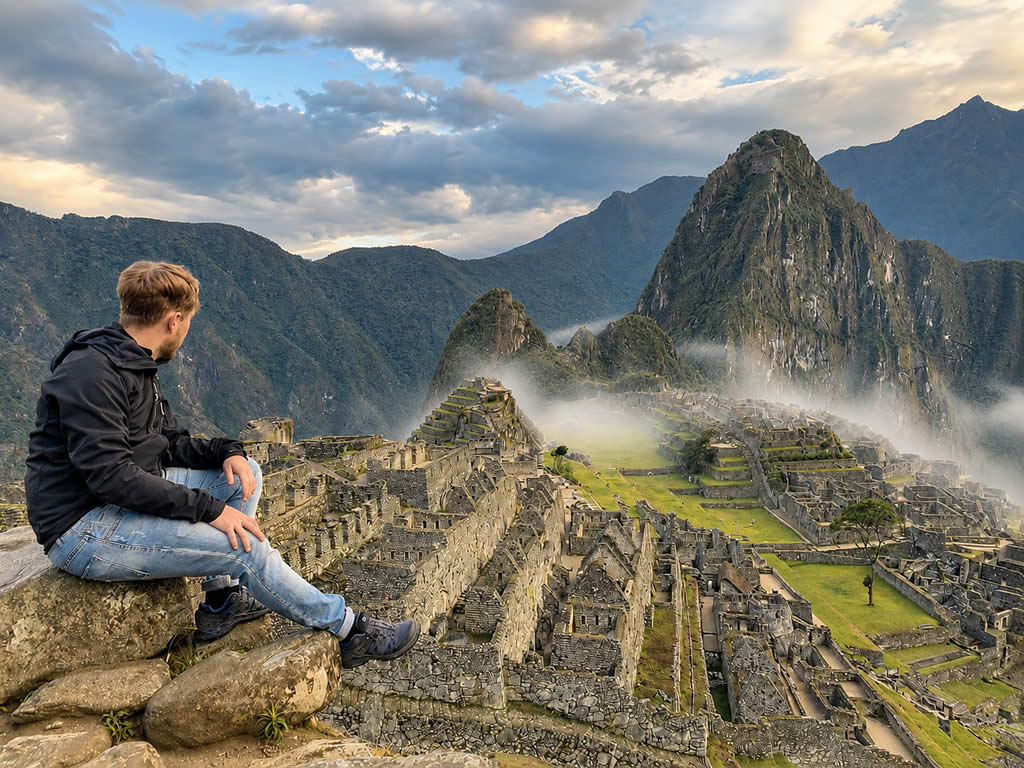
A stone city built on the top of an isthmus, between two mountains and between two geological faults, in a region subject to constant earthquakes and, above all, heavy rains all year round. No doubt that this city was a challenge for any master of engineering.

1.- Machu Picchu  It’s no stranger to earthquakes.


The stones in the most handsome buildings throughout the Inca Empire used no mortar. These stones were cut so precisely, and wedged so closely together, that a credit card cannot be inserted between them.

Aside from the obvious aesthetic benefits of this building style, there are engineering advantages.

Peru is a seismically unstable country—both Lima and Cusco have been leveled by earthquakes—and Machu Picchu itself was constructed atop two fault lines. When an earthquake occurs, the stones in an Inca building are said to “dance;” that is, they bounce through the tremors and then fall back into place.

Without this building method, many of the best known buildings at Machu Picchu would have collapsed long ago.


2.- Much of the most impressive stuff is invisible.


While the Inca are best remembered for their beautiful walls, their civil engineering projects were incredibly advanced as well. (Especially, as is often noted, for a culture that used no draft animals, iron tools, or wheels.)

The site we see today had to be sculpted out of a notch between two small peaks by moving stone and earth to create a relatively flat space. The engineer Kenneth Wright has estimated that 60 percent of the construction done at Machu Picchu was underground.

Much of that consists of deep building foundations and crushed rock used as drainage. (As anyone who’s visited in the wet season can tell you, Machu Picchu receives a lot of rain.)


3.- The location of Machu Picchu is not a coincidence


On Monday, 23 Sept. 2019, at the Geological Society of America Annual meeting in Phoenix, Rualdo Menegat, a geologist at Brazil’s Federal University of Rio Grande do Sul, will present the results of a detailed geoarchaeological analysis that suggests the Incas intentionally built Machu Picchu — as well as some of their cities — in locations where tectonic faults meet.

“Machu Pichu’s location is not a coincidence,” says Menegat. “It would be impossible to build such a site in the high mountains if the substrate was not fractured.”

Menegat found that these faults and fractures occur in several sets, some of which correspond to the major fault zones responsible for uplifting the Central Andes Mountains during the past eight million years.

Because some of these faults are oriented northeast-southwest and others trend northwest-southeast, they collectively create an “X” shape where they intersect beneath Machu Picchu.


4.- There’s more than one peak to climb


When you visit Machu Picchu for sure you want to visit also the Huayna Picchu peak (the small green peak, shaped like a rhino horn, that appears in the background of many photos of Machu Picchu.) but only  400 people are permitted to climb Huayna Picchu daily.

Almost no one bothers to ascend the pinnacle that anchors the opposite end of the site, which is usually called Machu Picchu Mountain. At 1,640 feet it is twice as tall, and the views it offers of the area surrounding the ruins—especially the Urubamba River winding around Machu Picchu like a coiled snake—are spectacular.


5.- There’s a secret temple.


Should you be one of the lucky early birds who snags a spot on the guest list to Huayna Picchu, don’t just climb the mountain, snap a few photos, and leave.

Take the time to follow the hair-raising trail to the Temple of the Moon, located on the far side of Huayna Picchu. Here, a ceremonial shrine of sorts has been built into a cave lined with exquisite stonework and niches that were once probably used to hold mummies.


6.- It has a great sense of orientation


There is solid evidence that the builders took into account astronomical and ritual criteria for the construction of Machu Picchu, according to studies by Dearborn, White, Thomson and Reinhard, among others.

Indeed, the alignment of some important buildings coincides with the solar azimuth during the solstices, in a constant and therefore not accidental way, with the rising and setting points of the sun at certain times of the year and with the peaks of the surrounding mountains.


Recent research has shown that the site’s location of many constructions of the Incas and the orientation of them, was strongly influenced by the location of nearby holy mountains, or Apus.


For example, an arrow-shaped stone atop the peak of Huayna Picchu appears to point due south, directly through the famous Intihuatana Stone, to Mount Salcantay, one of the most revered apus in Inca cosmology.


Giardino Tours /  Travel Blog


@Giardinotoursperu

#ItravelwithGiardino #OneTripManyExperiences


Sources:

National Geographic: Machu Picchu 10 secrets

Wikipedia: Machu Picchu

BBC News (Mitos y verdades de Machu Picchu)

La vanguardia: Machu Picchu en un lugar tan complicado

Science daily: Ancient Incan sanctuary intentionally built on faults


4 FacebookTwitterPinterestEmail
Peru Great Destinations

Amazing Tour Maras Salt ponds in Cusco (Virtual)

by Giardino Tours February 15, 2021

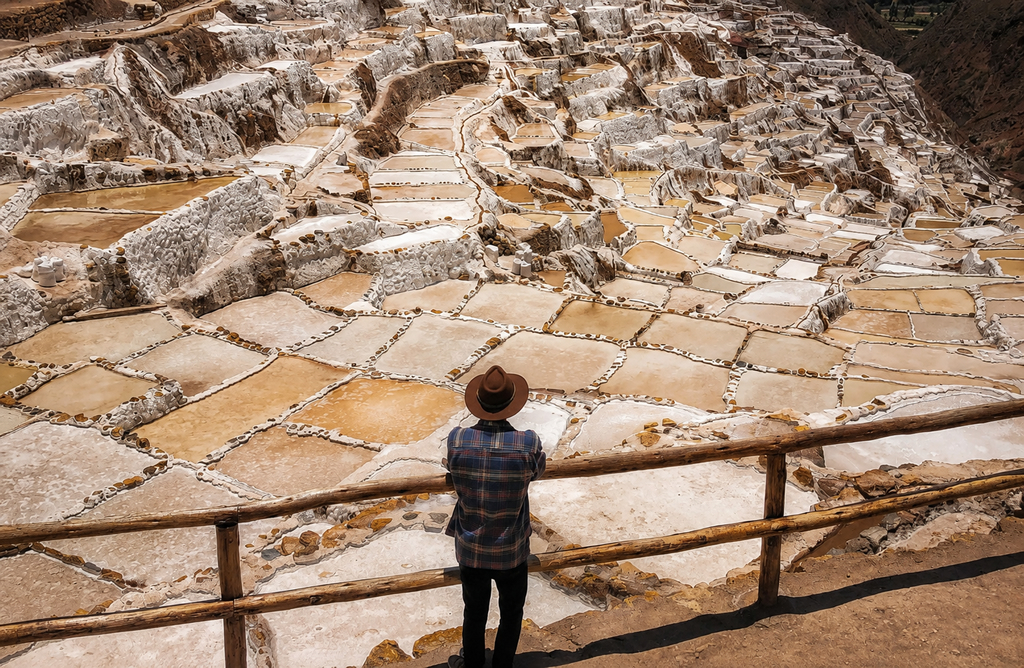
Salineras of Maras is among the most spectacular sights in Cusco area, with thousands of salt pans that have been used for salt extraction since Inca times.

Since pre-Inca times, salt has been obtained in Maras by evaporating salty water from a local subterranean stream. The highly salty water emerges at a spring, a natural outlet of the underground stream. The flow is directed into an intricate system of tiny channels constructed so that the water runs gradually down onto the several hundred ancient terraced ponds.

Almost all the ponds are less than four meters square in area, and none exceeds thirty centimeters in depth.

All are necessarily shaped into polygons with the flow of water carefully controlled and monitored by the local workers.

Maras Salt Ponds

The Salt Mines of Maras are located 50 km in the northeast of Cusco city, at an altitude of 3,200 m.a.s.l.  The salt mines themselves are constituted by a set of approximately 4,500 salt wells placed in the form of stepped terraces in the middle slope of the hill Qaqawiñay.

This hill has slopes of 20 degrees of inclination to the bottom of the gorge on the left bank of the Salineras stream, with dimensions that vary around 5 linear meters, occupying a total area of approximately 1.5 to 2 hectares (Silva Guerra, 2006:).The terraces are formed by retaining walls of irregular stone seated with mud mortar, forming dikes that delimit the wells as small reservoirs of approximately 5m2. The conduction system of the saltwater from its catchment, is done through a main irrigation channel, which branches out into several small channels that feed the wells. The conduction and maintenance of the saltwater channel is associated with a path that is assumed to be of prehispanic origin due to its layout and characteristics.

This technology is similar to that of irrigation in prehispanic agricultural terraces characterized by the conduction and equitable distribution of water. The upper part of the salt mines crosses a road, from the prehispanic time, in the direction of the K’arachaka (Half Moon) bridge. From this road, there are several branches for the circulation between the wells. The set of wells and canals is in perfect continuous operation from the pre-Inca period to the present (Silva, 2007:18).

It is notorious the very particular effect and its great landscape value that the set of stepped wells produces, being perceived as the total of numerous white, creams or browns squares, arranged with particular order.They followed the topography of a slope of the Qaqawiñay hill, most of them looks flooded with water and other dry with salt on its surface, where the particular configuration of the set and the chromatic contrast with the natural environment provided with low shrub vegetation stand out.The salt production takes place once a month and is marked by the calendar of the seasons of the year. Thus, in the dry season (from May to October) the accumulation of salt is fast, there is greater production, and a better quality of salt is obtained with a “white or pink color that characterizes commercially this salt”.
In the salt extraction and elaboration process predominate the traditional social relationships of communitarian type, keeping till the present its traditional way.

When and how to book Salinas de Maras

The best time to visit in in the dry Season (from March to October) and is the most recommended.  If you prefer  an organized tour,  in every Cusco travel agency you will find offers for a Day Tour of the Sacred Valley, that include a visit to the Salineras de Maras or organized Tours to visit Maras and Moray (Group tours).

The area of Maras is located near to the Sacred Valley of the Incas; which makes it perfect for personalized activities in private Tours from Cusco or from Sacred valley such and Full day  bikes excursions, hikings and customized tours with visit to Moray remains and then keep traveling to Machu Picchu.

The entrance fee to Maras is S/. 7 soles per persons (USD2,5) :)Curious about this magnificent destination?

Come to Perú!

Giardino Team!@Giardinotoursperu

#ItravelwithGiardino ‘OnetripManyExperiences[vc_gmaps link=”#E-8_JTNDaWZyYW1lJTIwd2lkdGglM0QlMjIxMDAlMjUlMjIlMjBoZWlnaHQlM0QlMjI0ODBweCUyMiUyMHNyYyUzRCUyMmh0dHBzJTNBJTJGJTJGcG9seS5nb29nbGUuY29tJTJGdmlldyUyRjJ4eE0wNllDdGQtJTJGZW1iZWQlM0ZjaHJvbWUlM0RtaW4lMjIlMjBmcmFtZWJvcmRlciUzRCUyMjAlMjIlMjBzdHlsZSUzRCUyMmJvcmRlciUzQW5vbmUlM0IlMjIlMjBhbGxvd3ZyJTNEJTIyeWVzJTIyJTIwYWxsb3clM0QlMjJ2ciUzQiUyMHhyJTNCJTIwYWNjZWxlcm9tZXRlciUzQiUyMG1hZ25ldG9tZXRlciUzQiUyMGd5cm9zY29wZSUzQiUyMGF1dG9wbGF5JTNCJTIyJTIwYWxsb3dmdWxsc2NyZWVuJTIwbW96YWxsb3dmdWxsc2NyZWVuJTNEJTIydHJ1ZSUyMiUyMHdlYmtpdGFsbG93ZnVsbHNjcmVlbiUzRCUyMnRydWUlMjIlMjBvbm1vdXNld2hlZWwlM0QlMjIlMjIlMjAlM0UlM0MlMkZpZnJhbWUlM0U=” title=”Maras Virtual”]

2 FacebookTwitterPinterestEmail
Peru Great Destinations

Enigmatic Sillustani & best way to book a Tour

by Giardino Tours February 15, 2021


Walking and exploring among the imposing Chulpas of Sillustani is undoubtedly one of the most fascinating experiences on the region of Puno close to Lake Titicaca .

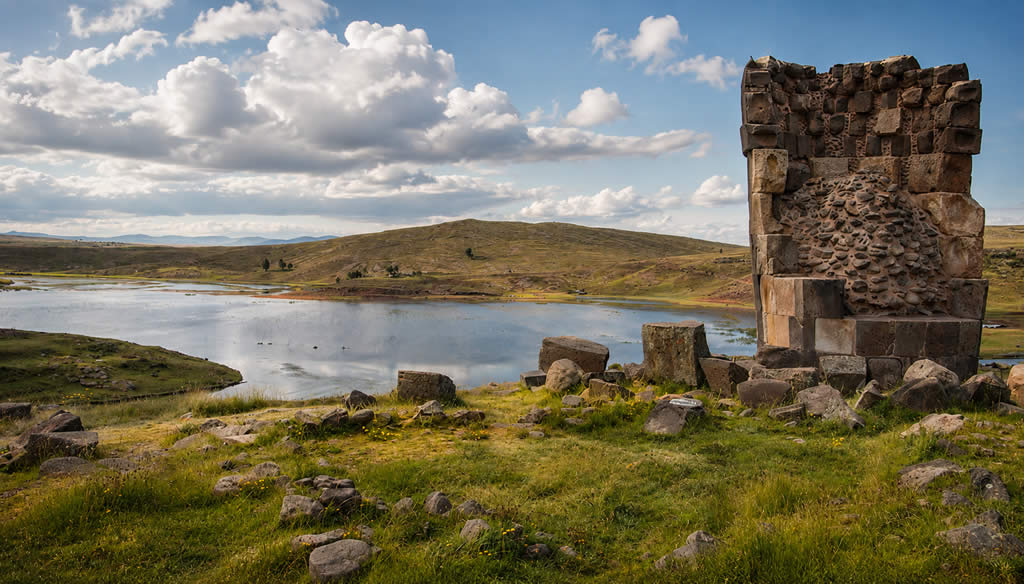
The stillness and beauty of Lake Umayo and the rugged landscape at almost 4000 meters above sea level, contribute to creating this enigmatic atmosphere that is part of the environment where an ancient culture also developed.


Chullpas de Sillustani

About 34 km from the city of Puno are these fascinating pre-Inca funerary monuments. In them the ancient Peruvians of this area buried their nobles to give them eternal rest. The so-called “Chullpas” are volcanic stone towers that resemble an inverted cone. The stone material was brought from nearby quarries and even today, there are around 90 of these chulpas or “ayawasis” in this archaeological complex that is scattered on a large hill, from where you can see the landscape next to the icy lake.

These monuments not only served to preserve the body of a “great lord”, but also showed the respect that inspired his memory or the “ayllu” to which he belonged. The corpse of the “noble”, belonged to an authority, curaca or priest, was previously mummified and placed in a fetal position. Next to it, gold and silver artifacts, utensils and ceramics were frequently buried. The tallest tower in the archaeological complex is the so-called “chullpa del lagarto”, 12 meters high. This complex was declared a cultural heritage of the nation in 2003.

Within the same area of ​​the archaeological complex you can visit the site museum. Where you can learn more about the ancient cultures that inhabited the area, among which the Kollas, Tiahuanacos and Incas stand out. In a few minutes the inhabitants of the town of Atuncolla also offer boat rides across the lake.


How to get to Sillustani?

It is recommended to depart from Puno by land. The archaeological complex is open from Monday to Sunday from 8:30 a.m. at 5:30 p.m. (referential) and the entrance costs approximately S / 5.50 soles, (approximately 2.00 US dollars). You can also start from Juliaca, which is about 40 km away. It is advisable and essential to have the tourist guide service since this service does not exist on site.


The best way to visit and used for many of the travelers visiting Peru is to drive to Sillustani and Puno city  after visiting the city of Arequipa and the Colca Canyon. Currently there is an excellent road that runs Arequipa – the Colca valley – to Sillustani – Puno.

The journey  offers a beautiful Andean landscapes, where you can take excellent photographs crossing the highlands by transport. On the route you can make stops to appreciate more the Andean lagoons and a variety of birds.
From Colca valley you will need about 5 hours of driving to reach the Sillustani complex. After the visit, the travelers are transferred to Puno city to rest at their hotel and continue their journey.

This option is ideal for those travelers who are traveling through southern Peru, as it optimizes their travel time (at least one day) by going directly from Colca to Sullustani and then to Puno.


But also you will find daily Tours to Sillustani leaving from Puno city at around 2:30pm and cost from S30 per peson (With  a Group). The round-trip takes about 3½ hours and allows you about 1½ hours at the ruins.

It is recommended to take the service also in private in order to enjoy more time exploring the ruins and surroundings.

TIPS: The chullpas are well preserved. The afternoon light is the best for photography.


Curious about this magnificent destination?

Come to Perú!

Giardino Team!


@Giardinotoursperu

#ItravelwithGiardino ‘OnetripManyExperiences


2 FacebookTwitterPinterestEmail
Culture & TraditionsPeru Great Destinations

Arequipa Tour: 2 surprising curiosities about this destination!

by Giardino Tours February 10, 2021

The famous “White City” of Arequipa enjoys Its own currency and special passport.

If you travel to Perú and you will visit the white city of Arequipa; you have to know that in “few cities of the world” there are people that love so much their land as the “Arequipeños”.

First you should know that those born in Arequipa are called “Characatos” and here we explain you why.

Characato is the name of one of the most popular and traditional districts of the city and is the origin of many customs and cultural expressions typical of the city. In Arequipa, it is considered that a “Characato” is a very hardworking person, who is always in a good mood and loyal to his traditions. Also this is a person that raises its voice to greet its friends and family or to welcome visitors and always offering, as an act of friendship, a glass of good Chicha (Typical Drink made of fermented corn).

Moreover, the characato is a person proud to have been born at the foot of not one, but three volcanoes: the Misti, the Chachani and the Pichu Pichu. “This is the reason why each characato (Arequipeño) is unique and special in the world” Then, you shouldn’t be surprised that the people born in Arequipa say that they don’t get angry, they, erupt as a volcano because in their veins flow “volcanic blood”

Another interesting detail is that the “Characato” is mainly manifested in the character of the “loncco”, a person that lives and work in the countryside of the city and speaks with a mixture of quechuismos (Quechua is the name of the Inca’s language) and barbarisms, which makes him a unique character in every sense.

Initially the expression “loncco” was used to point that work tools that had lost the edge of their edges. This word “Loncco” also began to be used to point out people who did not work well or were not so talented to work in the field. With the time that word “Loncco” became popular in Arequipa to point to the “chacarero” (Man who works in the field) a rude and tough man who lives in the countryside; a hardworking person that always speaks loudly.

Here some typical expressions of a “Loncco”
  • Alalau: Expression that means that it is very cold.
  • Acacau: when something burns or is very hot.
  • Atatau: Feeling that something produces disgust.
  • Calincha: A girl who behaves like a boy.
  • Chascoso(a): Someone who hasn’t combed his/her hair.

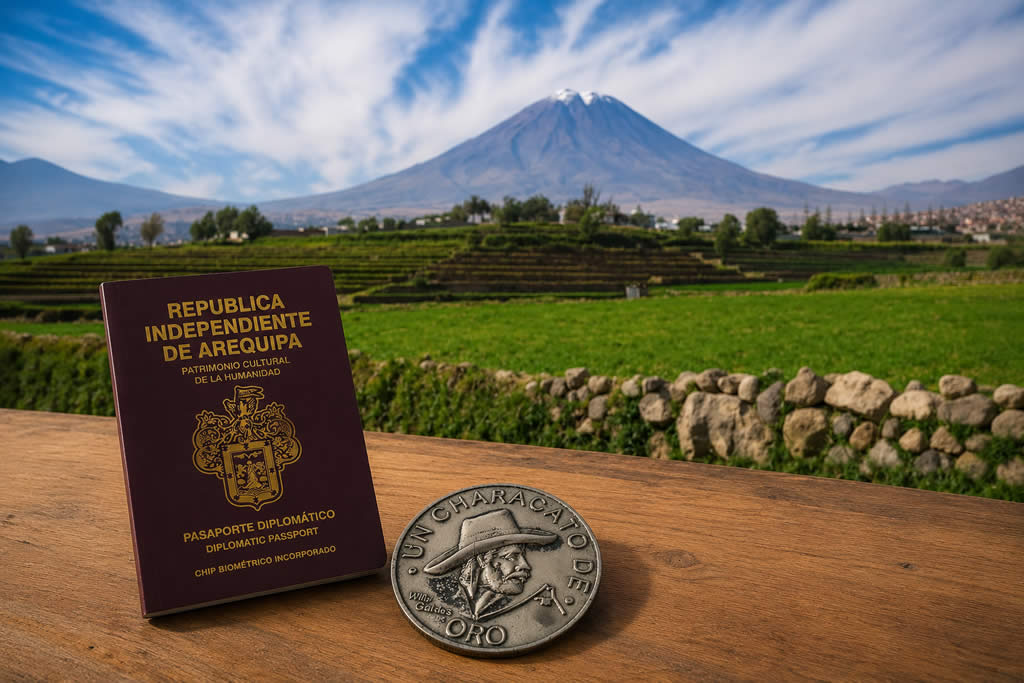
Seeing all these points doesn’t surprise too that Arequipa is the only city in Peru that has its own currency “the Golden Characato” and its own “Passport”. These two acts have no legal value in Peru but certainly allow us to understand the originality of the Arequipeños and this spirit to feel that they are unique.


The passport of the “Independent Republic of Arequipa” is one of the most requested souvenirs by national and international tourists and the “Characato de oro” permit us to enjoy a souvenir of a “currency” that “never devalues”.

The Arequipa Passport:

The Passport: The passport of the “Independent Republic of Arequipa” originated during the war Perú– Chile. At the time that Lima was occupied by the invading army, Arequipa city was declared capital of the Republic and immediately the passport was established as a security measure. But today the passport is a document without any legal value and is a souvenir where you can read inside of its pages funny and typical Arequipeño phrases. You can also custo

The “Characato de Oro”:

Details of the “golden characato”: The Golden Characato is a currency typical from Arequipa and was born as a sign of gratitude to all its visitors. It is printed with the figure of a “loncco” (Now you know what means “loncco”) and the Misti volcano. The “Golden Characato is so important for the locals that the first day that open to the market; the “Characatos” were sold out.
mize it by typing your name and personal data. They have become so famous and popular that it is already part of the local culture.As you see; Arequipa is not only a must-see destination in Perú for its beautiful colonial architecture, its incredible landscapes and its exquisite gastronomy; it offers an endless number of cultural traditions and the incomparable human warmth and hospitality of the characatos!

Ready to visit Arequipa?

We are waiting for you…. 🙂

@GiardinoToursPeru
#OneTripManyExperiences #TravelWithGiardino

2 FacebookTwitterPinterestEmail
Peru Great Destinations

Colca Canyon Tour: Introducing the awesome Colca Canyon

by Giardino Tours February 4, 2021

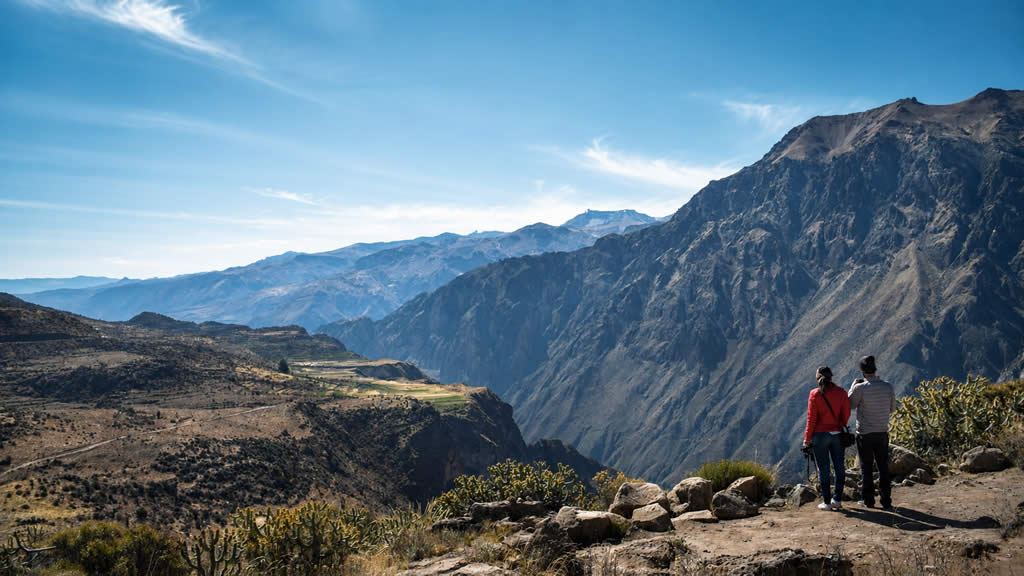
The Colca Canyon is one of the most scenic regions in Peru, a land of imposing snowcapped volcanoes, narrow gorges, artistically terraced agricultural slopes that predate the Incas, arid desert landscapes and vegetation, and remote traditional villages.

Some of Peru’s most recognizable wildlife, including llamas, alpacas, vicuñas are easy to find here. Also the canyon is home to the Andean condor (Vultur gryphus); here you will have the best chance to get of them amazing pictures!

The 120km-long “Cañón del Colca” is set among high volcanoes (6613m-high Coropuna and 6310m-high Ampato are the tallest) and ranges from 1000 mts. to more than 4160 mts. depth. For years there was raging controversy over whether or not this was the world’s deepest canyon with 4,160mts, but recently it ranked as the third one after Kali Gandaki in Nepal with 4,375 mts.Despite its depth, the Colca canyon is geologically young. The Colca river has cut into beds of mainly volcanic rocks, which were deposited less than 100 million years ago along the line of a major fault in the earth’s crust.

The climate is cool and dry on the plateau and slopes high above the Colca river.

The Colca Canyon is also synonym for extensive biodiversity, with an incredible flora and fauna. This special characteristic of the canyon occurs because Peru is located in the subtropical area of South America and it has a rugged geography, in addition, ocean currents and the air mass movements, create an incomparable ecological, climatic and geological variety.

This is a the reason of the importance of conserving the ecosystems that keep alive the variety of animals and plants that this canyon has, a true natural wonder.


The condors are best seen in the early morning and late afternoon when they are hunting. At this point the canyon floor is 3,960 feet (1,200 m). Also Viscachas (burrowing rodents closely related to chinchillas) are also common around the canyon rim, darting furtively among the rocks.

Cacti dot many slopes and, if they’re in flower, you may be lucky enough to see tiny nectar-eating birds braving the spines to feed. In the depths of the canyon it can be almost tropical, with palm trees, ferns and even orchids in some isolated areas.The La Calera natural hot springs are located at Chivay, the biggest town in the Colca Canyon. But you can also enjoy others hots springs with less visitors in other towns such as Yanque and Coporaque.
Festivals throughout the year, including the Wititi festival in Chivay, (December 8–) are a high light. The Wititi has been declared the dance most representative of the Arequipa region, and named as a “cultural heritage” of Peru.The Colca canyon is also well known for two forms of crafts: goods knitted from 100% baby alpaca fiber (hats, gloves, etc.), and a unique form of embroidery that adorns skirts (polleras), hats, vests, and other items of daily wear and use.

The local people (especially the women) are known for their highly decorative traditional clothing. The women’s dresses and jackets are intricately embroidered, and their hats are distinctive.
In the Chivay area at the east end of the canyon, the white hats are usually woven from straw and are embellished with lace, sequins and medallions. At the west end of the canyon, the hats are of cotton and are painstakingly embroidered.

The women don’t particularly enjoy being photographed, so always ask permission. And those who pose for photographs expect a tip.

Colca canyon Activities:

Fauna and Flora observations, Hiking, short walks, mountain biking, trekking, rafting, horseback riding, fishing, and sightseeing.

Organized tours to this destination have daily departures.

It is a destination for all type of travelers, from those who are looking for some relaxing days with luxury service (hotels 4* and 5 *), adventure lovers (because of the many activities that here can be done); classic travelers and family tours (organized tours with visit to all highlights, and family experiences with locals) to low budget travelers.Sources: Wikipedia, Lonely Travel, Promperu.

2 FacebookTwitterPinterestEmail
Newer Posts
Older Posts

More Articles/Más Artículos

  • Colca Canyon Tour: Introducing the awesome Colca Canyon
  • Peru Trip: Altitude mountain sickness and 6 easy tips to avoid it
  • Peruvian Carnivals: Magic, culture & celebration
  • Arequipa Tour: 2 surprising curiosities about this destination!
  • Colca Sour: An unique Cactus cocktail
  • Peru 2 love’s story tellings and myths
  • Enigmatic Sillustani & best way to book a Tour
  • Amazing Tour Maras Salt ponds in Cusco (Virtual)
  • Tips for a Responsible Peru Travel Experience!
  • Colca canyon Travel Guide: 7 Questions about Colca Tours
  • Facebook
  • Twitter

@2021 - All Right Reserved. Designed and Developed by PenciDesign


Back To Top
Giardino Tours Blog
  • Go to Giardino Tours
  • English
  • Español