Top Posts
Cusco Tour: 3 differences between Machu Picchu, Mountain...
Quechua Travel Words: Useful words for a great...
Tour Arequipa: The fascinating stone city of Choqolaqa
Tour Arequipa: Stunning Salinas and Aguada Blanca N.R....
Protecting Our Planet Starts with You – 9...
8 highlights of Arequipa – Tips to enjoy...
FOOD in Arequipa: 8 delicious Dishes that Are...
Embroidery in the Colca Valley a Cultural Heritage...
The interdimensional gate Aramu Muru. Fascination & mystery.
Pacaya Samiria Reserve: A world destination not to...
  • Go to Giardino Tours
  • English
  • Español
Giardino Tours Blog
TRANSFORMING TRAVELS INTO MEMORABLE STORIES
Tag:

Lake Titicaca

Culture & TraditionsFeaturedLake TiticacaPeru Great Destinations

The interdimensional gate Aramu Muru. Fascination & mystery.

by Giardino Tours June 21, 2021
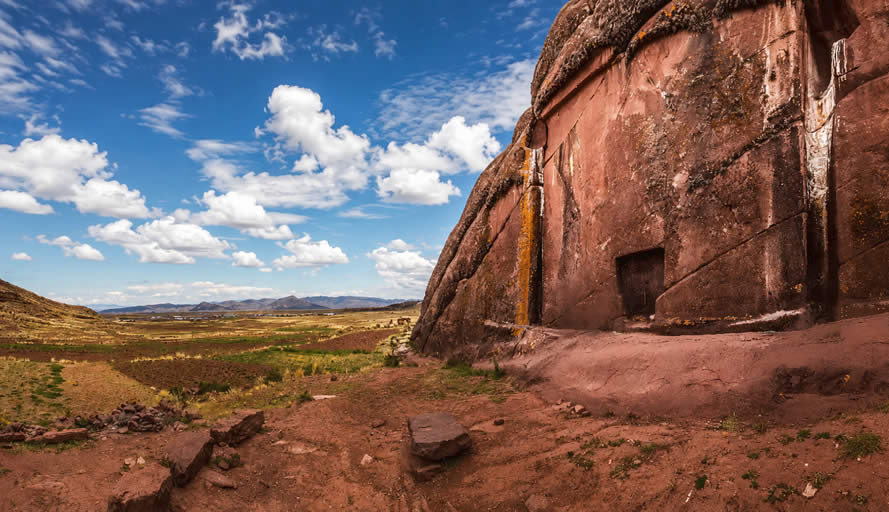
“A portal, that according to a legend allowed the Inca’s priests to be transported to different places of the Inca Empire and even to any place of  the world” The interdimensional gate Aramu Muru also known as: Hayu Marca means: “City of spirits or” Willka Uta: “Place of the sun or gate of the gods.”
Location:

“La Puerta” (The door) is located 35 kilometers from the city of Puno (Lake Titicaca area), in south area of the district of Ilave in the province of Collao and 1 hour and 10 minutes by car from Puno city. This enigmatic place It is located also near a fascinating stone forest and the terrain is cold and quite dry.

The portal has the shape of a square with 7 meters on each side and it is carved in a unique rock. So far no in-depth archaeological study has been conducted that can reveal the date when the first settlers began to consider this door “a sacred place”.

Data:

For many, Aramu Muru door is a place where a lot of energy is concentrated, our body and soul are immediately nourished, also you get a feeling of to be in a safe place, where the body feels free and all the pressures of that daily life go away.  A place where you encounter peace. For many people this is a good place to meditate on our daily and spiritual lives. To find the answers to many questions and return home with more hope and energy.

But lets us to talk a bit more about the legends of the area, that will lead us to understand why it is considered a mystical and special place.

According to story-telling and legends, when the Spanish arrived in the Inca empire, there was a priest named Aramu Muro, who belonged to the monastery of the 7 rays and was responsible for the initiation ceremony and worship of the God; The “Inti” (the Sun).

Legends said that Aramu Muru was the one who took the golden solar disk kept in Koricancha tempel (Sun tempel in Cusco) and fled from the Spanish conquers to some place save place in the Juli Province (Lake Titicaca). Then, he reached the sacred door and placed the Sun disk on the door, using it as a door key, and opened the door. After that, he cross the portal and disappeared behind it.Nowadays; locals carry out rituals of all kinds at the door of Aramu Muru, to ask for peace, to say thank you to the Gods or ask for hope.

Also the door is a very attractive spot for many esoteric groups, that visit the place hoping that maybe the door will be opened, and they have a chance to see a bit to the world of the Gods.

“The legend says that this door opens only for those people who are spiritually ready to connect to the spirit of Lake Titicaca.”

But without doubt, Aramu Muru is a place surrounded by mystery, where people comment that they have had sightings of strange lights and claim to have had visions of stars or columns of fire, or to have heard sounds and have even felt the presence of a tunnel behind the door.Interesting is also that just on the other side of the mountain, Archeologist have found the remains of what seems to be a tunnel that connected the cities of Tiahuanaco (Bolivia)  and Cusco city. They think that this tunnel was used by the Incas to move around the areas. According to Inca traditions and legends, this tunnel was built before the Inca empire arrive in the area, and only was used by the Incas.

The question is…  if the Incas were not the builders of this tunnel, then who were they?

There are many interesting and fascinating stories and legends that surround the mystical world of ancient Peru, such as the legend of Lake Titicaca, from where Manco Cápac and Mama Ocllo (Founders of the Inca empire) emerged and in which “La isla de la Luna” (Moon island) is located, in this island you will find similar doors.  Or the ceremonial center of “Ñaupa Iglesia” in Cusco city, in the province of Urubamba, where you can also find a similar wall or door and many rituals take place.

Certainly many questions that we cannot answer yet.

When to visit Aramu Muru?

The best time to visit Aramu Muru is in August because the earth is said to be more willing to accept offerings. But the truth is that July and August are the months where most people visit it to explore, make same hiking, rituals etc.So, what do you think?  Do you dare to visit places enclosed with so much mystery?

Whatever the reason is that you visit Aramu Muru, you will certainly be fascinated, for the natural beauty that surrounds Lake Titicaca, the varied geography, the legends or the spiritual energy that undoubtedly recharges us in this beautiful area of ​​Peru.

We are ready to take you on this adventure

And you?

We will wait for you!!!GIARDINO BLOG

#OneTripManyExperiences #ITravelwithGiardinoOther links:

Protecting Our Planet Starts with You – 9 Things You Can Do

Quechua Travel Words: Useful words for a great Peru experience

Tour Arequipa: The Cathedral & 5 curious facts that you should know
0 FacebookTwitterPinterestEmail
Peru Great Destinations

Taquile Island: Details and great Tips for your Tour

by Giardino Tours March 1, 2021

Taquile Island, another jewel of Titicaca Lake

Set within Lake Titicaca, Taquile Island has a colorful history and a distinct culture.

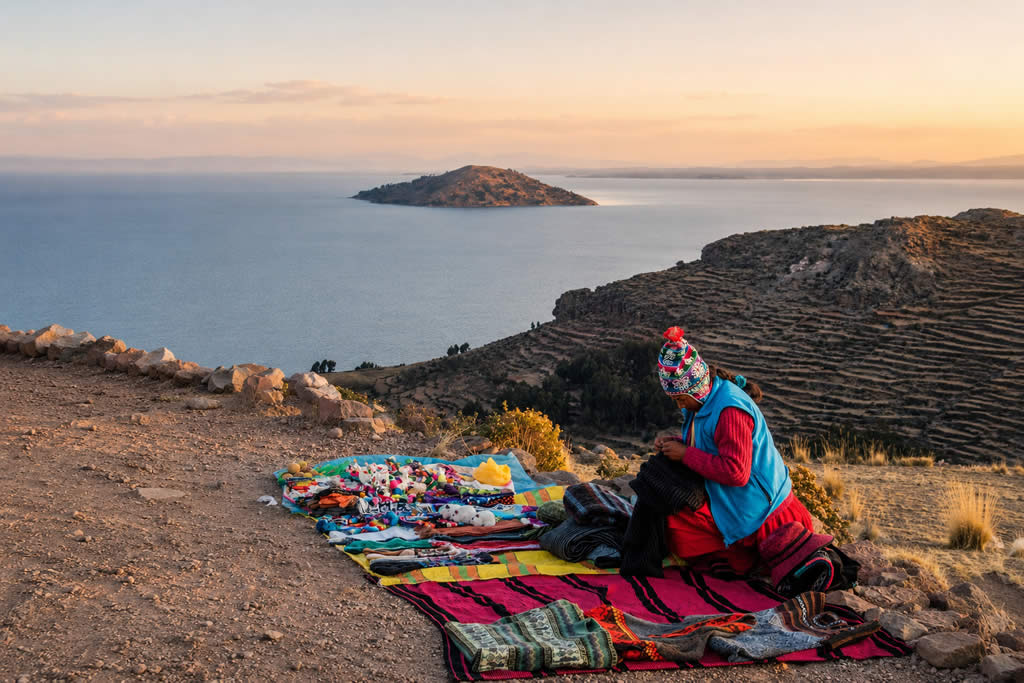
Taquileans are so well-known for intricate and well-made handwoven textiles that in 2005 the United Nations Educational, Scientific and Cultural Organization (UNESCO) declared them to be a “Masterpiece of Oral and Intangible Heritage.” These textiles are a character-defining element of their culture .

Taquile: Nature, culture and knitters

Taquile island is home of a Quechua population of about 2,000 people who are mainly farmers, fishermen and above all renowned weavers.

By the age of seven, boys are proficient knitters. In fact, the entire family is involved in knitting or weaving. Children knit “chullos” (hats), gloves and finger puppets of condors and llamas, common animals of the Andes. Women hand-spin the soft fleece of the sheep and alpaca into fine yarn for sweaters and blankets.

The island offers beautiful landscapes of hills, stone archways and, of course, the blue water of lake Titicaca around it.

The locals grow crops like corn, beans and quinoa on the pre-Incan terraces that cover its hilly terrain. Thanks to a largely vegetarian diet, the locals are said to live an average of 90-100 years.

The island is largely untouched by modernity with not even a bicycle to be seen in the island.

In July, villagers observe the Feast of Santiago Apostol with music and dancing. Whether celebrating weddings or religious holidays, there is always a reason to enjoy the folk music and dance that is an important part of island life.

Taquileños run their society based on community collectivism and on the Inca moral code „ama sua, ama llulla, ama qhilla“ (Quechua for “do not steal, do not lie, do not be lazy”).

The island has a radio station and is equipped with generators. Islanders have elected to use solar panels to generate energy.

Location:

Taquile Island is located 36 Km (22 miles) away from the city of Puno. It takes a 2 and half-hour boat ride to arrive in the island’s main dock.

The island highest elevation is 4100 m (13451 feet); it has a length of 5 Km (3.10 miles) and a width of 1.5 Km (0.93 miles). To walk across the island takes about two hours.

Tours to Taquile island

You can enjoy Taquile in 2 forms:

A full day Excursion:

These tours has a departure in Puno and begin with a visit to the floating island Uros before continuing to Taquile.

During the visit to Taquile visitors follow enjoyable paths that gradually take them to the main village or to other more remote sectors of Taquile. These other paths of access to the main village allow you to catch spectacular views of Lake Titicaca.

Many tours try to avoid climbing up the 535 stairs that take the visitors to the main village, but it is unavoidable to walk the stairs down to go back to the main dock.  So it is very important you have a good physical condition and good boots to walk.

Also a demonstration of traditional Andean weaving is the highlight of this visit.

A 2 days Excursion with a Overnight in Taquile:

If you decide for an overnight experience in Taquile Island,  (Normally with a previous visit to Uros floating islands) you can take your time and visit interesting sights with a host family, such as monuments to Pachamama (Mother Earth) , which are especially fascinating during Taquile’s wild festivals.

Enjoy the sunset and sunrise. 😉

Staying with a family gives you the chance that a local family will open its doors to you and you’ll get a glimpse into the Taquile lifestyle and the family’s dynamics, all topped off with a delicious homemade meal.

Additionally, you must know that the island’s tourism is operated exclusively by its inhabitants, so you’ll get first-hand knowledge from locals who know the area.

We highly recommend that you book your tours with a serious and formal travel agency. Please get informed about the company where you are going to take your tour in order to ensure that the tours are realized in a sustainable way and if handling is in accordance with the respect of the local rules and activities of the island.

@GiardinoTours

#ITravelwithGiardino #OneTripManyExperiences

3 FacebookTwitterPinterestEmail
FeaturedPeru Great Destinations

Discover Uros, the floating islands on lake Titicaca and how to book a Tour

by Giardino Tours February 24, 2021
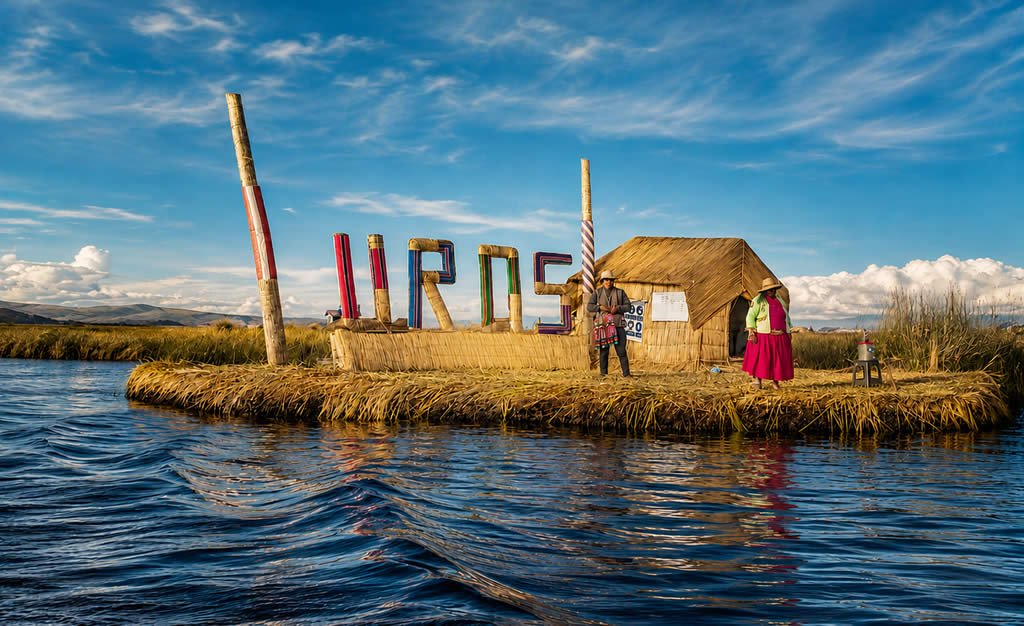
The floating islands of UROS are located inside the bay of Lake Titicaca only 14 Km. (about 9 miles) away from the city of Puno (20 to 30 minutes of navigation time). These human-made islands constructed from reeds are without doubt one of the fascinating half-day Tours from Puno on Lake Titicaca. – Perú.
How the islands are made?

The floating islands are constructed from many layers of the totora reeds, which are constantly replenished from the top as they rot from the bottom, so the ground is always soft and dry as much as possible. (When you visit the islands please be careful not to put your foot through any rotten sections!)

Nowadays, the reeds are still very important material for the Uros. They eat the reeds, build boats and houses with them, feed their few animals with reeds, and they use the reeds to make fire and cook.

We can say that the Totora are the backbone of Uros’ life.

Each islet is home to between one and ten Uros families. Also in some islets children are able to attend kindergarten and elementary school . However, older children must continuing their education in Puno city.

That make the future of Uros, their traditions and way of life uncertain.

Origen of the name

“URU” was the name of a very particular ethnic group that co-existed in lake Titicaca with the Inkas, Aymaras and possibly with older civilizations.

Today some theories claim that in the name “Uru” derives from the Pukina language; (also spelled Puquina) and it is already mentioned that this may have been the native and secret language of the Incas, and has remained hidden for hundreds of years.

The first clue to this language is given by the Inca Garcilaso de la Vega in his Royal Comments. In this work, the author tells us the following:

“The Incas had another particular language that spoke between them, that the other Indians did not understand it nor was it lawful for them to learn it, as divine language,”

He also adds that according to information from their sources, this language “had been totally lost, because, The particular republic of the Incas perisched and their language perished too.“

According to documents it is known that the Spanish Empire decreed in 1575 as the official languages of the kingdom of Peru, three languages: Quechua, ayumara and puquina. Languages that were to be learned primarily by Spanish priests for evangelizing purposes.

Rodolfo Cerrón Palomino, Peruvian linguist, explains that the Spanish people had a quite pragmatic approach. So, seeing that the mayority of people already spoke Quechua or Aymara, they did not see the use in creating documents in Pukina language. “We lost a great opportunity to have materials for this language,” laments Palomino.

The Uros People

In fact, it is believed that the Uros people were one of the first ethnic groups populating the Andean region. Contrary to the claim by many authors that the Uros’ ethnic group is extinguished; a recent study of the genetic structure of the Quechua and Aymara groups of lake Titicaca has found that today’s UROS people preserve part of the original gene of ancient Uros.

These people were simple fishermen, bird hunters and recoletc eggs from the reeds and preferred to remain isolated from the other civilizations. Their search for isolation may be one reason why they decided to live in mobile boats on the lake.

When the Spanish chroniclers encountered the UROS by the end of the XVI century, the UROS people were still living on the lake in small reed-boats that they used as floating houses. Only in the early 60s, the Uros started to build small artificial islands with reeds for bigger homes.Today the Uros Islands are floating on the Peruvian side of Lake Titicaca, a few miles from Puno city. On the past the islands used to be closer to the middle of the lake Titicaca, but they moved or rebuilt the islands closer to the shore after a devastating storm in 1986.

Uros is a gem on Titicaca lake; thanks to existing Uros people, we can still imagine and appreciate the way of life of an ancient ethnic group on the Andean area of Lake Titicaca.

How to book the Tour to Uros Islands
  • The best way to visit the Uros Islands is a guided tour from Puno city. All guided tours depart to Uros every day specially during dry season.
  • Most boats depart in the morning between 7 and 8 AM. The ride take about 20 minutes to the islands.
  • The city of Puno is easily accessible from Cusco, Arequipa, and La Paz, Bolivia.
  • Cusco and Puno are well connected with transportation options. From Arequipa, Colca Canyon tours can continue onto Puno by van. Buses run daily to and from La Paz.
  • Each tour of Uros begins with a demonstration on how the islands are made. After that, the islanders invite their guests to visit a home built from the same Totora reeds.

The islanders always present their handicrafts to tourists towards the end of each tour. While some visitors find this annoying, it is important to keep in mind that a large percentage of their income comes from selling souvenirs to tourists.

Travel Tips

  • The best time to visit the Uros Islands is during the dry season from April to November.
  • Bring your passport for a souvenir stamp on one of the main islands (additional cost of 1 sol per stamp).
  • Each tour to Uros Islands visits two islands. IN the tour you will have the option to take a handmade reed boat from first island to the second island (15-20 minute ride). This boat ride costs an additional 10 soles per person. This payment goes directly to the family that owns the boat.
  • Important: Remember that Uros Islands and Lake Titicaca sit at 12,500 feet (3,810 meters) above sea level. It is best to acclimatize by first visiting cities in lower altitudes such as Arequipa or Cusco before heading to Lake Titicaca.
  • Fort he Tour to Uros and specially for tours in the andean area; bring sun protection, warm layers, comfy shoes.
  • The best time to depart on Tours to Lake Titicaca is in the morning. Therefore, we recommend staying in a Puno hotel one night before visiting the lake.

Giardino Tours

Fuentes:

Wikipedia / www.pucp.edu.pe / Lonely Planet@GiardinoToursPeru

#ItravelwithGiardino #OneTripManyExperiences

3 FacebookTwitterPinterestEmail
Peru Great Destinations

Enigmatic Sillustani & best way to book a Tour

by Giardino Tours February 15, 2021


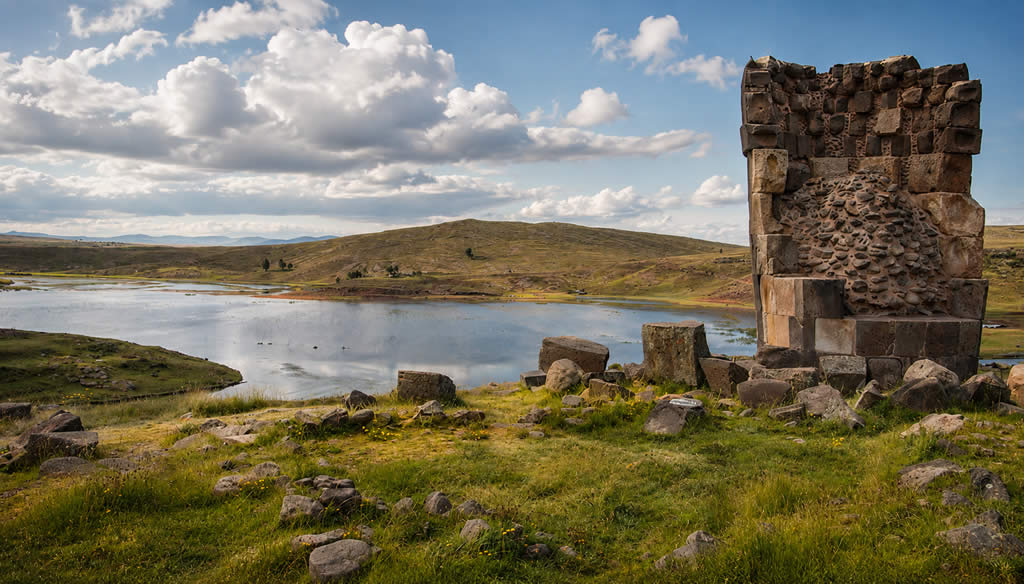
Walking and exploring among the imposing Chulpas of Sillustani is undoubtedly one of the most fascinating experiences on the region of Puno close to Lake Titicaca .

The stillness and beauty of Lake Umayo and the rugged landscape at almost 4000 meters above sea level, contribute to creating this enigmatic atmosphere that is part of the environment where an ancient culture also developed.


Chullpas de Sillustani

About 34 km from the city of Puno are these fascinating pre-Inca funerary monuments. In them the ancient Peruvians of this area buried their nobles to give them eternal rest. The so-called “Chullpas” are volcanic stone towers that resemble an inverted cone. The stone material was brought from nearby quarries and even today, there are around 90 of these chulpas or “ayawasis” in this archaeological complex that is scattered on a large hill, from where you can see the landscape next to the icy lake.

These monuments not only served to preserve the body of a “great lord”, but also showed the respect that inspired his memory or the “ayllu” to which he belonged. The corpse of the “noble”, belonged to an authority, curaca or priest, was previously mummified and placed in a fetal position. Next to it, gold and silver artifacts, utensils and ceramics were frequently buried. The tallest tower in the archaeological complex is the so-called “chullpa del lagarto”, 12 meters high. This complex was declared a cultural heritage of the nation in 2003.

Within the same area of ​​the archaeological complex you can visit the site museum. Where you can learn more about the ancient cultures that inhabited the area, among which the Kollas, Tiahuanacos and Incas stand out. In a few minutes the inhabitants of the town of Atuncolla also offer boat rides across the lake.


How to get to Sillustani?

It is recommended to depart from Puno by land. The archaeological complex is open from Monday to Sunday from 8:30 a.m. at 5:30 p.m. (referential) and the entrance costs approximately S / 5.50 soles, (approximately 2.00 US dollars). You can also start from Juliaca, which is about 40 km away. It is advisable and essential to have the tourist guide service since this service does not exist on site.


The best way to visit and used for many of the travelers visiting Peru is to drive to Sillustani and Puno city  after visiting the city of Arequipa and the Colca Canyon. Currently there is an excellent road that runs Arequipa – the Colca valley – to Sillustani – Puno.

The journey  offers a beautiful Andean landscapes, where you can take excellent photographs crossing the highlands by transport. On the route you can make stops to appreciate more the Andean lagoons and a variety of birds.
From Colca valley you will need about 5 hours of driving to reach the Sillustani complex. After the visit, the travelers are transferred to Puno city to rest at their hotel and continue their journey.

This option is ideal for those travelers who are traveling through southern Peru, as it optimizes their travel time (at least one day) by going directly from Colca to Sullustani and then to Puno.


But also you will find daily Tours to Sillustani leaving from Puno city at around 2:30pm and cost from S30 per peson (With  a Group). The round-trip takes about 3½ hours and allows you about 1½ hours at the ruins.

It is recommended to take the service also in private in order to enjoy more time exploring the ruins and surroundings.

TIPS: The chullpas are well preserved. The afternoon light is the best for photography.


Curious about this magnificent destination?

Come to Perú!

Giardino Team!


@Giardinotoursperu

#ItravelwithGiardino ‘OnetripManyExperiences


2 FacebookTwitterPinterestEmail

More Articles/Más Artículos

  • Colca Canyon Tour: Introducing the awesome Colca Canyon
  • Peru Trip: Altitude mountain sickness and 6 easy tips to avoid it
  • Peruvian Carnivals: Magic, culture & celebration
  • Arequipa Tour: 2 surprising curiosities about this destination!
  • Colca Sour: An unique Cactus cocktail
  • Peru 2 love’s story tellings and myths
  • Enigmatic Sillustani & best way to book a Tour
  • Amazing Tour Maras Salt ponds in Cusco (Virtual)
  • Tips for a Responsible Peru Travel Experience!
  • Colca canyon Travel Guide: 7 Questions about Colca Tours
  • Facebook
  • Twitter

@2021 - All Right Reserved. Designed and Developed by PenciDesign


Back To Top
Giardino Tours Blog
  • Go to Giardino Tours
  • English
  • Español