Top Posts
Cusco Tour: 3 differences between Machu Picchu, Mountain...
Quechua Travel Words: Useful words for a great...
Tour Arequipa: The fascinating stone city of Choqolaqa
Tour Arequipa: Stunning Salinas and Aguada Blanca N.R....
Protecting Our Planet Starts with You – 9...
8 highlights of Arequipa – Tips to enjoy...
FOOD in Arequipa: 8 delicious Dishes that Are...
Embroidery in the Colca Valley a Cultural Heritage...
The interdimensional gate Aramu Muru. Fascination & mystery.
Pacaya Samiria Reserve: A world destination not to...
  • Go to Giardino Tours
  • English
  • Español
Giardino Tours Blog
TRANSFORMING TRAVELS INTO MEMORABLE STORIES
Tag:

Cusco

FeaturedPeru Great DestinationsTravel Tips

Cusco Tour: 3 differences between Machu Picchu, Mountain & Huayna Picchu

by Giardino Tours February 4, 2025

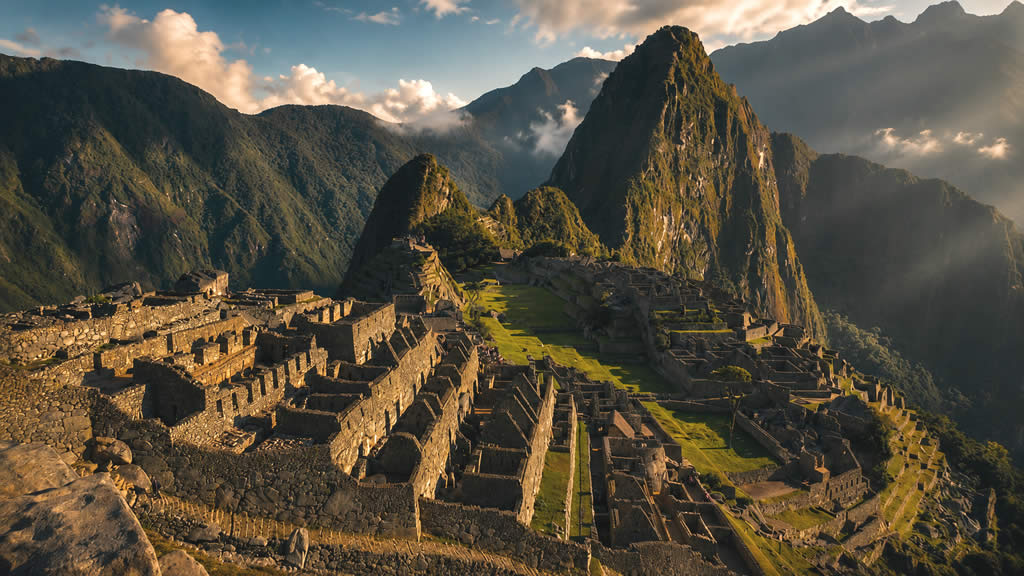
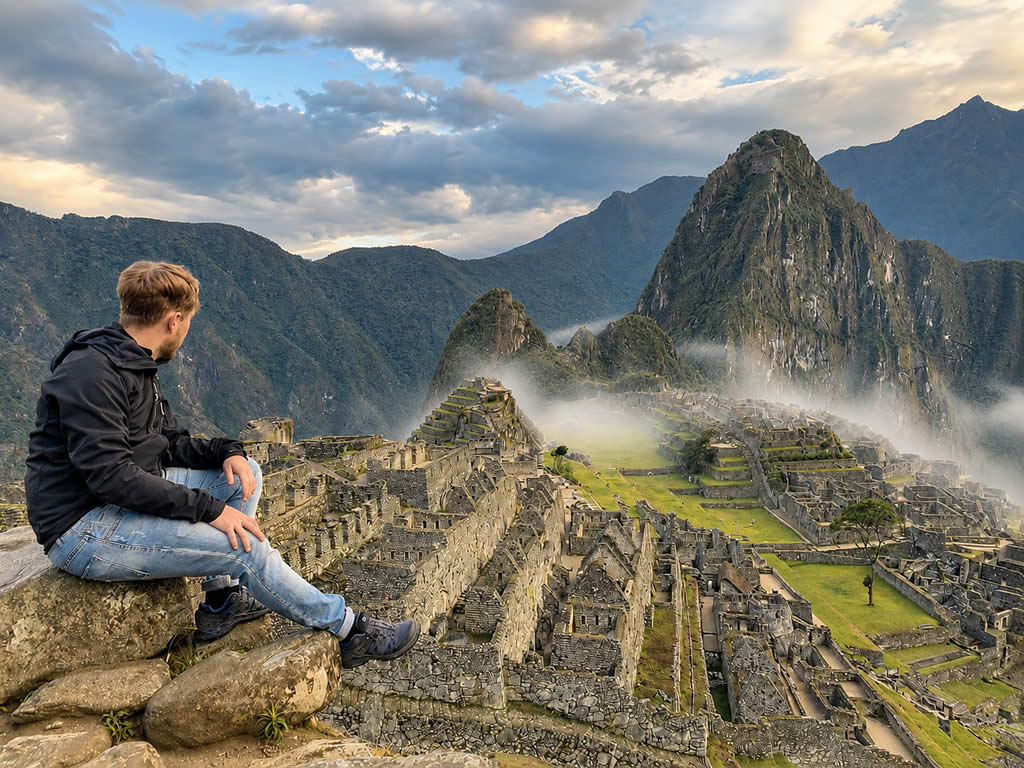
Today there are different concepts about entrances when you want to visit Machu Picchu that oft lead to some confusion to our travelers, here we explain you the differences:[penci_fancy_heading _text_align=”left” p_title=”Citadel or Sanctuary (LLaqta):” turn_on_title=”yes” _title_typo=”font_family:%3A” _title_fsize=”20px” _subtitle_typo=”font_family:%3A” _desc_typo=”font_family:%3A” title_color=”#3cc154″][/penci_fancy_heading]The Citadel or Sanctuary of Machu Picchu, are the Inca ruins itself, this is what we see in all pictures, that have made this Peruvian attraction so famous. There are buses from Machu Picchu Pueblo that take you to the entrance of the Sanctuary, where you will check your entrance ticket according to your booked schedule.
The citadel is located to 2.490 meters high and takes the name of the “Mountain” where it is located; in other words, the name of the “citadel itself“ still unknown.[penci_fancy_heading _text_align=”left” p_title=”Huayna Picchu Peak:” turn_on_title=”yes” _title_typo=”font_family:%3A” _title_fsize=”20px” _subtitle_typo=”font_family:%3A” _desc_typo=”font_family:%3A” title_color=”#3cc154″][/penci_fancy_heading]The famous Huayna Picchu peak is one of the mountains that is located in front of Machu Picchu citadel, and which can be climbed using a path that departs from the Citadel itself.
At the top there are some ruins and you will have an amazing view of the citadel and the area and if you want more, there is also another trail up to the temple of the moon.
This mountain is located to 2,720 mts and is only allows the entry of 400 people per day, in two groups of 200 persons (07:00 AM and 10:00 AM). For this reason the tickets must be bought in advance. The ascent takes approximately two hours, and the trail to the temple of the moon, or the Great Cavern, are about 4 hours.

Some facts:

  • It is known as the ‘Young Mountain’. Walking along its trails is recognized as one of the most incredible short walks on the planet.
  • The trails are steep and narrow. They were built on one side of the mountain. They can be terrifying for people afraid of heights.
  • If you suffer from vertigo or acrophobia, it’s best to avoid to walk to this mountain.

[penci_fancy_heading _text_align=”left” p_title=”Machu Picchu Mountain:” turn_on_title=”yes” _title_typo=”font_family:%3A” _title_fsize=”20px” _subtitle_typo=”font_family:%3A” _desc_typo=”font_family:%3A” title_color=”#3cc154″][/penci_fancy_heading]Now you know that the “Inca city” is located on the mountain of Machu Picchu at 2,490 meters; but the mountain has an altitude of 3.061 meters. So now you have the possibility to walk to the TOP of the Mountain “Machu Picchu”.
From there the view is also spectacular and has the big advantage that allow 600 persons per day in 2 time schedule 09:00AM and 10:00AM, still not so popular as Huayna Picchu peak so the tickets do not run out so fast; but an incredible view is guaranteed.[penci_fancy_heading _text_align=”left” p_title=”¿Aguas Calientes = Machu Picchu Pueblo?” turn_on_title=”yes” _title_typo=”font_family:%3A” _title_fsize=”20px” _subtitle_typo=”font_family:%3A” _desc_typo=”font_family:%3A” title_color=”#3cc154″][/penci_fancy_heading]Aguas Calientes, currently known as Machu Picchu Pueblo; It is the nearest town to the ruins. This town can only be reached by train or by walking. This is the town where the trains arrive from Cusco or Ollantaytambo for the tour to Machu Picchu, there are hotels for visitors, restaurants and you can do some shopping.
Now! From Machu Picchu Pueblo are the departures of the buses that drive up to Citadel, This drive takes about 20 to 25 minutes. Machu Picchu Pueblo is located at 2,040 meters and its name before (Aguas Calientes = Hot water) comes from the hot springs that are close to the town.

Machu Picchu:

The citadel of Machu Picchu is maybe the main reason that thousands of visitor travel to Peru and also appears in the top destinations list by U.S. News.

It is ranked as the eighth best place to visit. Machu Picchu was discovered by Hiram Bingham in 19, the ruins are today part of the UNESCO World Heritage sites, and since 2007 is one of the New Seven Wonders of the world.
2 FacebookTwitterPinterestEmail
Culture & TraditionsFeatured

Quechua Travel Words: Useful words for a great Peru experience

by Giardino Tours April 21, 2024

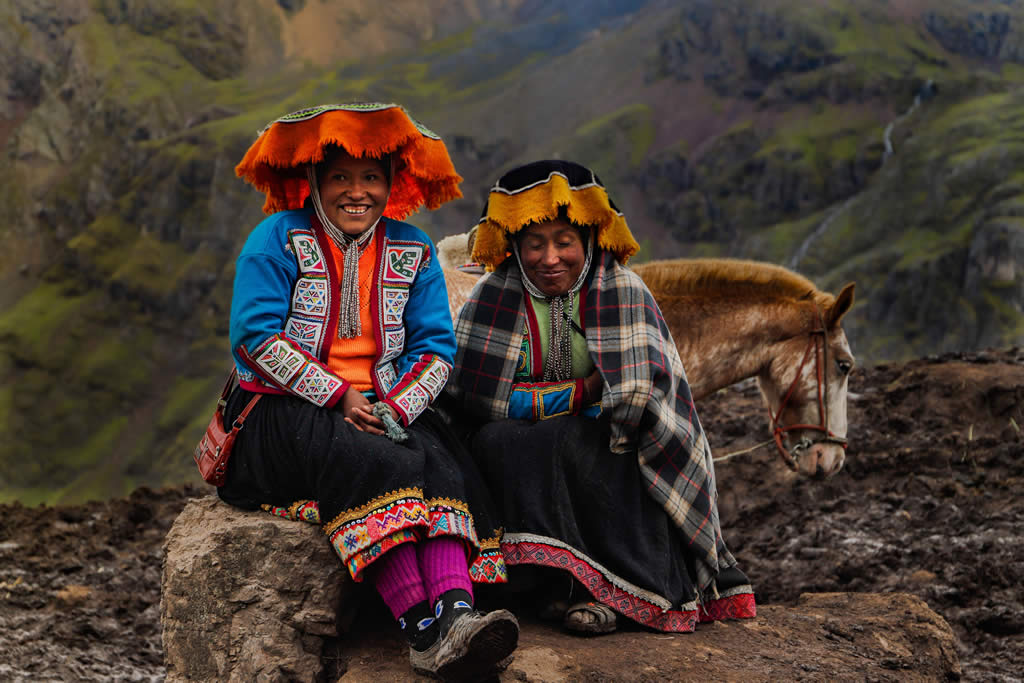
When you travel to Peru for the first time,  you will immediately realize that our country has a rich and admirable indigenous heritage. This makes Peru a beautiful and diverse destination.

For travellers who want to learn more and connect with indigenous Andean communities and their culture, it is a great help to know a little bit of the Quechua language. If you greet someone in quechua during your trip, no doubt the answer will be smiles among the people you visit and a more pleasant feeling of “welcome”.

The Quechua language called „Runasimi“ in Quechua means: runa ‘people’ + simi ‘speech,’ is a family of some 45 closely-related languages spoken in the Andean region of South America by close to 8 million people.

“If Latin is said to be the language of the angels, then Quechua is the language for expressing the subtleties of existence on Earth. That is why it is still alive.”

– Demetrio Túpac Yupanqui (New York Times- 2008 – Armed With a Pen, and Ready to Save the Incas’ Mother Tongue)

Beautiful words in Quechua!

Quechua is a official language in Peru, along with Spanish and Aymara. In rural areas, it is used for everyday communication in informal contexts. Since most Native speakers of Quechua are illiterate in their native language, it remains largely an oral language. In formal contexts, such as government, administration, commerce, education, and the media, Spanish is used. The only cultural domain where Quechua is used extensively is traditional Andean music.

„One example of this important momentum is the 2015 adoption of Indigenous Andean principles in Quechua, by the United Nations General Assembly: The principles of Ama Sua (“you shall not steal”), Ama llulla (“you shall not lie”) and Ama Quella (“you shall not be lazy”) were distinguished by the international body.   – Penn Arts & Sciences / United Nations Secretary-General.

“Quechua is such a beautiful language,” said Ms. Ambía, a retired teacher and social worker. “I want to help preserve it. I want for people to feel proud of our heritage, to feel proud about our culture.”  –  Elva Ambía (The Wall Street journal – 2014 – Reviving a Fading Language Called Quechua )

Some useful words in Quechua for those who travel to Peru

If you find yourself in the jungle, or in the central or southern part of the Andes in Peru, you will find that the language varies, but in general with these words you will have a good chabnce of comunication. Remember that Quechua and Spanish have somewhat similar phonetics (ex.: the double /l/ or “ll” sound like an English /y/).If you meet somebody fort he First time:

Rimaykullayki: It is the most widespread form of greeting, this amounts to: good morning, good afternoon and good night of Spanish. It literally means “I speak to you politely.”

Chaskillaykim: It literally means “I answer the greeting.”

If you meet a friend or you already know the person:

Imaynallam?:  How are you?

Allinllanchu:  Are you ok?

Allinllam:  I’m well, thank you.

Somaq mihuna: That means: „This is amazing food“ If somebody hears you say this at their restaurant or food stand, they will be very happy.

Sulpayki: Thank you  (The most important Word in the world!)

Tinkunanchiskama: I will see you later, farewell)

Paqarin kama: See you tomorrow

Tupananchikama: Goodbye in general.

Allin P’unchay: Good morning

Allin Sukha: Good afternoon

Allin Tuta: Good night

Did You Know?

These words came into English from Quechua via Spanish:

coca:  kuca, the native name of the plant
condor:  kuntur, the native name for the bird
guano:  huanu ‘dung’
jerky:  ch’arki ‘dried flesh’
llama:  llama, the native name of the animal (with Spanish spelling)
puma:  puma, native name of the animal
vicuña:  wikuna, the native name of the animal

Are you starting  planning a journey to Peru? Contact our team of expert travel advisors and lets together organize your perfect trip. 🙂
Giardino Tours – Blog


#ITravelwithGiardino #OneTripManyExperiences

3 FacebookTwitterPinterestEmail
Peru Great Destinations

Machu Picchu: Check these amazing secrets before the Tour

by Giardino Tours February 19, 2021


Machu Picchu:

A stone city built on the top of an isthmus, between two mountains and between two geological faults, in a region subject to constant earthquakes and, above all, heavy rains all year round. No doubt that this city was a challenge for any master of engineering.

1.- Machu Picchu  It’s no stranger to earthquakes.


The stones in the most handsome buildings throughout the Inca Empire used no mortar. These stones were cut so precisely, and wedged so closely together, that a credit card cannot be inserted between them.

Aside from the obvious aesthetic benefits of this building style, there are engineering advantages.

Peru is a seismically unstable country—both Lima and Cusco have been leveled by earthquakes—and Machu Picchu itself was constructed atop two fault lines. When an earthquake occurs, the stones in an Inca building are said to “dance;” that is, they bounce through the tremors and then fall back into place.

Without this building method, many of the best known buildings at Machu Picchu would have collapsed long ago.


2.- Much of the most impressive stuff is invisible.


While the Inca are best remembered for their beautiful walls, their civil engineering projects were incredibly advanced as well. (Especially, as is often noted, for a culture that used no draft animals, iron tools, or wheels.)

The site we see today had to be sculpted out of a notch between two small peaks by moving stone and earth to create a relatively flat space. The engineer Kenneth Wright has estimated that 60 percent of the construction done at Machu Picchu was underground.

Much of that consists of deep building foundations and crushed rock used as drainage. (As anyone who’s visited in the wet season can tell you, Machu Picchu receives a lot of rain.)


3.- The location of Machu Picchu is not a coincidence


On Monday, 23 Sept. 2019, at the Geological Society of America Annual meeting in Phoenix, Rualdo Menegat, a geologist at Brazil’s Federal University of Rio Grande do Sul, will present the results of a detailed geoarchaeological analysis that suggests the Incas intentionally built Machu Picchu — as well as some of their cities — in locations where tectonic faults meet.

“Machu Pichu’s location is not a coincidence,” says Menegat. “It would be impossible to build such a site in the high mountains if the substrate was not fractured.”

Menegat found that these faults and fractures occur in several sets, some of which correspond to the major fault zones responsible for uplifting the Central Andes Mountains during the past eight million years.

Because some of these faults are oriented northeast-southwest and others trend northwest-southeast, they collectively create an “X” shape where they intersect beneath Machu Picchu.


4.- There’s more than one peak to climb


When you visit Machu Picchu for sure you want to visit also the Huayna Picchu peak (the small green peak, shaped like a rhino horn, that appears in the background of many photos of Machu Picchu.) but only  400 people are permitted to climb Huayna Picchu daily.

Almost no one bothers to ascend the pinnacle that anchors the opposite end of the site, which is usually called Machu Picchu Mountain. At 1,640 feet it is twice as tall, and the views it offers of the area surrounding the ruins—especially the Urubamba River winding around Machu Picchu like a coiled snake—are spectacular.


5.- There’s a secret temple.


Should you be one of the lucky early birds who snags a spot on the guest list to Huayna Picchu, don’t just climb the mountain, snap a few photos, and leave.

Take the time to follow the hair-raising trail to the Temple of the Moon, located on the far side of Huayna Picchu. Here, a ceremonial shrine of sorts has been built into a cave lined with exquisite stonework and niches that were once probably used to hold mummies.


6.- It has a great sense of orientation


There is solid evidence that the builders took into account astronomical and ritual criteria for the construction of Machu Picchu, according to studies by Dearborn, White, Thomson and Reinhard, among others.

Indeed, the alignment of some important buildings coincides with the solar azimuth during the solstices, in a constant and therefore not accidental way, with the rising and setting points of the sun at certain times of the year and with the peaks of the surrounding mountains.


Recent research has shown that the site’s location of many constructions of the Incas and the orientation of them, was strongly influenced by the location of nearby holy mountains, or Apus.


For example, an arrow-shaped stone atop the peak of Huayna Picchu appears to point due south, directly through the famous Intihuatana Stone, to Mount Salcantay, one of the most revered apus in Inca cosmology.


Giardino Tours /  Travel Blog


@Giardinotoursperu

#ItravelwithGiardino #OneTripManyExperiences


Sources:

National Geographic: Machu Picchu 10 secrets

Wikipedia: Machu Picchu

BBC News (Mitos y verdades de Machu Picchu)

La vanguardia: Machu Picchu en un lugar tan complicado

Science daily: Ancient Incan sanctuary intentionally built on faults


4 FacebookTwitterPinterestEmail
Peru Great Destinations

Amazing Tour Maras Salt ponds in Cusco (Virtual)

by Giardino Tours February 15, 2021

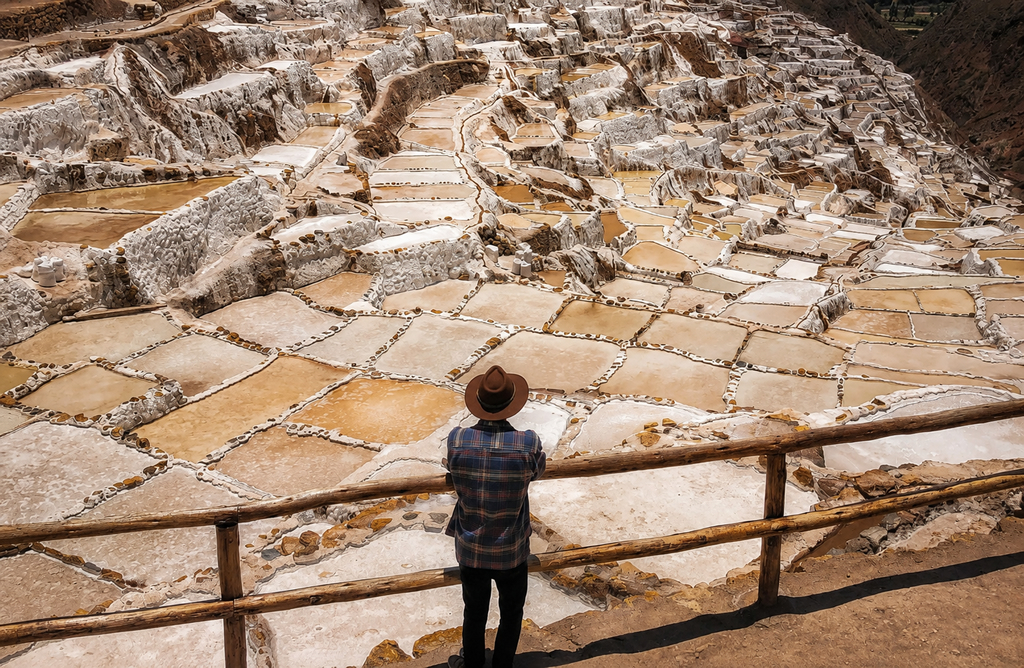
Salineras of Maras is among the most spectacular sights in Cusco area, with thousands of salt pans that have been used for salt extraction since Inca times.

Since pre-Inca times, salt has been obtained in Maras by evaporating salty water from a local subterranean stream. The highly salty water emerges at a spring, a natural outlet of the underground stream. The flow is directed into an intricate system of tiny channels constructed so that the water runs gradually down onto the several hundred ancient terraced ponds.

Almost all the ponds are less than four meters square in area, and none exceeds thirty centimeters in depth.

All are necessarily shaped into polygons with the flow of water carefully controlled and monitored by the local workers.

Maras Salt Ponds

The Salt Mines of Maras are located 50 km in the northeast of Cusco city, at an altitude of 3,200 m.a.s.l.  The salt mines themselves are constituted by a set of approximately 4,500 salt wells placed in the form of stepped terraces in the middle slope of the hill Qaqawiñay.

This hill has slopes of 20 degrees of inclination to the bottom of the gorge on the left bank of the Salineras stream, with dimensions that vary around 5 linear meters, occupying a total area of approximately 1.5 to 2 hectares (Silva Guerra, 2006:).The terraces are formed by retaining walls of irregular stone seated with mud mortar, forming dikes that delimit the wells as small reservoirs of approximately 5m2. The conduction system of the saltwater from its catchment, is done through a main irrigation channel, which branches out into several small channels that feed the wells. The conduction and maintenance of the saltwater channel is associated with a path that is assumed to be of prehispanic origin due to its layout and characteristics.

This technology is similar to that of irrigation in prehispanic agricultural terraces characterized by the conduction and equitable distribution of water. The upper part of the salt mines crosses a road, from the prehispanic time, in the direction of the K’arachaka (Half Moon) bridge. From this road, there are several branches for the circulation between the wells. The set of wells and canals is in perfect continuous operation from the pre-Inca period to the present (Silva, 2007:18).

It is notorious the very particular effect and its great landscape value that the set of stepped wells produces, being perceived as the total of numerous white, creams or browns squares, arranged with particular order.They followed the topography of a slope of the Qaqawiñay hill, most of them looks flooded with water and other dry with salt on its surface, where the particular configuration of the set and the chromatic contrast with the natural environment provided with low shrub vegetation stand out.The salt production takes place once a month and is marked by the calendar of the seasons of the year. Thus, in the dry season (from May to October) the accumulation of salt is fast, there is greater production, and a better quality of salt is obtained with a “white or pink color that characterizes commercially this salt”.
In the salt extraction and elaboration process predominate the traditional social relationships of communitarian type, keeping till the present its traditional way.

When and how to book Salinas de Maras

The best time to visit in in the dry Season (from March to October) and is the most recommended.  If you prefer  an organized tour,  in every Cusco travel agency you will find offers for a Day Tour of the Sacred Valley, that include a visit to the Salineras de Maras or organized Tours to visit Maras and Moray (Group tours).

The area of Maras is located near to the Sacred Valley of the Incas; which makes it perfect for personalized activities in private Tours from Cusco or from Sacred valley such and Full day  bikes excursions, hikings and customized tours with visit to Moray remains and then keep traveling to Machu Picchu.

The entrance fee to Maras is S/. 7 soles per persons (USD2,5) :)Curious about this magnificent destination?

Come to Perú!

Giardino Team!@Giardinotoursperu

#ItravelwithGiardino ‘OnetripManyExperiences[vc_gmaps link=”#E-8_JTNDaWZyYW1lJTIwd2lkdGglM0QlMjIxMDAlMjUlMjIlMjBoZWlnaHQlM0QlMjI0ODBweCUyMiUyMHNyYyUzRCUyMmh0dHBzJTNBJTJGJTJGcG9seS5nb29nbGUuY29tJTJGdmlldyUyRjJ4eE0wNllDdGQtJTJGZW1iZWQlM0ZjaHJvbWUlM0RtaW4lMjIlMjBmcmFtZWJvcmRlciUzRCUyMjAlMjIlMjBzdHlsZSUzRCUyMmJvcmRlciUzQW5vbmUlM0IlMjIlMjBhbGxvd3ZyJTNEJTIyeWVzJTIyJTIwYWxsb3clM0QlMjJ2ciUzQiUyMHhyJTNCJTIwYWNjZWxlcm9tZXRlciUzQiUyMG1hZ25ldG9tZXRlciUzQiUyMGd5cm9zY29wZSUzQiUyMGF1dG9wbGF5JTNCJTIyJTIwYWxsb3dmdWxsc2NyZWVuJTIwbW96YWxsb3dmdWxsc2NyZWVuJTNEJTIydHJ1ZSUyMiUyMHdlYmtpdGFsbG93ZnVsbHNjcmVlbiUzRCUyMnRydWUlMjIlMjBvbm1vdXNld2hlZWwlM0QlMjIlMjIlMjAlM0UlM0MlMkZpZnJhbWUlM0U=” title=”Maras Virtual”]

2 FacebookTwitterPinterestEmail

More Articles/Más Artículos

  • Colca Canyon Tour: Introducing the awesome Colca Canyon
  • Peru Trip: Altitude mountain sickness and 6 easy tips to avoid it
  • Peruvian Carnivals: Magic, culture & celebration
  • Arequipa Tour: 2 surprising curiosities about this destination!
  • Colca Sour: An unique Cactus cocktail
  • Peru 2 love’s story tellings and myths
  • Enigmatic Sillustani & best way to book a Tour
  • Amazing Tour Maras Salt ponds in Cusco (Virtual)
  • Tips for a Responsible Peru Travel Experience!
  • Colca canyon Travel Guide: 7 Questions about Colca Tours
  • Facebook
  • Twitter

@2021 - All Right Reserved. Designed and Developed by PenciDesign


Back To Top
Giardino Tours Blog
  • Go to Giardino Tours
  • English
  • Español