Top Posts
Cusco Tour: 3 differences between Machu Picchu, Mountain...
Quechua Travel Words: Useful words for a great...
Tour Arequipa: The fascinating stone city of Choqolaqa
Tour Arequipa: Stunning Salinas and Aguada Blanca N.R....
Protecting Our Planet Starts with You – 9...
8 highlights of Arequipa – Tips to enjoy...
FOOD in Arequipa: 8 delicious Dishes that Are...
Embroidery in the Colca Valley a Cultural Heritage...
The interdimensional gate Aramu Muru. Fascination & mystery.
Pacaya Samiria Reserve: A world destination not to...
  • Go to Giardino Tours
  • English
  • Español
Giardino Tours Blog
TRANSFORMING TRAVELS INTO MEMORABLE STORIES
Category:

Travel Tips

FeaturedPeru Great DestinationsTravel Tips

Cusco Tour: 3 differences between Machu Picchu, Mountain & Huayna Picchu

by Giardino Tours February 4, 2025

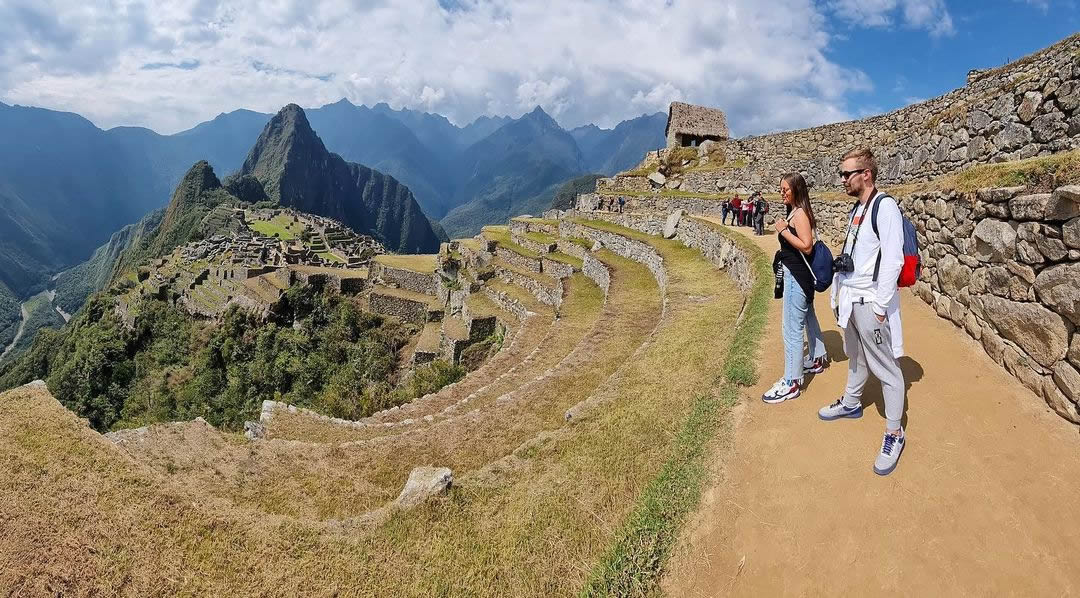
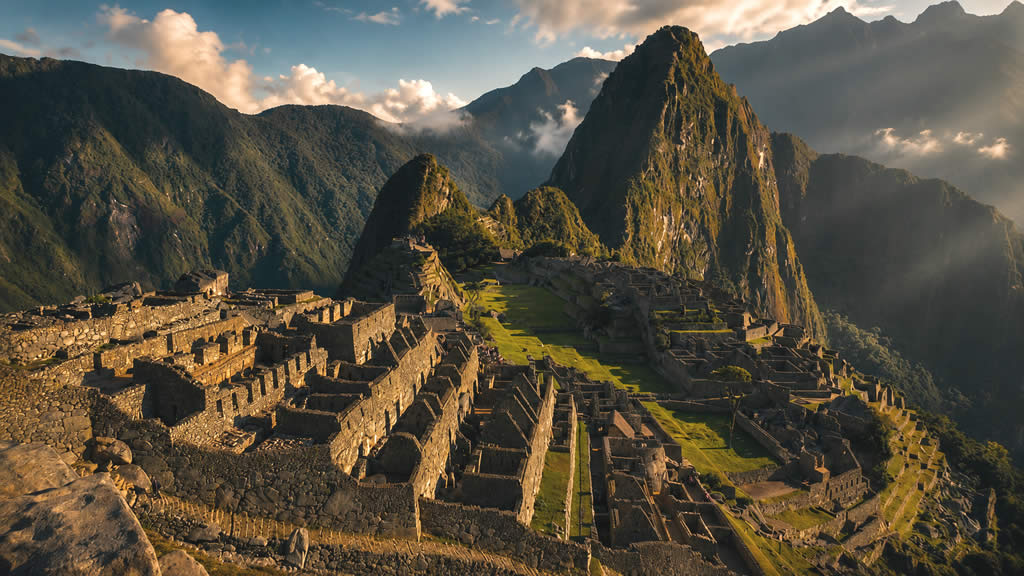
Today there are different concepts about entrances when you want to visit Machu Picchu that oft lead to some confusion to our travelers, here we explain you the differences:[penci_fancy_heading _text_align=”left” p_title=”Citadel or Sanctuary (LLaqta):” turn_on_title=”yes” _title_typo=”font_family:%3A” _title_fsize=”20px” _subtitle_typo=”font_family:%3A” _desc_typo=”font_family:%3A” title_color=”#3cc154″][/penci_fancy_heading]The Citadel or Sanctuary of Machu Picchu, are the Inca ruins itself, this is what we see in all pictures, that have made this Peruvian attraction so famous. There are buses from Machu Picchu Pueblo that take you to the entrance of the Sanctuary, where you will check your entrance ticket according to your booked schedule.
The citadel is located to 2.490 meters high and takes the name of the “Mountain” where it is located; in other words, the name of the “citadel itself“ still unknown.[penci_fancy_heading _text_align=”left” p_title=”Huayna Picchu Peak:” turn_on_title=”yes” _title_typo=”font_family:%3A” _title_fsize=”20px” _subtitle_typo=”font_family:%3A” _desc_typo=”font_family:%3A” title_color=”#3cc154″][/penci_fancy_heading]The famous Huayna Picchu peak is one of the mountains that is located in front of Machu Picchu citadel, and which can be climbed using a path that departs from the Citadel itself.
At the top there are some ruins and you will have an amazing view of the citadel and the area and if you want more, there is also another trail up to the temple of the moon.
This mountain is located to 2,720 mts and is only allows the entry of 400 people per day, in two groups of 200 persons (07:00 AM and 10:00 AM). For this reason the tickets must be bought in advance. The ascent takes approximately two hours, and the trail to the temple of the moon, or the Great Cavern, are about 4 hours.

Some facts:

  • It is known as the ‘Young Mountain’. Walking along its trails is recognized as one of the most incredible short walks on the planet.
  • The trails are steep and narrow. They were built on one side of the mountain. They can be terrifying for people afraid of heights.
  • If you suffer from vertigo or acrophobia, it’s best to avoid to walk to this mountain.

[penci_fancy_heading _text_align=”left” p_title=”Machu Picchu Mountain:” turn_on_title=”yes” _title_typo=”font_family:%3A” _title_fsize=”20px” _subtitle_typo=”font_family:%3A” _desc_typo=”font_family:%3A” title_color=”#3cc154″][/penci_fancy_heading]Now you know that the “Inca city” is located on the mountain of Machu Picchu at 2,490 meters; but the mountain has an altitude of 3.061 meters. So now you have the possibility to walk to the TOP of the Mountain “Machu Picchu”.
From there the view is also spectacular and has the big advantage that allow 600 persons per day in 2 time schedule 09:00AM and 10:00AM, still not so popular as Huayna Picchu peak so the tickets do not run out so fast; but an incredible view is guaranteed.[penci_fancy_heading _text_align=”left” p_title=”¿Aguas Calientes = Machu Picchu Pueblo?” turn_on_title=”yes” _title_typo=”font_family:%3A” _title_fsize=”20px” _subtitle_typo=”font_family:%3A” _desc_typo=”font_family:%3A” title_color=”#3cc154″][/penci_fancy_heading]Aguas Calientes, currently known as Machu Picchu Pueblo; It is the nearest town to the ruins. This town can only be reached by train or by walking. This is the town where the trains arrive from Cusco or Ollantaytambo for the tour to Machu Picchu, there are hotels for visitors, restaurants and you can do some shopping.
Now! From Machu Picchu Pueblo are the departures of the buses that drive up to Citadel, This drive takes about 20 to 25 minutes. Machu Picchu Pueblo is located at 2,040 meters and its name before (Aguas Calientes = Hot water) comes from the hot springs that are close to the town.

Machu Picchu:

The citadel of Machu Picchu is maybe the main reason that thousands of visitor travel to Peru and also appears in the top destinations list by U.S. News.

It is ranked as the eighth best place to visit. Machu Picchu was discovered by Hiram Bingham in 19, the ruins are today part of the UNESCO World Heritage sites, and since 2007 is one of the New Seven Wonders of the world.
2 FacebookTwitterPinterestEmail
sustainabilityTravel Tips

Protecting Our Planet Starts with You – 9 Things You Can Do

by Giardino Tours January 27, 2024

Protecting our Planet starts with you!

“Throughout the time, man enjoy and took the necessary space to be able to coexist with the nature, currently things are different and it is necessary to make a “space” for nature in the world of man”

This week we commemorate mother earth. However, there is not much to celebrate. Despite the fact that, as an indirect effect of the pandemic, the cleaning of the beaches, the contamination of fossil residues and the care of wild fauna were a bit better compared to the pre-pandemic time, now we observe that threats to the environment continue and we are generating new ones.

Here you will find 9 easy tips that you can add to your daily routine to Protecting Our Planet.

1.- Do not use face masks unnecessarily

We know that in the current situation our health is important, however the huge use of disposable surgical masks leaves a large amount of waste. We must therefore try as much as possible to use reusable masks.

Surgical masks are made of polypropylene non-woven fabric, produced from ethylene, which is a chemical compound derived from petroleum or natural gas.

That’s why they take around 450 years to decompose.Among the recommendations published by the main national and international health authorities, in GTF M. Camps we want to highlight the following:

  1.  The masks should be left in a safe place for 24 hours before throwing them into a garbage can, for example, inside a waste bag. This serves primarily to prevent anyone, who has to handle garbage, to get infected.
  2. It is Important that before placing the surgical masks in a garbage container, that you cut the two rubber bands that hold the mask around the ears. In this way you will be able to avoid that, in an unwanted way, if this mask ends up in our seas and oceans, it does not behave like a net-trap for the animals.

2.- Save on electricity consumption

You can start by unplugging all electrical appliances when you don’t use them or you finish using them, for example, unplugging your cell phone or laptop charger when the battery reaches 100 percent, unplugging the microwave after heating food, and even unplugging the fan, the television etc … Remember that plugged-in appliances continue to consume electricity and it is important Protecting Our Planet.

Another action that will help you take care of the environment is to turn off the lights when you leave a room. Also, you should check that when you leave the house there are no lights on. It is important that you change all the bulbs in your house for ones that are low energy consumption

3.- Recycle and educate about garbage

Take the time to separate the garbage and especially we must create a culture of environmental care at home.

For this reason, we must have a discipline to separate waste into: those that can be reused or reinserted into the production circuit (paper, cardboard, glass, plastics, etc.) and on the other hand those elements that cannot be reused (broken glass, napkins, sanitary waste, etc.).

Also It is also important to educate ourselves about this problem. When you expand your own education, you can help others understand the importance and value of our natural resources and Protecting Our Planet.

4.- Buy food from your area.

The transport of food from one area to another pollutes a lot. Whenever you can, consume products from nearby areas, your city or your region that will help also to Protecting Our Planet.

 5.- Save and Take Care of Water.

Water is a natural resource that cannot be wasted. In this sense, there are small actions that can help you take care of it such as taking a 5-minute shower, recycling rainwater, turning off the tap while brushing your teeth or washing dishes, can make a huge difference.

Likewise, it is very important not to throw food, oil residues and cleaning products into the house pipes (kitchen, bathroom, etc.), to prevent that the water get contaminated.

It is important to check that in your home all pipes work well.

6.- Plant trees and prepare your urban garden

The best hobby in the world is to be in tune with nature and what better than to start in your own place, planting trees if you have a large garden or planting potted plants if you don’t have much space. The important thing is to enjoy this hobby giving life to the planet and more oxygen to your place.

Another way is to start your own garden and enjoy to obtain your own food, you will feel a joy and mixed feelings when you see how the fruit of your dedication is growing and this hobby not only helps the planet but also your health because your products at home are the best guarantee of not having additives such as hormones or pesticides.

In addition, from your garden you can create your own compost. This brings a series of benefits to your garden, providing more nutrients for your plants to grow strong and reducing the generation of garbage.

7.- DO NOT buy single-use products – Buy reusable ones

Always buy products that you can reuse. We must end with the use and throw away life style.  The world is not disposable.

Buying single-use items such as disposable napkins, plates and cups, as well as plastic bottles and containers, makes the planet sick and generates garbage which is a huge problem.

Use reusable cloth bags or biodegradable bags instead, and if for any reason you have a plastic bag, don’t throw it away, keep it in your car or purse, etc., And try to use it as much as possible. Remember the idea is not to generate more garbage and plastic production.

8.- Be creative and Reuse materials

The best way to Protecting Our Planet is also in the power of our imagination.

With a little creativity you can reuse and give new life to the most varied materials.

Each of us can find the best way to reuse and recycle. How about and using this challenge to use it as a game at home for every weekend?.

Finding and creating a new way of using something that you thought to throw away is also the best way to Protecting Our Planet.

9.- Practice sustainable tourism

If you love to travel the world, do sustainable tourism. This is one of the actions to protect the environment with which you can venture through the 5 continents respecting the environment that surrounds you and learning to be a Responsible ecological traveler.

It is important that you travel with hotels or travel agencies that practice or have sustainability as a mission of the company, that you know their sustainable activities, perhaps being able to volunteer, that they have recognized certifications, etc.

Let’s together Protecting Our Planet . We don’t have a Planet “B”
In this beautiful home called Earth, there are the most indescribable landscapes, that surely, we all want to keep enjoying.  It is up to us to maintain its beauty.

The change begins in our homes. Let us be responsible citizens and remember that we all need our mother earth.

Giardino Tours – Blog

#ITravelwithGiardino #OneTripManyExperience #Safetravel

Our Activities and Volunteering:

[vc_gallery interval=”3″ images=”2926,2931,2895,2925,2932,2894,2898,2900,2924,2930,2933″ img_size=”full”]Check these usefull links:

Peru Packing List post Covid-19: 5 Items that You Need to take to your Peru Trip

Tips for a Responsible Peru Travel Experience!

4 FacebookTwitterPinterestEmail
Peru Great DestinationsTravel Tips

8 highlights of Arequipa – Tips to enjoy Peru’s prettiest city

by Giardino Tours January 25, 2024

Arequipa Tour

In 1500s, the Hispanic-Peruvian chronicler Garcilaso de la Vega wrote the story of how Inca King Mayta Capac stopped his troops in the valley of the Chili river dazzled by the beauty of the place saying “Ari qepay” – That in Quechua language means something like “yes, You can stay” or “stay here”. With those words, said de la Vega, the city of Arequipa was born.

Well, we do not want to exaggerate being to much romantic, but for sure we have understood the symbolic message of this story.

Arequipa is not a city to pass quickly on the route during your trip to Peru; once here you are going to say “let’s stay here”

1.- Enjoy the gorgeous historical centre of Arequipa

Arequipa’s main attraction is unequivocally the magnificent historical centre, which owes its beauty and significance to more than just its impeccable off-white facades.

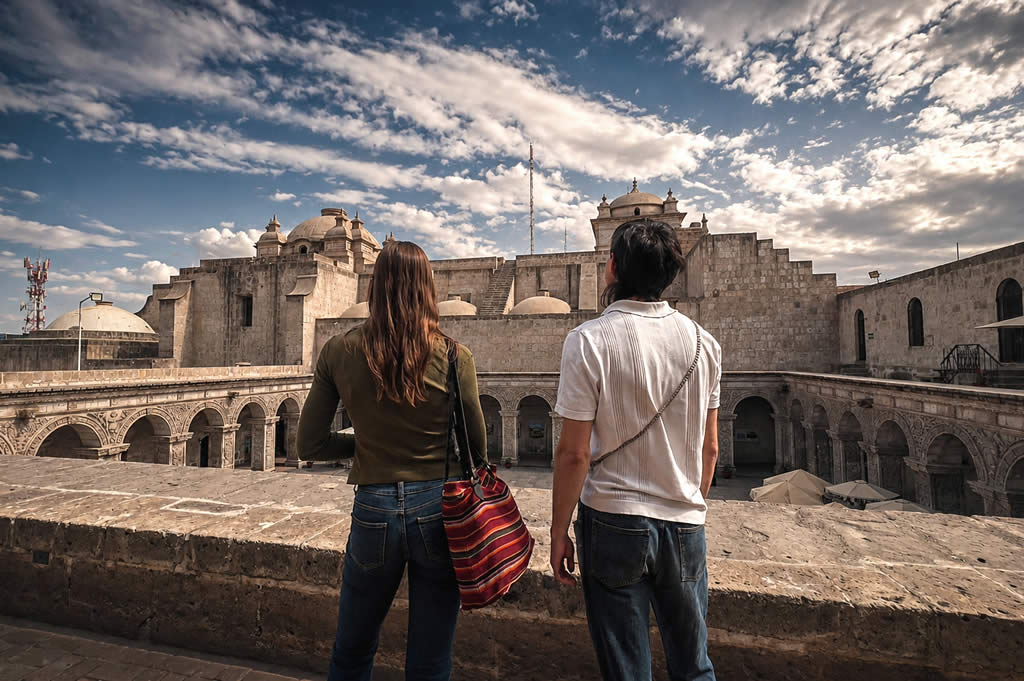
The architectural style of most structures, built in volcanic rock, shows an unprecedented and harmonious blend of European and native indigenous elements and techniques, which resulted in a spectacular display of exquisitely-decorated mansions, courtyards, cloisters and churches.

Peruvian architect and writer Hector Velarde couldn’t have described it better: “the architecture of Arequipa is all about the marriage between conqueror and conquered, it’s a true fusion. It is the perfect colonial architecture, maybe the most complete of all Mestizo-American architectures”

  • Plaza de Armas (The best photos are during Sunset)
  • Casa Tristan del Pozo
  • Casa Moran
  • Plaza San Lazaro
  • Plaza and Church San Francisco.
  • Church and cloister of La Compañía de Jesus
  • Streets of Arequipa City center that close into the Main Square

2.- Mundo Alpaca

If you think that to visit “Mundo alpaca” is only a shopping store with live alpacas, it is wrong! Mundo Alpaca it’s actually a small and very well-organized “Alpaca Boutique and Museum”.

Live the experience of the “Alpaca and Vicuña” and learn about the tradition, process and history of its fibers and the wonderful textiles of the Andes.

Here you will not only interact with the Alpacas but also you will travel to the past through the textile history that you will appreciate in its ” Museo Textil Pre-Columbian Amano – Michell”, which exhibits valuable textile pieces from pre-Columbian cultures.

To close the experience you will visit the Boutique where you can find excellent and top quality products for you and your family.

3.- San Camilo Market

Take your time to stroll down the different alleys, which are neatly organized by product type. You will be amazed by the quantity of products and colors. Walk through the alleys of herbs, meats, breads, fruits, cheeses etc… Walk through the juice alley and taste a good glass of fresh juice (the best juices we’ve ever tasted) and on the second floor visit the sale of flowers, textiles and also look some restaurants for locals.

Here you will discover the huge variety of potatoes that Peru offers.

Do you know that Peru has more than 3,500 varieties of potato, the largest in the world, and there are more than 700,000 families that live from its cultivation in 19 producing regions?

4.- Walk to the Yanahuara scenic lookout

For a wonderful view of this city and its volcanoes, there is no better place than the Yanahuara Lookout. On a clear day (which in Arequipa is almost 300 days a year) you will have photos of the city and its volcanoes as a postcard, from some elegant arches made arches made from the same volcanic rock used in the historical city center (Sillar).

Note that the arches have some inscriptions, which are quotes from famous Arequipan writers.

Take time to explore the Plaza. Church and some close streets and get in the Plaza a delicious “Queso helado” a kind of Traditional ice cream of this city.

5.- The Recoleta Convent

Only a 10-minute walk from the Plaza de Armas crossing the Río Chili over pleasant Puente Bolognesi on the way to Yanahuara, you will find the Recoleta convent museum.

It was founded in 1648 by Franciscan friars and rebuilt after many earthquakes. The peaceful Franciscan convent contains impressive cloisters with sillar columns, patios and lovely gardens.

Bibliophiles will delight walking around the Convent’s huge library, which contains more than 20,000 dusty books and maps; including rare published texts from the 15th century. The library is open for supervised visits, just ask at the entrance if you visit.

The convent museum includes several collections that are good to visit. One room is a collection of pre-Inca culture artifacts, including funereal masks, textiles, and totems; in another are mummies and a series of paintings of the 12 Inca emperors. Also is interesting to observe that the missionaries were understandably fascinated by prehistoric-looking fish, crocodiles, piranhas, and the clothing of indigenous communities.

6.- Santa Catalina Monastery

This incredible monument is located in the historic center of Arequipa. It served as a cloister for Dominican nuns from the 16th to the 18th centuries, and still houses a small religious community today.

The monastery occupies a territory of 20,426 m2 and was opened on September 10, 1579, just 39 years after the foundation of Arequipa city.

The whole complex is built from volcanic ashlar stone “Sillar” and is organized into cloisters, houses, patios, square, a gallery and a small chapel.

This monastery shouldn’t be missed!

7.-  Santa Teresa Monastery

This gorgeous 17th-century Carmelite convent is open to the public as a “living museum”; so called because several of the objects and rooms continue to be used as it was over 3 centuries ago.

The colonial-era buildings are justifiably famed for their decorative painted walls and restored rooms filled with priceless objects of art, murals, precious metalwork, paintings and other historical artifacts.

The museum is located in the city centre of Arequipa, a few bloks from the main square on calle Melgar 303.

PS: You must visit the Candy Shop: where you can taste cakes and desserts made daily by the nuns with ancient recipes. Also in the shop you will Souvenirs and craft items such as parsley and roses soap made from the roses of the monastery, Apple Vinegar and Bee Honey.

This monastery is also another gem of Arequipa!

8.- The Library  “Mario Vargas Llosa.”

Mario Vargas Llosa was born in Arequipa, Peru in 1936. He is the author of fifteen novels, including La Ciudad de los Perros (The Time of the Hero) (1963), La casa verde (The Green House) (1966), and La guerra del fin del mundo (The War of the End of the World) (1981).  He has also written three short story collections, including Los jefes (The Leaders) (1959), as well as several collections of essays. His books have been translated into more than thirty languages.

In 2010, Vargas Llosa was awarded the Nobel Prize for Literature.

So, there is no doubt that Arequipa city is proud of Its son, who now resides in Spain.

The Mario Vargas LLosa library is located in a Colonial house in the historical center of Arequipa and offers 7,900 titles ranging from fiction, history, social sciences and magazines, but the number keep growing.

“Through books we can see what we don’t have and we would like to have, thanks to books we will fight prejudice and see how absurd and irrational differences are. Literature makes us more human, makes us more reasonable, literature makes us more free, breaks borders,” – Mario Vargas Llosa on the inauguration of the Library.

What do you think?

We invite you to Discover Arequipa and live the experience of the White City of Peru

Giardino Tours – Blog

#ItravelWithGiardino #OneTripManyExperiencesInteresting related links:

Tour Arequipa: The Cathedral & 5 curious facts that you should know

Tour Arequipa: The fascinating stone city of Choqolaca

Tour Arequipa: Stunning Salinas and Aguada Blanca N.R. & the Best way Visit It[vc_gmaps link=”#E-8_JTNDaWZyYW1lJTIwc3JjJTNEJTIyaHR0cHMlM0ElMkYlMkZ3d3cuZ29vZ2xlLmNvbSUyRm1hcHMlMkZlbWJlZCUzRnBiJTNEJTIxMW03MCUyMTFtMTIlMjExbTMlMjExZDc2NTUuMTY0OTU5Nzc5OTUlMjEyZC03MS41NDE2MjY1MjM3NTM0JTIxM2QtMTYuMzk1MjE3ODA0NzIwOTUlMjEybTMlMjExZjAlMjEyZjAlMjEzZjAlMjEzbTIlMjExaTEwMjQlMjEyaTc2OCUyMTRmMTMuMSUyMTRtNTUlMjEzZTIlMjE0bTUlMjExczB4OTE0MjRhNTlmZmFlMjk5OSUyNTNBMHhjNDE5ZjQ5ZDFmOWNkMjcwJTIxMnNQbGF6YSUyNTIwZGUlMjUyMEFybWFzJTI1MjBBcmVxdWlwYSUyNTJDJTI1MjBBcmVxdWlwYSUyNTJDJTI1MjBQZXJ1JTIxM20yJTIxMWQtMTYuMzk4ODA4NCUyMTJkLTcxLjUzNjkwNTYlMjE0bTUlMjExczB4OTE0MjRiNGRiM2FiMTM0NSUyNTNBMHhhYTNkNjY1NWExZTUxNzE0JTIxMnNNZXJjYWRvJTI1MjBTYW4lMjUyMENhbWlsbyUyMTNtMiUyMTFkLTE2LjQwMzAyNTElMjEyZC03MS41MzQ5NjQzOTk5OTk5OSUyMTRtNSUyMTFzMHg5MTQyNGE1MTY5NmIxNWU3JTI1M0EweGFmOGMwNjRiZDVlNjliMDIlMjEyc1NhbnRhJTI1MjBUZXJlc2ElMjUyQyUyNTIwQXJlcXVpcGElMjUyQyUyNTIwUGVydSUyMTNtMiUyMTFkLTE2LjM5NjU5MDUlMjEyZC03MS41MzE4OTQxJTIxNG01JTIxMXMweDkxNDI0YTRmZTFhZTJkODUlMjUzQTB4ODRhYTFjNzU5M2YxM2NjZSUyMTJzTXVuZG8lMjUyMEFscGFjYSUyMTNtMiUyMTFkLTE2LjM5MjkyMzElMjEyZC03MS41MzU0NTM5JTIxNG01JTIxMXMweDkxNDI0YjFkY2Q5ZDAzMjElMjUzQTB4OGQ4N2Y0ZTkzYTQzOGU3ZSUyMTJzWWFuYWh1YXJhJTI1MkMlMjUyMFlhbmFodWFyYSUyNTIwRGlzdHJpY3QlMjUyQyUyNTIwUGVydSUyMTNtMiUyMTFkLTE2LjM4NzQxMDYlMjEyZC03MS41NDE5Mjk0JTIxNG01JTIxMXMweDkxNDI0YTUwNThjYTU5YTklMjUzQTB4NjIyZTBhOWQ1MGYxZThlZCUyMTJzQmlibGlvdGVjYSUyNTIwUmVnaW9uYWwlMjUyME1hcmlvJTI1MjBWYXJnYXMlMjUyMExsb3NhJTIxM20yJTIxMWQtMTYuMzk1NTk3MiUyMTJkLTcxLjUzNDkxODglMjE0bTUlMjExczB4OTEwNzM3ZDk0YTg0MDZiZCUyNTNBMHg2OWY3NWFkOWJkMzA1OTAlMjEyc1NhbnRhJTI1MjBDYXRhbGluYSUyNTIwTW9uYXN0ZXJ5JTIxM20yJTIxMWQtMTYuMzk1MjgyODk5OTk5OTk4JTIxMmQtNzEuNTM2NzkwNzk5OTk5OTklMjE0bTUlMjExczB4OTE0MjRhNWU5ODZhOTA1MSUyNTNBMHgyZjYwNGRlYTk1YmM2MjlmJTIxMnNNb25hc3RlcmlvJTI1MjB5JTI1MjBNdXNlbyUyNTIwZGUlMjUyMGxhJTI1MjBSZWNvbGV0YSUyMTNtMiUyMTFkLTE2LjM5MzkwMzIlMjEyZC03MS41NDE0Nzg1OTk5OTk5OSUyMTRtNSUyMTFzMHg5MTQyNGE1OWZmYWUyOTk5JTI1M0EweGM0MTlmNDlkMWY5Y2QyNzAlMjEyc1BsYXphJTI1MjBkZSUyNTIwQXJtYXMlMjUyMEFyZXF1aXBhJTI1MkMlMjUyMFR1dHVydXR1JTI1MkMlMjUyMEFyZXF1aXBhJTI1MkMlMjUyMFBlcnUlMjEzbTIlMjExZC0xNi4zOTg4MDg0JTIxMmQtNzEuNTM2OTA1NiUyMTVlMCUyMTNtMiUyMTFzZW4lMjEyc2RlJTIxNHYxNjE3MTA3ODY5NjQzJTIxNW0yJTIxMXNlbiUyMTJzZGUlMjIlMjB3aWR0aCUzRCUyMjYwMCUyMiUyMGhlaWdodCUzRCUyMjQ1MCUyMiUyMHN0eWxlJTNEJTIyYm9yZGVyJTNBMCUzQiUyMiUyMGFsbG93ZnVsbHNjcmVlbiUzRCUyMiUyMiUyMGxvYWRpbmclM0QlMjJsYXp5JTIyJTNFJTNDJTJGaWZyYW1lJTNF”]

4 FacebookTwitterPinterestEmail
Culture & TraditionsFeaturedTravel Tips

FOOD in Arequipa: 8 delicious Dishes that Are Worth a Trip to Arequipa, Peru

by Giardino Tours July 7, 2021

FOOD in Arequipa: 8 delicious Dishes that Are Worth a Trip to Arequipa, Peru

In January 2015 the UNESCO recognized Arequipa city as one of the 66 World’s creative cities in gastronomy.

The certificate was delivered by the Unesco representative in Peru, Ernesto Fernández, who highlighted that Arequipa city is one of the 66 cities in the world that were declared creative cities in gastronomy.

According to the Arequipa Picantera Society (Picanteria is the name of traditional restaurants in Arequipa), the number of dishes that this region offers would reach about 194 (40 entrees, 22 types of soups, 70 stews and 62 desserts and drinks). For this reason, this city has earned a deserved culinary fame, both among locals and travelers.
Without a doubt, Arequipa’s cuisine has in the “Picanterías” the sanctuaries of knowledge and flavor, which treasure centuries of tradition, creativity and innovation because they are the authentic guarantors of the future of this emblematic Peruvian regional cuisine.
If you are planning to visit Arequipa and you don’t want to miss dishes that will delight your palate, we show you this list with some of our typical dishes. – Enjoy them!

1.- El Rocoto Relleno (The stuffed Rocoto).

One of the most emblematic dishes of Arequipa is “Rocoto relleno”

This is a type of stuffed pepper. But unlike other recipes that are based on sweet peppers, this dish uses ROCOTO, a red pepper that is ten times hotter than the famous jalapeño.

These rocotos are so spicy that to reduce the itchiness they are cooked in water and vinegar, however this does not take away totally the spicy flavor that also contains a first-class taste and aroma.

The filling is based on a mixture of meat, butter, cream and nuts. It is also often topped with a slice of melted cheese. The most typical thing is that it is accompanied by a piece of potato cake (Pastel de papa).

2.- El “Americano”  (The American)

The “American” is a very traditional dish in Arequipa and although currently it is presented in many forms and combinations in the traditional Picanterías, the original recipe presents a conjunction of 4 hot spices: a portion of rice, meat stew, pumpkin chili pepper, brambles of legs and a torreja, served in a single plate one after another.

The delicious Arequipeño meat stew is one of the most common dishes and can be prepared from various types of meat, but the one served in the “americano dish” is beef, onion, carrot, potatoes and red chili, accompanied with white rice.The stew can also be replaced by the locro (a spicy made with mash potatoes). Nowadays the American is also served with a stuffed hot pepper or a noodle cake.

3.- Chupe de Camarones  (Shrimp great soup).

This soup prepared with shrimp is a very powerful dish and with a great taste.

It is based on Shrimp accompanied by onion, tomato, beans, garlic. Yellow potatoes, corn, boiled eggs, rice, cheese, and milk are added to the soup.

This dish is typical throughout the coastal area of Peru; However, the Arequipeño Chupe de camarones is simply the king of all of them.

4.- Soltero de Queso (Chees fresh salad)

This entrée is used also as a garnish.

This salad is based in fresh cheese, hot peppers, onion, olives, beans and tomato. The most common is to find this typical dish seasoned with vinegar, parsley, salt and pepper.

This “salad” is a popular main dish for dinners in Arequipa and sometimes it is accompanied by boiled potato slices.

5.- Adobo Arequipeño

Adobo arequipeño, also known as adobo de chancho, is a traditional dish from Arequipa.

Normally it is tha Sunday brunch dish at Arequipa’s local picanterías. Amazing taste and very popular among the locals and visitors.

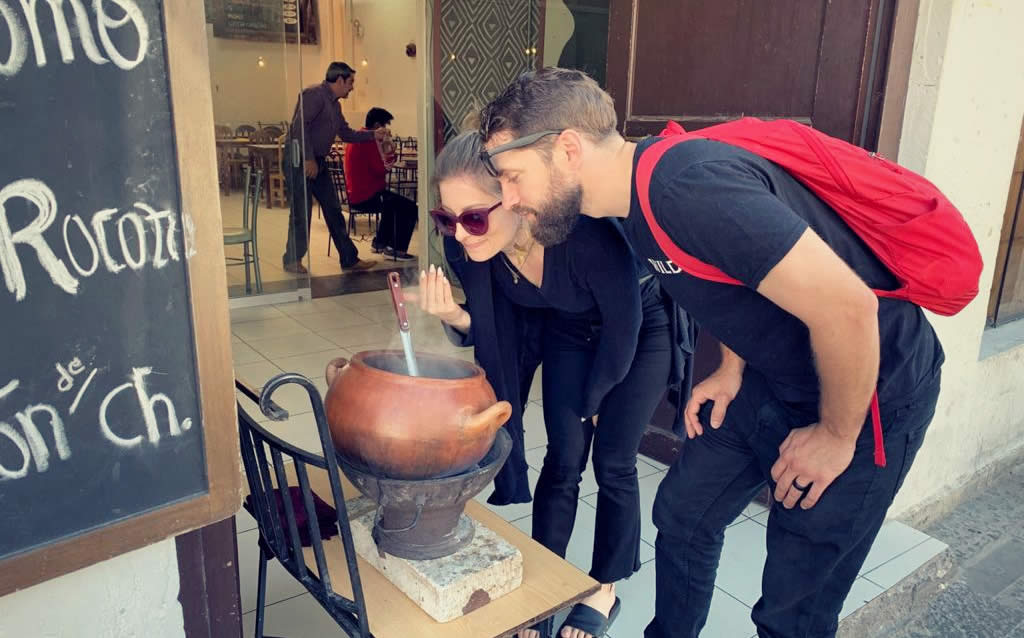
How maybe you already know, the term “adobo” is derived from the Spanish word adobar, meaning marinade and you will find many adobos around the world. But Arequipa’s adobo is quite different from the other adobos in the world.The arequipeño dish is a soupy pork stew, slow-simmered with chicha de jora, spicy rocoto pepper, aji panca, garlic, onions, oregano, cumin, and other herbs and spices. It is made in a clay pot to take advantage of all its flavor and It is cooked overnight.

Currently in the Cayma district it is possible to enjoy this dish every day in its famous picanterías (typical food establishments) Don’t forget to ask also for your “pan de tres puntas” (Bread with 3 cornes).

6.- Ocopa Arequipeña – Spicy traditional sauce

Ocopa Arequipena is a simple dish consisting of cooked and sliced potatoes covered in a Ocopa sauce.

Yes! IT IS THE SAUCE that gives it that special touch to this dish, since it is made from yellow hot pepper, onions, garlic, huacatay (a typical local herb), roasted peanuts, walnuts, cheese and breadcrumbs.

Bu, what make the big different to the taste? – It is the Huacatay (called black mint) is an endemic herb from Peru, it belongs to the mint family, I could say that it has a touch of bitterness like mint, but it has simply a unique flavor and aroma.

🙂 Boiled eggs, whole olives and lettuce leaves can be added to the unique “Ocopa arequipeña”.

7.- El Escribano – “The writer or Notary”

“El Escribano” is considered the ancestor of many dishes in Arequipa and its name comes from the tradition of the type of diners.

It is said that the origin of this dish dates back to colonial times. The judges, lawyers and especially the “Escribano (or writer)”, who exercised the functions of our current Notaries, went to the picanterías to eat something very quickly before the next session or at the end of their daily workday.

Sometimes they arrive to early or to late and did not always find food ready, so the spicy dishes would put on the table with a little of what was in all typical Arequipa cuisine; potatoes, tomatoes and of course the spicy rocoto, making sure that is very spicy so the diners become thirsty and consumed a lot of chicha (Traditional drink), while the main meal arrived.They say that some of the diners came up with the idea of mixing everything they had on hand and made their version of salad and so, this improvised dish, became part of the menu in the picanterías. As most of the diners were Notaries, they baptized it with that name, although it was also served to other members of the legal service and later to the general public.

8.- La Chicha de Guiñapo (Traditional drink)

As you’re traveling in Peru and visit traditional restaurants you may encounter a interesting drink called “Chicha de Jora”. This beverage is dating back thousands of years. Chicha is a timeless and iconic drink that every visitor to Peru should taste at least once.

La chicha de Jora is made similarly to other types of beer: by germinating corn, extracting malt sugars, boiling the wort, and then fermenting.

BUT…. In Arequipa you will find another version of the Chicha and this is the “Chica de Guiñapo”.

Chicha de guiñapo is the signature variety of Arequipa and uses a special type of maize (Purple) which only grows in that region. It is fermented for a couple of days, which gives it a low alcohol content of around 2-3%.

The taste is light and sweet, and it so perfect to any of of the spicy food of the unique Arequipa gastronomy.[vc_zigzag]

And do you get curious? We got to open your appetite?


Arequipa is a destination that will fill you with surprises and beautiful experiences, not only not only for its incredible geographical areas, parks and culture heritage, but will also be a feast for the good palate.
visit Arequipa in peru
We are waiting for you!

Giardino Blog

#ITravelwithGiardino #OneJourneyManyExperiences


Other links:

Embroidery in the Colca Valley a Cultural Heritage of the Nation

The interdimensional gate Aramu Muru. Fascination & mystery.

Chan Chan mud city, keeps surprising the world!

1 FacebookTwitterPinterestEmail
Colca CanyonCulture & TraditionsFeaturedTravel Tips

Embroidery in the Colca Valley a Cultural Heritage of the Nation

by Giardino Tours June 25, 2021
“On August 17th, 2018, was published on the newspaper “El Peruano” the knowledge and practices associated with embroidery in the Colca Valley a Cultural Heritage of the Nation”

“The recognition was granted for its important technical richness, historical, traditional and artistic value of the iconographic and symbolic contents that they communicate, which are strongly rooted in the Collagua and Cabana worldview, as part of a process of empowering identity of the culture of the population of the Colca valley. ” – Andina 2018

If you are going to visit the Colca canyon, you will be surprised not only by the affection, the spectacular views of the valley, the depths of one of the deepest canyons in the world, the flight of the condor, the joy and gastronomy of its people, but in addition, the parade of colors of their crafts, especially that of their traditional costumes, which represent the identity, love, art and pride of the region.

Undoubtedly it can be affirmed that the craftsmanship of the Colca valley is extraordinary, due to the high development achieved, but very particularly that development is appreciated in its textile art of embroidery.

Through folklore, the Colca people express their culture through symbolic representations related to ecology, their cultural, social, geographical and historical environment and, therefore, are important elements of cultural identity and / or ethnic heritage.

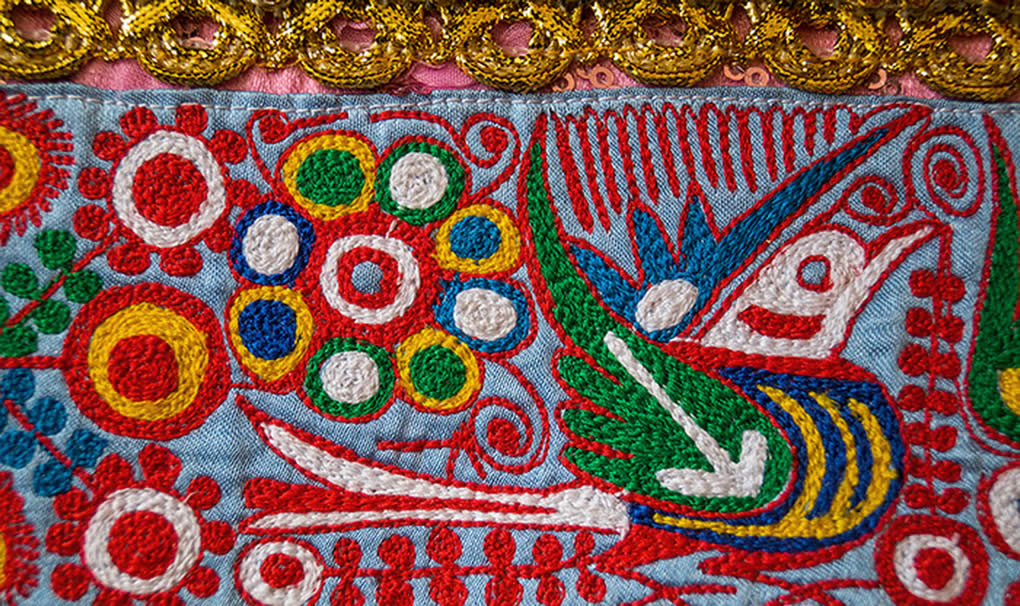
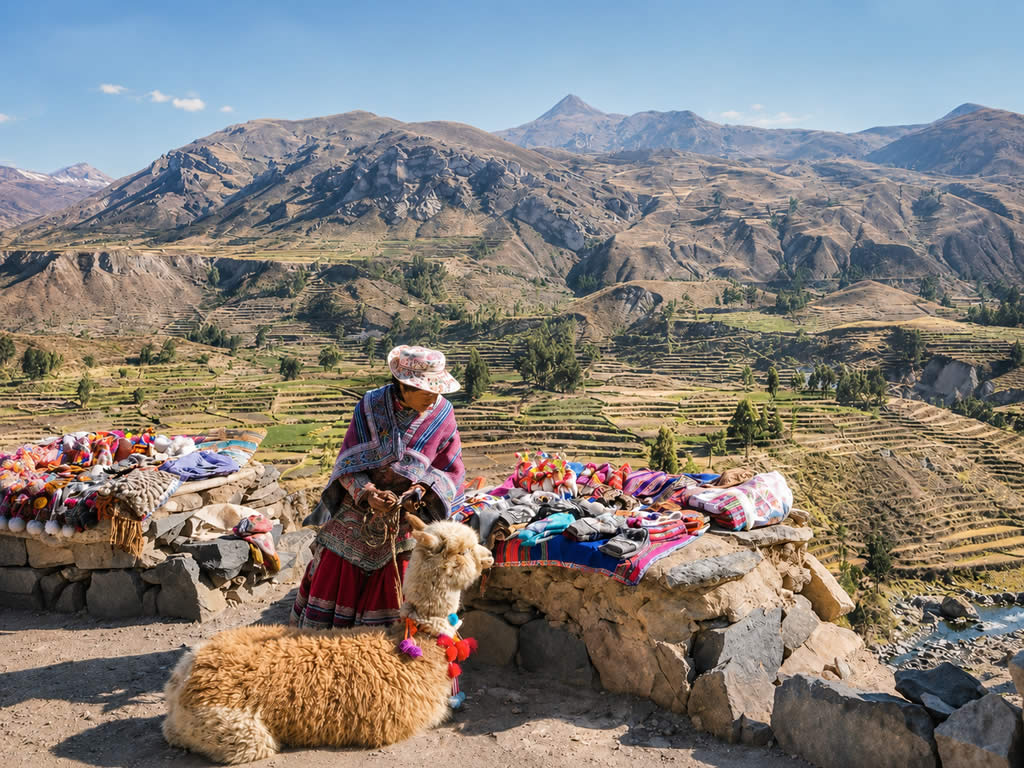
We will find skirts, shirts, hats, blankets, sweaters, chullos (hats), gloves, stockings, scarves, ponchos and other beautifully embroidered fabrics which all reflect the uses and customs of the men and women of Colca valley and their close relationship with nature.

This art also reflects the spirituality of the local people, where the iconography and polychrome, with colorful works, shows the richness and art of the Andean cosmo-vision.

The technique for embroidery work is called the “maquinasca” (sewing machine), which is a widely known technique in the southern Andean region. The artists take the machine and begin to embroider hearts, chamomile and cantuta flowers, sparrows, etc.

In addition, and according to the client’s requirements, other representative products of the region such as “trout” can be added to the work. Sometimes, to give it a more elegant touch, the artists complement their work with industrial fabrics, gold and silver silks and ornaments of different colors.But beyond the craft itself, as a result of a work, at the center of all this is the human factor, the craftsman, who with their artistic hands turns every product into unique pieces in which they express their creativity and imagination but supported by the realities of their daily and ancestral life.

And this is the most prominent factor in the inevitable association of tourism with the crafts of the destinations that we visit.

All type of Crafts offers to the travelers the opportunity to take home “the stories”. Each Souvenir is more than a thing, is the “memory” that transform itself to a open book, that talk to us with all the symbols through which the territories visited murmur magical stories to travelers and their environment.

Today’s traveler not only wants to see places but also to experience them, feel that they are part of their life for a moment, living the culture, their artisans and their manifestations.

The magnificent Colca region has many reasons for you to visit it, but without a doubt, it is also the place that allows you to bend time, find calm and awaken in each one of us the passion for life details.

Write down the “Colca canyon” among your great travel destinations, here you will find thousands of reasons to live the legend! And consider to spend more then one night to enjoy experiences full of emotions, respect and learning.

We are waiting for you!

Giardino Blog

#ITravelwithGiardino #OneJourneyManyExperiences


Other links:

8 highlights of Arequipa – Tips to enjoy Peru’s prettiest city

Peru Packing List post Covid-19: 5 Items that You Need to take to your Peru Trip

Peru Travel Restrictions Covid-19: Updates to Government of Peru

0 FacebookTwitterPinterestEmail
Pacaya samiria national reservePeru Great DestinationsTravel Tips

Pacaya Samiria Reserve: A world destination not to be missed

by Giardino Tours May 27, 2021

Pacaya Samiria Reserve: A world destination not to be missed

¡We have great news this May 2021! 🙂

Pacaya Samiria National Reserve, Peru’s second-largest protected natural area located in Loreto region— once again attracted the interest of the international tourism, as it was chosen as a must-visit destination during the 41st edition of the International Tourism Fair – FITUR 2021 in Madrid, Spain.

This was reported by the Spanish newspaper español La Vanguardia, in an article that explores destinations to travel “despite” COVID-19. This article was wroten by the journalist Lidia Bernaus and published in the  Magazine Lifestyle.

In the publication, the Pacaya Samiria National Reserve is described as “an amazing place that will impress even the most adventurous people.”

[vc_gallery interval=”3″ images=”2969,2970″ img_size=”large”]The Pacaya Samiria National Reserve is the only tourist attraction in Peru and the Americas that stands out as a world’s must-visit destination at FITUR 2021.

The Reserve is a tropical humid forest that can be flooded, and is home of lagoons such as El Dorado, and where up to 1,000 species of animals and more than 900 wild plants live, in addition to 50 native communities that are dedicated to hunting, fishing, and agriculture. Also the tourism as one of their main means of subsistence.

The extension of the reserve represents 1.5% of the Peruvian territory and 6% of the Loreto region, likewise, it is somewhat larger than the area of ​​Slovenia and comparable to 50% of the territory of Denmark, Switzerland, the Netherlands or Costa Rica or the 23% from Portugal, which ensures the ecological and genetic representativeness of the region.

Other destinations mentioned in this article include the volcanic island El Hierro, which is one of the Canary Islands  (Spain), Palma de Mallorca (Spain), the city of Cairo (Egypt), Bohol Island (Philippines), among others.

Clima:

The annual mean temperature ranges between 20 and 33 °C, while the annual mean precipitation ranges between 2000 and 3000 mm.[2] It is advisable to visit the reserve between May and January.[2] The climograph shown here corresponds to the nearby town of Nauta (93 m of elevation).

Tourism:

It is not possible to enter the Pacaya Samiria National Reserve on your own, it is always necessary to acquire the services of an authorized travel agency, a hostel, a cruise (luxury boats) or contact directly with the groups organized within the reserve.

On April 22, 2021, the Minister of Foreign Trade and Tourism, Claudia Cornejo, delivered the Safe Travels International Seal to the Iquitos-Amazon River-Pacaya Samiria National Reserve tourist destination. This was possible thanks to the coordination with the tourism sector, meeting in the Regional Pro Tourism Committee of Loreto.

We keep organizing and preparing ourselves better than ever, so that our travelers will enjoy our country in the safest, most personalized and sustainable way.

We are waiting for you!

GIARDINO BLOG

#OneTripManyExperiences #ITravelwithGiardino


Fuentes:

Mincetur / Turiweb / Wikipedia / Fitur2021


Other links:

8 highlights of Arequipa – Tips to enjoy Peru’s prettiest city

Peru Packing List post Covid-19: 5 Items that You Need to take to your Peru Trip

Peru Trip: Altitude mountain sickness and 6 easy tips to avoid it

0 FacebookTwitterPinterestEmail
FeaturedPeru Great DestinationsTravel Tips

Santa Catalina Monastery: What you need to know for your Tour in Arequipa

by Giardino Tours March 3, 2021
Have you ever heard of a city within a city?
In Arequipa we find a clear example of this, an architectural wonder that captivates those who visit it.

“The monastery of Santa Catalina occupies a territory of 20,426 m2 and was opened on September 10, 1579, just 39 years after the foundation of Arequipa city”

This incredible monument is located in the historic center of Arequipa. It served as a cloister for Dominican nuns from the 16th to the 18th centuries, and still houses a small religious community today.

The complex is built from volcanic ashlar stone and is organized into cloisters, houses, patios, square, a gallery and a small chapel.

History

Viceroy Francisco Toledo granted the licenses for the foundation of the “Private Monastery of Nuns of the Order of Santa Catalina de Siena”, however the foundation was in charge of a person outside the religious sphere.

This person was María de Guzmán, widow of Don Diego Hernández de Mendoza, who donated all her properties in order to create the beautiful place that we  can enjoy now.

Today16 nuns still living in the Monastery, who offer advice, sell articles made by themselves and above all, they pray constantly for the peace of the world.

In 1944 the monastery was recognized by the National Institute of Culture as the national heritage of Arequipa and Peru, and in year 2000 it was also with Arequipa city recognized as a cultural heritage of humanity (UNESCO).

It should be noted that it was not until 1970 that the monastery was opened to the public. Its multiple restorations have made it one of the city’s greatest cultural attractions today.

The monastery of Santa Catalina is considered a citadel within another city, because in this there are: six streets, three cloisters, a square, the church, the gardens, the cells, the courtyard of silence, the kitchen, a laundry, the church , vaults and even a small exclusive cemetery for the nuns of the monastery.

“This convent should not be missed, even if it has had an overdose of colonial buildings. Occupying an entire block and guarded by imposing high walls, it is one of the most fascinating religious buildings in Peru ”- Lonely Planet.

Architecture

“When you walk through the monastery of Santa Catalina it is very clear to us why it is the main monument of Arequipa architecture”

The monastery clearly presents the three styles of architecture that we can find in Arequipa city, the baroque, neoclassical and neocolonial.  It was built using the volcanic stone of ashlar and joined by lime, sand and pozzolana.

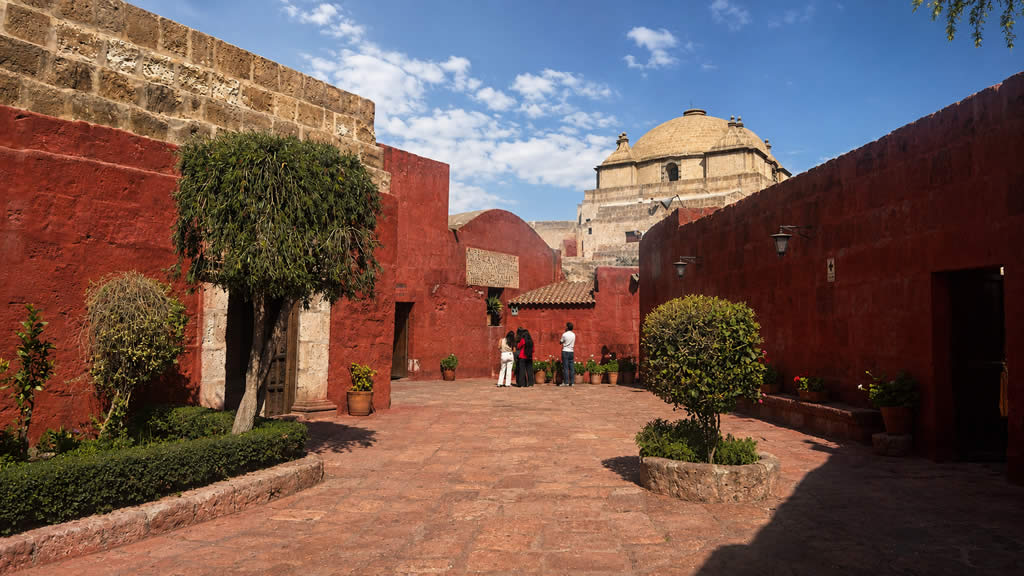
When you are entering to the monastery, the intense colored walls stand out at first glance. According to the Architect Marizol Velasquez Gutierres (specialty in art), the color used in the architecture of the Santa Catalina Monastery is not the natural color of the material (ashlar stone), but the color based on pigments that has the property of changing its appearance (wall painting).

“According to its use, it can be classified as flat wall painting and decorative wall painting. In the Monastery of Santa Catalina  coexist both, inside and outside the spaces, which configure it as an urban complex “

The colors that we can find in the monastery are indigo, blue, predominantly in the cloister of the Naranjos, the red ocher color for most of the streets, the white color for the novitiate cloister and the interior of the cells, the color orange ocher for the entrance and the main cloister, among others.

Velasquez Gutierrez also indicates this image was not always the same over time, because the quality of the color allows changing the appearance of the architecture according to fashions, remodeling, extensions, maintenance and also for health reasons, as evidenced in the polychromies hidden in the walls.

On the other hand, the decorative wall paintings of the interiors contain religious and floral designs and are the result of technical, social, historical and environmental facts.

How to visit Santa Catalina Monastery:

From March 1 you can visit the monument in the following ways:

1.- Virtual Tour: Virtual Tour with 7 chapters about its history. You can book a virtual visit of the place through the official website of the Monastery of Santa Catalina.

It is a way to anticipate the excitement of your next visit in which you can directly appreciate the majesty of the place.

2.- Direct visit to the Monument: From March 1st you can visit the Monastery with a fixed date and hour using the service of booking of the Monastery website.

*If you want to book a specialized guide please call 958 348 214

Open: Monday to Saturday from 09:00 to 17:00. – * LAST ENTRY 4:00 p.m.

Closed to the public  Easter Friday, December 25 and January 1


IMPORTANT INFORMATION – COVID -19

The Monastery of Santa Catalina has developed a strict biosafety protocol, to enjoy a safe and pleasant visit. You can read all the protocolo here .

The sale of tickets will be online and with reservation of time. Payments can be made with Visa, Mastercard, American Express, Dinners Club, Unionpay and Maestro.

Giardino Tours Blog

@GiardinoToursPeru

#ITravelwithGiardino #OneTripManyExperiences


Sources

Gutierrez, M. V. (27 de Enero de 2020). Universidad Catolica San Pablo.
Monasterio de Santa Catalina. (septiembre de 2020). Monasterio de Santa Catalina.
Lonely Planet_ArequipaOther Links:

Colca canyon Travel Guide: 7 Questions about Colca Tours

Peru Private Tours: 7 fantastic reasons to take a Private Service

Arequipa Treasures: Salinas and Aguada Blanca National Reserve

5 FacebookTwitterPinterestEmail
Travel Tips

Peru Private Tours: 7 fantastic reasons to take a Private Service

by Giardino Tours March 1, 2021

Peru Private Tours: 

Our Government has already begun with the re-activation of the tourism sector. Since March 1, it is already allowed in some places to take sightseeing tours.

But there is always a concern about what is the safest way to travel now and without question, it is recommended to make these visits minimizing all risk and especially if we travel with our family.

And… What if we told you that you can enjoy a tailor-made tour in a private service?

Apart that some private tours may cost a bit higher than group tours (SIC), they offer other advantages full of unique experiences, with an original and different look at the destinations that you visit in an great and personalized style of “information-entertainment”.

Here are 7 reasons why is a great and fantastic option to take a private tour in Peru!   🙂

1.- Making according to your way of travel

Private tours offer the possibility to design and customize your experience. To choose a route and itinerary from a range of options that we can find, to determine the duration of the tour and to decide where to start and end according to what suits us best.

2. Keep it as a family / Friends

Group Tours SIC (Seat in Coach) offers the possibility of making new friends as many travelers come together in one transport.

However, we may also like a more intimate experience and explore a destination with your loved ones at your own time and space. On a private tour, the only participants are you and your friends and/or family, so you’ll surely take countless memories of this experience.

In addition, the private tour offers a personal guide dedicated to answering every question you have. Your guide will be ready to answer any questions and inform you about any topics you want to know better. You’ll receive a number of recommendations and tips according to your interests.

The goal of a designed Private Tours is to make YOUR visit as enjoyable as possible.

3.- Tailor-made routes, exclusive for you and family

If we have family and are planning to travel, we usually ask our travel agents if the “youngest” can participate in our tours.

A three-hour tour can be a nightmare for children, and uncomfortable for parents who have to take care of them. But on a private tour you can choose the duration and route that interests you, so that the little ones have a good time too, as well as add activities that are more interesting for the children and so the parents maximize their experience as well as pleasant and memorable.

Also in the case there is someone with mobility problems, whether with a wheelchair, baby stroller or crutches, on a private tour you will be free of worries.

By booking a private tour you can inform in advance to your travel operator of the specific needs of your group / family and your agent will make a route that perfectly suits these special needs and provide all extras that you requiere.

4. The perfect gift

The truth is that today there is no better gift than the gift of knowledge.

When you invite to another friend / family to join you for a Private Travel experience is that exactly what you are giving.

Why buy a thing, when you can enjoy a life experience?

5.- A Guaranteed of departures

Another huge advantage of the private tour is in the answer to the question;

When?
The answer is… anytime!

Private tours are a service exclusive for you. So it is possible to start the trip on any day, depending on your convenience or when your flights and hotels are available.

6.- Flexibility

With a private tour, you decide how you use your time and you can adjusted your schedule according to your needs.

If you see a spectacular place and would like to make a stop to take some pictures…NO PROBLEM!

7.- Security:

Maybe one of the major reasons to book a Private service.

Today one of the most important advantages that you can manage in a Private Tour is your safety during the trip. In a Private tour you are preventing that people you don’t know join your trip.

Your agent elaborate a tour that is 100% customized and todays you must be sure that they offer all the biosecurity measures against the coronavirus.

Also, If something doesn’t make you feel safe during the trip, you can communicate it to your travel agent and they will pay special attention to your concerns, adjusting the journey to your needs.It is important that at the time of booking a tour or trip to Peru, you take some time to make a review of the reputation of the Tour Operator with whom you decide to make the trip.


Serious and formal companies offer more guarantee of quality service, a 24/7 personal attention and efficient logistics and bio securities protocols in all fields. Only then will you have an unforgettable experience!

Giardino Tours – Blog


@GiardinoToursperu

#ITravelwithGiardino  #OneTripManyExperiences


links  of interest:

Tips for a Responsible Peru Travel Experience!

Peru Packing List: 5 Items You Need to bring1

3 FacebookTwitterPinterestEmail
Travel Tips

Colca canyon Travel Guide: 7 Questions about Colca Tours

by Giardino Tours February 17, 2021
Colca canyon Travel Guide:  Find here the answers to frequently asked questions when you organize your trip to the Colca Canyon in Arequipa; Perú.  Colca canyon information that You Really Need To Know.

1.- Will I see Condors?

The Colca canyon is the “best place” in South America to see the Andean Condor. In our Colca canyon tours we will visit different viewing points to increase the chances to experience them closely.  If you get lucky they will fly just above your head! Remember that there is no guarantee that the condors will be seen, but in most cases it is possible to observe them at close range. 🙂

2.- Can I continue by land from Colca valley to Puno on Lake Titicaca?

Yes, this is possible!  And it is the most recommended itinerary to save time, because you do not have to return to Arequipa city.

If you are traveling alone: The Buses depart from Chivay plaza every day between 12 to 13:30 PM (approximately). It is recommended that you buy your bus ticket one day in advance. You must be at the bus station at least 40 minutes before Bus departure.In our organized Colca canyon excursions: In our Colca Tours the last day (Second day or Third day depending on your type of tour) you will return to Chivay town about 12:00 PM where you will have time for your lunch before taking our Giardino Transport and keep driving to Puno city (With stops on the route for pictures).

This transfer to Puno could be organized also with a Tourist Bus Company that offers this service. The coordination and logistic will be in our hands, so you don’t need to be worry and only relax and enjoy the tour!

You will be arriving in Puno about 7:00 PM (19:00hrs) and the drop off will be in your hotel (If it is located in city center), if your hotel is located out side of city center an extra charge can be added for transfer to your hotel.

3.- Can I start the Colca canyon 2 days tour from Puno?

YES! This service is possible in our Colca Canyon exclusive private tours!

But in case you want to join  a Group tour to Colca canyon and you are in Puno city; we can manage this provinding you with a transfer or Bus ticket from Puno to Chivay town; where you can join the Group Tour and keep the tour program until Arequipa city.

The transport or Bus will pick you up from your hotel between 6:00 to 6:15 am arriving at Chivay town approximately at noon, where you will join our Colca canyon Classic Tours  and keep the program according to the itinerary.

The excursions will end in Arequipa city in your hotel.

4.- I do not want to take all of my luggage to the tour. Where can I leave my luggage?

For excursion to Colca canyon with return to Arequipa city, hotels and hostels will normally store luggage in their safety deposit for free until you check-in again in your return.

In case your trip keep forward to Puno city, please inform us at the time of the Tour reservation so we can organized you with a group with similar schedule and provide with a transport with enough luggage space.

5.- I am afraid about altitude sickness: Is it a problem?

Altitude sickness can catch many travelers and normally we recommend that clients stay at least one night in Arequipa city in order to help to get to altitude.

To drink Coca Tea the frist day that you arrive to Arequipa will be very helpful! Also it is important to avoid alcoholic drinks and try to drink a lot of water.

In our tours to the Colca canyon our transportation provides “oxygen” in case of need.

6.- I want to do a Trek into the Colca canyon  but I am not traveling with any camping equipment.

If you travel solo: If you want to get down to the canyon it is only important that you have a very good physical condition and good orientation. In some villages as well as in the area near the Colca river are basic lodges where you can overnight. The lodges also offer dinner and lunch.

It is important that you get information about the route, take some maps or a GPS. Please keep on the marked routes and close to the villages. Don’t look for an adventure on unmarked routes. We strongly recommend taking a local guide.

If you take our Trekking Tours: For our organized tour only a good physical condition and a light personal backpack are required. Walking shoes and personal items.
The overnights during tour take place in basic rustic lodges at the bottom of the Canyon (provide bed, blankets and bathroom).

But it can get cold at nights and there is not heating, so it is important that you take with you warms clothes for the night and also light clothes for the day because can get very hot. – Very good Trekking shoes or boots is important.

7.- Family trips to Colca Canyon: Is right to travel with kids?

YES! It is great!  The Colca Valley is ideal for families especially if you are traveling with children.

Most travelers focus on hiking or to observe the condors on the canyon walls. However, children can enjoy a lot exploring the traditional villas during the short walks, bathing in  the hot springs pools, feeding animals, helping on the farms or sharing activities with locals.This is an extraordinary way to learn and share what the speed of the city has taken away from us; the harmony of nature and the ability to amaze us!
Activities such as feeding baby alpacas, horseback riding, hiking, artisanal textiles, games etc. are offered in family programs to the colca valley.

Ready to travel to one of the most beautiful natural landscapes in Peru?

Colca Canyon Travel Guide_ Giardino Tours


@GiardinoToursPeru

#ITravelwithGiardino #OneTripManyExperiences

3 FacebookTwitterPinterestEmail
Travel Tips

Tips for a Responsible Peru Travel Experience!

by Giardino Tours February 16, 2021
Responsible Peru Travel experiences:  Peru is one of the most beautiful and interesting countries of South America, help us to take care of it. Please organize and travel in a responsible form!.

RESPONSIBLE PERU TRAVEL TIPS:

1.- When are you planning your trip, choose those providers that offer guarantees of quality and respect for human rights and the environment.

2.- Also make sure that the companies that you hire during your trip are formal and established; because it means that they pay taxes and this support the growth and development of the country.

3.- Plan your route to minimize carbon emissions – travel by train or public bus where it is possible, minimize internal flights.

4.- Pack the right PPE gear. (Personal protective equipment). Bring Hand sanitizer and bring masks for you and your family.

BEFORE YOUR TRIP STARS

  • Read about our culture and learn a few words in spanish – traveling with respect earns you respect.
  • Remove all excess packaging – waste disposal is difficult in remote places like Valleys, rivers or traditional towns.
  • Take to your trip rechargeable batteries for camera or other electronic devices; if not, please return the old batteries to your country. In Peru battery recycling is difficult and in many places almost impossible; please do not forget that one battery can contaminate 40 liters of water.

If you dont know how to manage a old battery during your trip, please talk to us to inform you where and how is the best way to dispose  them.

  • Take a Reusable Botle of Water and a cloth bag. – Check a Full Post about this topics here.
  • Take with you Solid Shampu (You can not imagine the amount of bottles of shampoo and soap that our travelers leave in hotels.)
  • Ask to Giardino Tour agent or your Travel agent for specific tips for responsible travel in your destination.

DURING YOUR TRIP

  • Buy local products and use local restaurants.
  • Take tours where you know that hire a local guide – you’ll discover more about local culture and lives, and they will earn an income.
  • Remeber that “cheap prices” does not means “quality and fair prices” in many cases you are supporting informality or abuse of employes and providers.
  • Do not buy products made from endangered species, hard woods, or ancient remains or artefacts.
  • Respect local cultures, traditions and holy places – if you have a doubt ask for advice or don’t visit.
  • Hire a bike or walk when convenient – its a great way to meet local people on their terms and reduce pollution and carbon emissions: Support the walking tours offered by your local tour Operators.
  • Use water sparingly – its very precious in many regions and tourists tend to use more than local people.
  • Try to minimize waste generation. They are a source of contamination.
  • If you walk in a natural area, make sure that the only trace that you left behind is your “footprint”.

If you are interested in taking part in some social support during your trip to Peru; Giardino Tour Operator works with and organizes different actions to support our communities and the enviroment.  Please Check our website “Social Responsibility”.

Also Giardino Tour Operator works with the children’s house “Hogar de Cristo – Arequipa” a non-profit organization that help children who work on the streets and the organization of “Medicos Solidarios Arequipa” a group of professionals that work to reduce the contamination of health personnel during pandemic Covid-19.

Contact us to learn about the different ways and possibilities that you can help and participate in our social activities. 🙂

  • Remember that local people have different ways of thinking and concepts of time, this just makes them different, But is nothing wrong with that – cultivate the habit of asking questions. Be a curious and deep traveler, and take the advantages of this rich experience in Peru.
  • When you buy gifts and souvenirs look for products that are expressions of local culture. This promote the economy of the people and their cultural diversity.

Try to contribute during your trip with your presence to the development of responsible and sustainable tourism for a healthier planet and solidarity.

WHEN YOU GET BACK

  • Write to your tour operator or hotel with any comments or feedback about your holiday, and especially include any suggestions on reducing environmental impacts and increasing benefits to local communities.
  • Support good and Reliable Tour Operators using the Media like Trip advisor, Facebook, Instagram, Twitter etc…Positive comments motivate. Remember that is our goal that you get back home with great experiences and memories about our Country.
  • If you are no happy with a service, inform your agent immediately and ask for an explanation and more infos.
  • If you’ve promised to send pictures or gifts to local people remember to do so!

Giardino Tours Team.

Responsible Peru Travel Experiences@GiardinoToursPeru

#ItravelwithGiardino #OneTripManyExperiences

2 FacebookTwitterPinterestEmail
Newer Posts
Older Posts

More Articles/Más Artículos

  • Colca Canyon Tour: Introducing the awesome Colca Canyon
  • Peru Trip: Altitude mountain sickness and 6 easy tips to avoid it
  • Peruvian Carnivals: Magic, culture & celebration
  • Arequipa Tour: 2 surprising curiosities about this destination!
  • Colca Sour: An unique Cactus cocktail
  • Peru 2 love’s story tellings and myths
  • Enigmatic Sillustani & best way to book a Tour
  • Amazing Tour Maras Salt ponds in Cusco (Virtual)
  • Tips for a Responsible Peru Travel Experience!
  • Colca canyon Travel Guide: 7 Questions about Colca Tours
  • Facebook
  • Twitter

@2021 - All Right Reserved. Designed and Developed by PenciDesign


Back To Top
Giardino Tours Blog
  • Go to Giardino Tours
  • English
  • Español