Top Posts
Cusco Tour: 3 differences between Machu Picchu, Mountain...
Quechua Travel Words: Useful words for a great...
Tour Arequipa: The fascinating stone city of Choqolaqa
Tour Arequipa: Stunning Salinas and Aguada Blanca N.R....
Protecting Our Planet Starts with You – 9...
8 highlights of Arequipa – Tips to enjoy...
FOOD in Arequipa: 8 delicious Dishes that Are...
Embroidery in the Colca Valley a Cultural Heritage...
The interdimensional gate Aramu Muru. Fascination & mystery.
Pacaya Samiria Reserve: A world destination not to...
  • Go to Giardino Tours
  • English
  • Español
Giardino Tours Blog
TRANSFORMING TRAVELS INTO MEMORABLE STORIES
Tag:

National Reserves

Peru Great Destinations

Tour Arequipa: Stunning Salinas and Aguada Blanca N.R. & the Best way Visit It

by Giardino Tours January 30, 2024
The Salinas and Aguada Blanca National Reserve is one of the most important natural attractions of the city of Arequipa. This attraction, next to the Colca Valley, are the two most impressive ecosystems in the region.
Salinas and Aguada Blanca National Reserve

The Salinas and Aguada Blanca National Reserve was established in 1979 as a place for the protection of vicuñas, but today it also represents the main water reserve of the city of Arequipa and surroundings.

The reserve is distinguished by the presence of the majestic volcanoes Ubinas, Pichupichu, Misti and Chachani on the southwest part, and by the snow-capped Chuccura and Huarancante on the north side and  has an area of 366,936 hectares. And an altitude  between 3500 and 6000 meters.

The high Andean plains, dotted with beautiful lagoons and wetlands, complete the icy landscape of most of the territory inhabited mainly by South American camelids and by a large number of terrestrial and aquatic birds.

Objetive

Protect habitats that offer optimal conditions for the development of populations of vicuña, taruca, common parihuana, Andean parihuana and James parihuana. Protect forests from queñual.

Fauna/Flora

The vertebrates are represented by 207 species, of which 37 are mammals and 158 birds. Also the presence of 5 species of reptiles, 4 amphibians and 3 fish has also been reported. The herbivores characteristic of the fauna are the camelids of South America: Llama, alpaca, vicuña and guanaco.

Also here you will find the Tarucas, viscachas, puma, the andean cat, the andean fox, etc.  Among the resident birds we have  the Andean huallata or goose, the mountain duck and the flamingos or parihuanas.

And talking about the flora of the Reserve, you will find about  358 species of plants.The Salinas and Aguada Blanca National Reserve has a good network of roads that allow access to much of the protected natural area.

An ideal and easy way to observe part of the Natural Reserve (Pampa cañahuas area) is during the 2 days excursion to the Colca canyon.

There are also other excursions to the Reserve such as a visit to the Salinas lagoon, the Mauca rock formations or visit to Pillones and Puruña in the area of Pampa Cañahuas, the cave paintings of Sumbay and more.

Clima

The Salinas and Aguada Blanca National Reserve  has very low average temperatures ranging from 2° to 8° C. Extensive thermal fluctuations occur, both day and night, as well as between shade and sun exposure. It has annual precipitation averages of 200 to 600 mm, mainly from January to March, a period in which 65 per cent of the rains fall. Frost occurs almost all year round and can reach -20°C.

All these characteristics, together with their capricious rock formations, their archaeological remains, the rich living culture of their present inhabitants and their easy accessibility, make it one of the most valuable protected natural areas of the country.

The megadiversity of the reserve makes it one of the treasures of Arequipa region.
Peru is beautiful and megadiverse!


Giardino Tours – Blog.

@GiardinoToursperu

#ItravelwithGiardino #OneTripManyExperiences


Links that may be interesting:

Tips for a Responsible Peru Travel Experience!

Arequipa: The stone city Choqolaca

Santa Catalina Monastery: What you need to know for your Tour in Arequipa
3 FacebookTwitterPinterestEmail
Pacaya samiria national reservePeru Great DestinationsTravel Tips

Pacaya Samiria Reserve: A world destination not to be missed

by Giardino Tours May 27, 2021

Pacaya Samiria Reserve: A world destination not to be missed

¡We have great news this May 2021! 🙂

Pacaya Samiria National Reserve, Peru’s second-largest protected natural area located in Loreto region— once again attracted the interest of the international tourism, as it was chosen as a must-visit destination during the 41st edition of the International Tourism Fair – FITUR 2021 in Madrid, Spain.

This was reported by the Spanish newspaper español La Vanguardia, in an article that explores destinations to travel “despite” COVID-19. This article was wroten by the journalist Lidia Bernaus and published in the  Magazine Lifestyle.

In the publication, the Pacaya Samiria National Reserve is described as “an amazing place that will impress even the most adventurous people.”

[vc_gallery interval=”3″ images=”2969,2970″ img_size=”large”]The Pacaya Samiria National Reserve is the only tourist attraction in Peru and the Americas that stands out as a world’s must-visit destination at FITUR 2021.

The Reserve is a tropical humid forest that can be flooded, and is home of lagoons such as El Dorado, and where up to 1,000 species of animals and more than 900 wild plants live, in addition to 50 native communities that are dedicated to hunting, fishing, and agriculture. Also the tourism as one of their main means of subsistence.

The extension of the reserve represents 1.5% of the Peruvian territory and 6% of the Loreto region, likewise, it is somewhat larger than the area of ​​Slovenia and comparable to 50% of the territory of Denmark, Switzerland, the Netherlands or Costa Rica or the 23% from Portugal, which ensures the ecological and genetic representativeness of the region.

Other destinations mentioned in this article include the volcanic island El Hierro, which is one of the Canary Islands  (Spain), Palma de Mallorca (Spain), the city of Cairo (Egypt), Bohol Island (Philippines), among others.

Clima:

The annual mean temperature ranges between 20 and 33 °C, while the annual mean precipitation ranges between 2000 and 3000 mm.[2] It is advisable to visit the reserve between May and January.[2] The climograph shown here corresponds to the nearby town of Nauta (93 m of elevation).

Tourism:

It is not possible to enter the Pacaya Samiria National Reserve on your own, it is always necessary to acquire the services of an authorized travel agency, a hostel, a cruise (luxury boats) or contact directly with the groups organized within the reserve.

On April 22, 2021, the Minister of Foreign Trade and Tourism, Claudia Cornejo, delivered the Safe Travels International Seal to the Iquitos-Amazon River-Pacaya Samiria National Reserve tourist destination. This was possible thanks to the coordination with the tourism sector, meeting in the Regional Pro Tourism Committee of Loreto.

We keep organizing and preparing ourselves better than ever, so that our travelers will enjoy our country in the safest, most personalized and sustainable way.

We are waiting for you!

GIARDINO BLOG

#OneTripManyExperiences #ITravelwithGiardino


Fuentes:

Mincetur / Turiweb / Wikipedia / Fitur2021


Other links:

8 highlights of Arequipa – Tips to enjoy Peru’s prettiest city

Peru Packing List post Covid-19: 5 Items that You Need to take to your Peru Trip

Peru Trip: Altitude mountain sickness and 6 easy tips to avoid it

0 FacebookTwitterPinterestEmail
Peru Great Destinations

Tambopata National Reserve: How to visit this amazing destination

by Giardino Tours March 22, 2021

The Tambopata National Reserve is the dream place for any nature lover, It is one of the most precious biodiverse areas of our Peru.

The Tambopata National Reserve (RNTMB) is located south of the Madre de Dios River in the Tambopata and Inambari districts of the Tambopata province, in Madre de Dios department. It has an extension of 274 690.00 hectares and its most common ecosystems are aguajales, swamps, pacales and river side forests, whose natural characteristics allow local people to take advantage of natural resources.

Tambopata is home of 632 species of birds, 1200 species of butterflies, 169 species of mammals and hundreds of species of trees and plants. On the other hand, it is also home of many local communities such as the Ese Eja native community with thousands of indigenous families residing in that place.

We present here the best-known tourist routes for Tambopata Natural reserve.

Sandoval Lake

This is the most visited tourist destination in the Reserve and with good reason.

If your plan is to spend a relaxing moment full of peace and connection with nature, this lake is the perfect destination. It is considered the most beautiful lake in the Peruvian jungle with 3 km long by 1 km wide and a depth between half a meter and 3 meters.

In its waters you will find a large family of giant otters that can be seen hunting or resting on the logs. There is also an observatory tower for a panoramic view and due to its richness of mangroves and palm trees you can observe a large number and variety of birds that makes the place a truly paradise.

Macaw clay lick

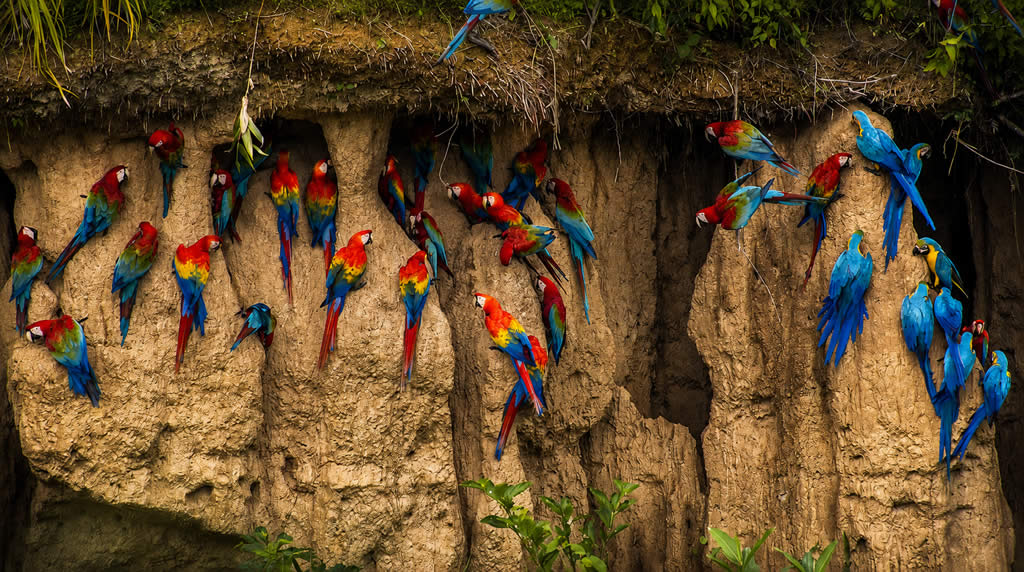
Who has not shared in Instagram photo where the Macaws are stapled to the wall and are a feast of colors? – Well in this Collpa you can live the experience live and make it one of “your photos”.

This visit to the Macaw Clay Lick offers an impressive show of color and sound (Special between 5:30 and 9:00 am). The clay licks are low cliffs caused by the erosion of the rivers which exposes mineral salts and organic components which are used by the great diversity of macaws and parrots as a complement to their diet.

There are several clay licks, but the best known and frequented by travelers are “El chuncho” and “Colorado”, their access is by river (canoe) and along the way you also will enjoy the diversity of the nature observing sachavacas, ronsocos, squirrels, monkeys and others.

Indigenous communities

The best thing about traveling is getting to know new cultures and traditions. The communities that inhabit this reserve are already partly used to the visitors and many of their members are part of the reserve’s protection programs.

With the communities we will be able to share their traditions and culture in a respectful way, thus living a very pleasant experience. Within these communities are the Eje Esa, the Harakbut and the Matsigenka, among others.

Activities:

The reserve offers programs of all kinds and for all types of travelers: Specialized tourism, family tourism, programs for children, adventure tourism, botanical, etc .

The reserve offers everything that a nature and adventure lover loves: walks, river rides, search for the river wolf, piranha fishing, talks for children about Biodiversity, night walks, Observatories, bike rides etc . Check here the activity offers of some of the most sustainable Lodges and choose the one you like the most.

How to visit and what should I consider for a healthy experience in Tambopata Natural Reserve?

The first thing you should do is find out about the lodges, research centers and Lodges that offer complete sustainable programs within the reserve.

Remember that it is important that your trip does not generate a negative impact, but rather helps us to promote responsible tourism.

We as travelers have great power “Your trip with the right company not only gives you a spectacular experience, but also contributes to making the reserve sustainable and protected.

The starting point is the city of Puerto Maldonado (From Lima and Cusco you can arrive by plane) Once there, a representative of the Lodge where you have made your reservation, will be waiting for you to transfer the boat to your respective Accommodation and thus start to your purchased program.

  • Tour Programs in the Jungle normally include Full board service, so it is important that you bring with you only what you need for the excursions and personal medication.
  • Electric power in most lodges is operated by generators that are turned on in the morning, around lunch, and for dinner. When you arrive at your hostel, the staff will inform you the electricity time schedule. Do not forget that the 0 V voltage will not work in Peru, in Peru we use the 220V.
  • The Weather conditions in general is hot and humid. In Tambopata, the average daytime temperature is between 78F and 93F (24C and 31C). The nighttime average is between 66F and 78F (20C and 24C).
  • Most travel agencies or Lodges have an office in Puerto Maldonado where you can leave the luggage that you do not want to take with you for the expedition in the jungle.
  • Also a great tip is to bring spare batteries (we recommend that you bring 3 spare batteries).
  • Make sure you have enough storage on your card, because most people take more photos than what they expect.
Due to the pandemic, all lodges in the Amazon forest now must apply a strict bio-security protocol. Please check direct with your lodge or with your travel consultant  about this information and verify that the regulations are being followed.
It is important to take care not only of your health, but also the health of all people in the communities that you’ll visit.

Check here our Travel List and Tips for a Trip to Peru with all Information that you will need before the trip ;)Ready to visit Tambopata? – An amazing experience is waiting for you!

Giardino Tours – Blog


#ITravelwithGiardino #OneTripManyExperience


Sources:

Monica. (23 de febrero de 2020).  / Sernap: Reserva de Tambopata.


Other links that may interesting for you:

Peru Packing List post Covid-19: 5 Items that You Need to take to your Peru Trip

Tips for a Responsible Peru Travel Experience![vc_gmaps link=”#E-8_JTNDaWZyYW1lJTIwc3JjJTNEJTIyaHR0cHMlM0ElMkYlMkZ3d3cuZ29vZ2xlLmNvbSUyRm1hcHMlMkZlbWJlZCUzRnBiJTNEJTIxMW0xNCUyMTFtOCUyMTFtMyUyMTFkNTY5MzkzMi41MjE4NzMwNTElMjEyZC03My4zMjI4NzczNzAzMjUlMjEzZC05Ljc3ODQzNTI2MzcyNzAxMiUyMTNtMiUyMTFpMTAyNCUyMTJpNzY4JTIxNGYxMy4xJTIxM20zJTIxMW0yJTIxMXMweDAlMjUzQTB4NjlkNzc4MmM2ZTRiNjU5OCUyMTJzUmVzZXJ2YSUyNTIwTmFjaW9uYWwlMjUyMFRhbWJvcGF0YSUyMTVlMCUyMTNtMiUyMTFzZW4lMjEyc2RlJTIxNHYxNjE2NDE1MTk1NTc2JTIxNW0yJTIxMXNlbiUyMTJzZGUlMjIlMjB3aWR0aCUzRCUyMjYwMCUyMiUyMGhlaWdodCUzRCUyMjQ1MCUyMiUyMHN0eWxlJTNEJTIyYm9yZGVyJTNBMCUzQiUyMiUyMGFsbG93ZnVsbHNjcmVlbiUzRCUyMiUyMiUyMGxvYWRpbmclM0QlMjJsYXp5JTIyJTNFJTNDJTJGaWZyYW1lJTNF”]

5 FacebookTwitterPinterestEmail
Culture & Traditions

Peru 2 love’s story tellings and myths

by Giardino Tours February 12, 2021

Love always contains a great mystery, because for each person, people and time love has been interpreted and manifested in different forms.

But today we are going to tell you about 2 romantic peruvian love’s story tellings related to ancient Peruvian traditions. These are popular stories in which fantastic or supernatural events are related, as if they were real events. Many of them are created by the community and are transmitted from parents to children, from generation to generation, that is why they are part of our culture and to the memory of Peruvians and are usually related to the beliefs and folklore of a certain region in Peru.

Love’s story tellings of Huascarán and Huandoy mountains.

This romantic love’s story telling takes place in time of the Inca Empire, when the people of Cusco expanded their dominions through the Callejón de Huaylas. In this region (located in Ancash) there are more than 20 snow-capped peaks that exceed 6000 m.a.s.l. and the highest mountain in Peru and the intertropical zone is the Huascarán.
The legend said that there was a laborious and peaceful tribe in “Callejon de Huaylas” where one day a very badly wounded soldier arrived with a message to the Great chief. The man informed that some warriors from Cusco had sacked his town without mercy and that they were heading towards the village.
Looking at the situation the great chief ordered his warriors to go in search of the leader of the Cusco army, proposing a peaceful negotiation. And so it happened. Days later, the soldiers returned to the tribe with a Cusqueño warrior “Huáscar”, the most recognized warrior of the invading tribe of Cusco.Shortly afterwards, someday the strong Huáscar met on his path a beautiful young woman with long black hair, big eyes and a beautiful smile; she was the daughter of the great chief of the tribe; her name was Huandy.


As in every romantic story, the warrior Huascar and the beautiful girl fell in love, but this was a “forbidden” love. So the lovers decided to run away together.

Furious for the offense realized by Huascar and his daughter, the Great Chief ordered their capture. Once in prison, the great Chief humiliated them in public and then tied them to wooden logs, placed in such a way that they could see each other as they died.

The warrior Huascar hoped that his people (the Incas) would arrive and rescue them. However, when the Cusco army arrived, they supported the decision of the Great chief.
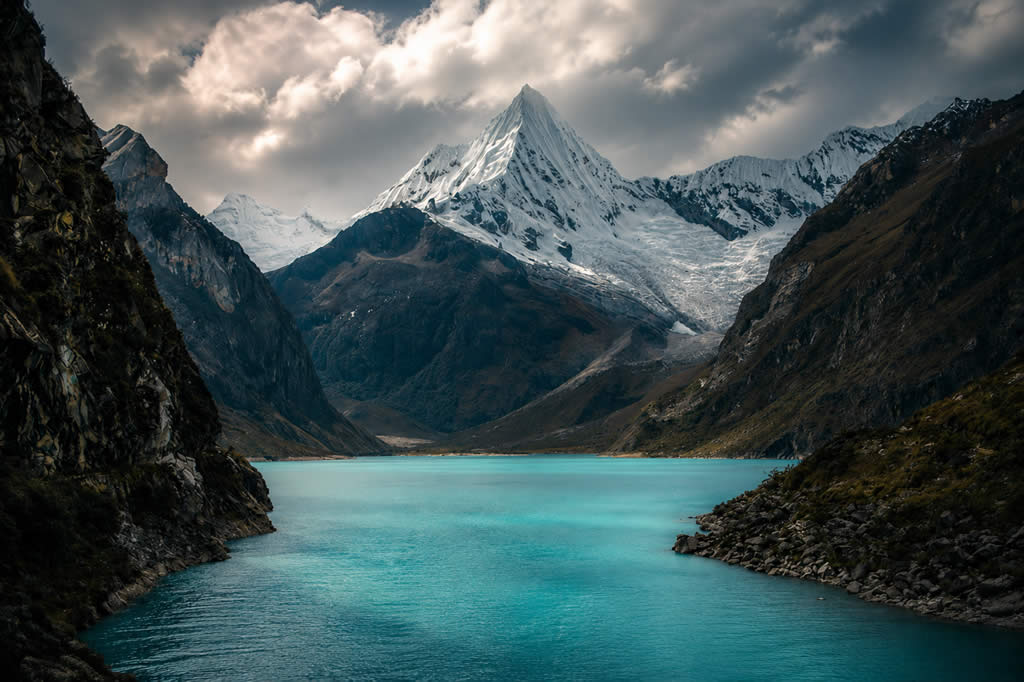
Without hope and prisoner of great impotence, Huascar swore revenge on all of them and thus both lovers began to cry full of pain. The legend said that both lovers cried until they were completely dry. From the tears of Princess Huandy, Lake Chinancocha was formed, also known as “the female lagoon” and from the tears of Huáscar, Lake Orcococha, also known as “the male lagoon”. (Also known as Lagunas Llanganuco)
The god “Inti” (the Sun) observing what happened and in pain also, sent a lot of rain, thunder, lightning and hailstorm to all the area. The legend said that it was so much and for so long time that the bodies of the lovers were covered, thus forming the snow-covered mountain Huascarán (for Huáscar) and the snow-covered mountain Huandoy (for Huandy) .

This love’s story tellings said specially among the local people of the Callejón de Huaylas, that in 100 or 200 years the snow-capped mountains will remain without snow and Huáscar and Huandy will resurrect and meet again to live their love forever. (Cardenas, 2020)

Love’s story tellings of the Huacachina oasis – Ica

In the middle of the coastal desert of the Pacific Ocean, in the Ica region, there is a beautiful oasis “La Huacachina”. A Oasis of green waters and around which there is abundant vegetation composed of palm trees, eucalyptus and huarangos, the same that are used for migrant birds that usually pass through This region.  That makes it one of the most beautiful and striking tourist spots in Peru, however, its beauty also contains a myth related to unconditional and infinite love.
Huacachina,means the “crying woman” in the Quechua language. The legend said that in this lagoon an Inca princess named Huacca China was born (Her name means “the one who makes people cry.”).They said that the princess fell in love with a young warrior of the empire who died shortly after they met. It is said that when the princess was informed of the tragedy, she went to the place where they had met for the first and c and cried intensely; then, while crying, she looked through her hand mirror and saw young man who was looking at her; the young man tried to get closer to her, but she got scare and began to run through the desert.According to legend, her clothes shaped the dunes that surround the oasis and the mirror got broken, giving shape to the lagoon.

After that the princess enters the lagoon and becomes a mermaid and the tradition tells that this mermaid appears every night on full moon to sing old songs to her lover.

Apart for knowing now these love’s story tellings, for sure now when you travel to Huaraz (Ancash) or to the Huacachina Oasis, you will look at every detail with different eyes …

And perhaps through the eyes of those “lovers”.


GIARDINO TEAM@GiardinoToursperu

#ItravelwithGiardino #OneTripManyExperiences

2 FacebookTwitterPinterestEmail

More Articles/Más Artículos

  • Colca Canyon Tour: Introducing the awesome Colca Canyon
  • Peru Trip: Altitude mountain sickness and 6 easy tips to avoid it
  • Peruvian Carnivals: Magic, culture & celebration
  • Arequipa Tour: 2 surprising curiosities about this destination!
  • Colca Sour: An unique Cactus cocktail
  • Peru 2 love’s story tellings and myths
  • Enigmatic Sillustani & best way to book a Tour
  • Amazing Tour Maras Salt ponds in Cusco (Virtual)
  • Tips for a Responsible Peru Travel Experience!
  • Colca canyon Travel Guide: 7 Questions about Colca Tours
  • Facebook
  • Twitter

@2021 - All Right Reserved. Designed and Developed by PenciDesign


Back To Top
Giardino Tours Blog
  • Go to Giardino Tours
  • English
  • Español