Top Posts
Quechua Travel Words: Useful words for a great...
Tour Arequipa: The fascinating stone city of Choqolaqa
Tour Arequipa: Stunning Salinas and Aguada Blanca N.R....
Protecting Our Planet Starts with You – 9...
8 highlights of Arequipa – Tips to enjoy...
FOOD in Arequipa: 8 delicious Dishes that Are...
Embroidery in the Colca Valley a Cultural Heritage...
The interdimensional gate Aramu Muru. Fascination & mystery.
Pacaya Samiria Reserve: A world destination not to...
Tambopata National Reserve: How to visit this amazing...
  • Go to Giardino Tours
  • English
  • Español
Giardino Tours Blog
TRANSFORMING TRAVELS INTO MEMORABLES STORIES
Tag:

Colca Canyon

Peru Great Destinations

Tour Arequipa: Stunning Salinas and Aguada Blanca N.R. & the Best way Visit It

by Giardino Tours January 30, 2024
The Salinas and Aguada Blanca National Reserve is one of the most important natural attractions of the city of Arequipa. This attraction, next to the Colca Valley, are the two most impressive ecosystems in the region.
Salinas and Aguada Blanca National Reserve

The Salinas and Aguada Blanca National Reserve was established in 1979 as a place for the protection of vicuñas, but today it also represents the main water reserve of the city of Arequipa and surroundings.

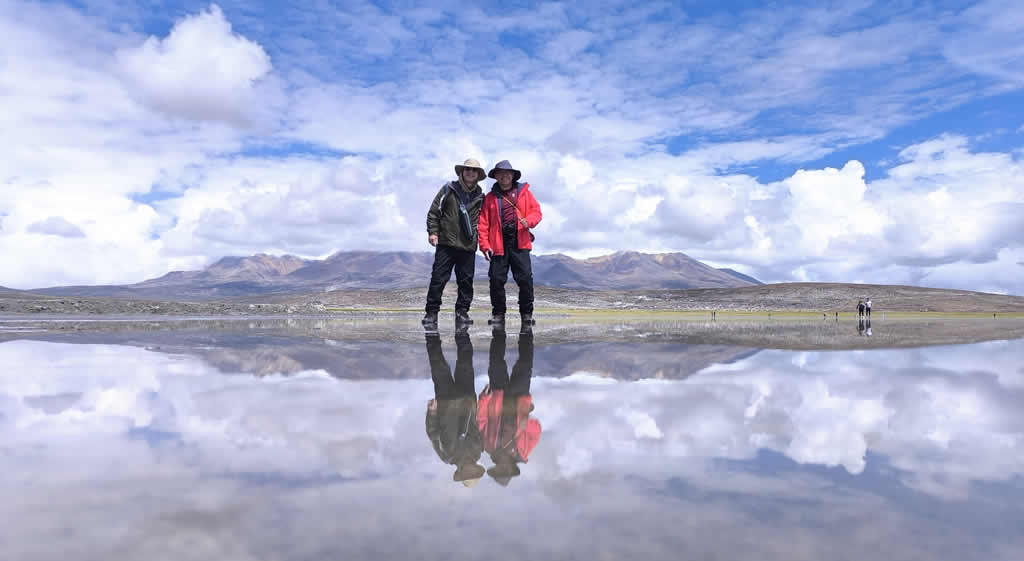
The reserve is distinguished by the presence of the majestic volcanoes Ubinas, Pichupichu, Misti and Chachani on the southwest part, and by the snow-capped Chuccura and Huarancante on the north side and  has an area of 366,936 hectares. And an altitude  between 3500 and 6000 meters.

The high Andean plains, dotted with beautiful lagoons and wetlands, complete the icy landscape of most of the territory inhabited mainly by South American camelids and by a large number of terrestrial and aquatic birds.

Objetive

Protect habitats that offer optimal conditions for the development of populations of vicuña, taruca, common parihuana, Andean parihuana and James parihuana. Protect forests from queñual.

Fauna/Flora

The vertebrates are represented by 207 species, of which 37 are mammals and 158 birds. Also the presence of 5 species of reptiles, 4 amphibians and 3 fish has also been reported. The herbivores characteristic of the fauna are the camelids of South America: Llama, alpaca, vicuña and guanaco.

Also here you will find the Tarucas, viscachas, puma, the andean cat, the andean fox, etc.  Among the resident birds we have  the Andean huallata or goose, the mountain duck and the flamingos or parihuanas.

And talking about the flora of the Reserve, you will find about  358 species of plants.The Salinas and Aguada Blanca National Reserve has a good network of roads that allow access to much of the protected natural area.

An ideal and easy way to observe part of the Natural Reserve (Pampa cañahuas area) is during the 2 days excursion to the Colca canyon.

There are also other excursions to the Reserve such as a visit to the Salinas lagoon, the Mauca rock formations or visit to Pillones and Puruña in the area of Pampa Cañahuas, the cave paintings of Sumbay and more.

Clima

The Salinas and Aguada Blanca National Reserve  has very low average temperatures ranging from 2° to 8° C. Extensive thermal fluctuations occur, both day and night, as well as between shade and sun exposure. It has annual precipitation averages of 200 to 600 mm, mainly from January to March, a period in which 65 per cent of the rains fall. Frost occurs almost all year round and can reach -20°C.

All these characteristics, together with their capricious rock formations, their archaeological remains, the rich living culture of their present inhabitants and their easy accessibility, make it one of the most valuable protected natural areas of the country.

The megadiversity of the reserve makes it one of the treasures of Arequipa region.
Peru is beautiful and megadiverse!


Giardino Tours – Blog.

@GiardinoToursperu

#ItravelwithGiardino #OneTripManyExperiences


Links that may be interesting:

Tips for a Responsible Peru Travel Experience!

Arequipa: The stone city Choqolaca

Santa Catalina Monastery: What you need to know for your Tour in Arequipa
3 FacebookTwitterPinterestEmail
Colca CanyonCulture & TraditionsTravel Tips

Embroidery in the Colca Valley a Cultural Heritage of the Nation

by Giardino Tours June 25, 2021
“On August 17th, 2018, was published on the newspaper “El Peruano” the knowledge and practices associated with embroidery in the Colca Valley a Cultural Heritage of the Nation”

“The recognition was granted for its important technical richness, historical, traditional and artistic value of the iconographic and symbolic contents that they communicate, which are strongly rooted in the Collagua and Cabana worldview, as part of a process of empowering identity of the culture of the population of the Colca valley. ” – Andina 2018

If you are going to visit the Colca canyon, you will be surprised not only by the affection, the spectacular views of the valley, the depths of one of the deepest canyons in the world, the flight of the condor, the joy and gastronomy of its people, but in addition, the parade of colors of their crafts, especially that of their traditional costumes, which represent the identity, love, art and pride of the region.

Undoubtedly it can be affirmed that the craftsmanship of the Colca valley is extraordinary, due to the high development achieved, but very particularly that development is appreciated in its textile art of embroidery.

Through folklore, the Colca people express their culture through symbolic representations related to ecology, their cultural, social, geographical and historical environment and, therefore, are important elements of cultural identity and / or ethnic heritage.

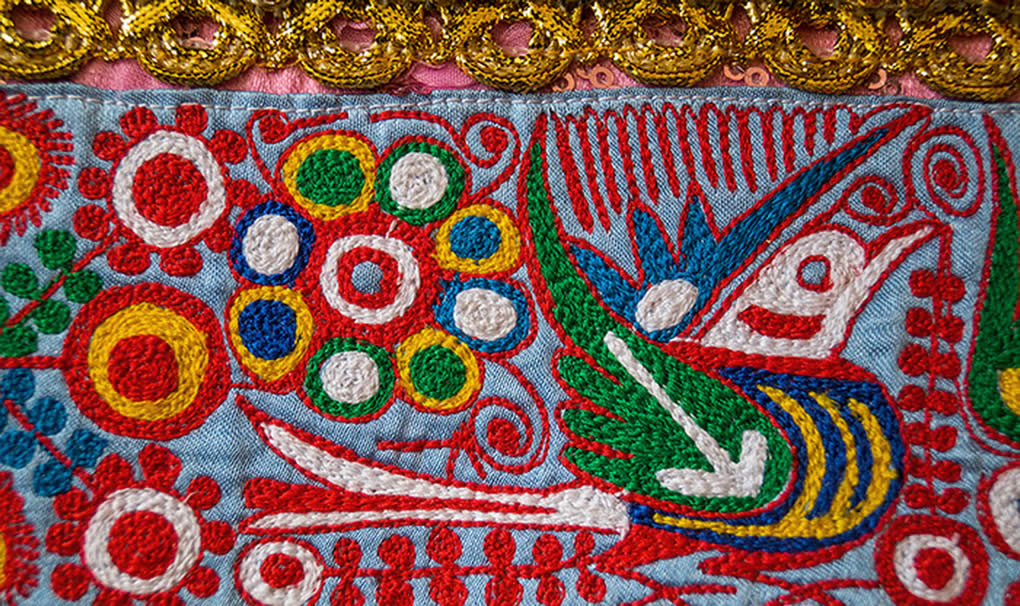
We will find skirts, shirts, hats, blankets, sweaters, chullos (hats), gloves, stockings, scarves, ponchos and other beautifully embroidered fabrics which all reflect the uses and customs of the men and women of Colca valley and their close relationship with nature.

This art also reflects the spirituality of the local people, where the iconography and polychrome, with colorful works, shows the richness and art of the Andean cosmo-vision.

The technique for embroidery work is called the “maquinasca” (sewing machine), which is a widely known technique in the southern Andean region. The artists take the machine and begin to embroider hearts, chamomile and cantuta flowers, sparrows, etc.

In addition, and according to the client’s requirements, other representative products of the region such as “trout” can be added to the work. Sometimes, to give it a more elegant touch, the artists complement their work with industrial fabrics, gold and silver silks and ornaments of different colors.But beyond the craft itself, as a result of a work, at the center of all this is the human factor, the craftsman, who with their artistic hands turns every product into unique pieces in which they express their creativity and imagination but supported by the realities of their daily and ancestral life.

And this is the most prominent factor in the inevitable association of tourism with the crafts of the destinations that we visit.

All type of Crafts offers to the travelers the opportunity to take home “the stories”. Each Souvenir is more than a thing, is the “memory” that transform itself to a open book, that talk to us with all the symbols through which the territories visited murmur magical stories to travelers and their environment.

Today’s traveler not only wants to see places but also to experience them, feel that they are part of their life for a moment, living the culture, their artisans and their manifestations.

The magnificent Colca region has many reasons for you to visit it, but without a doubt, it is also the place that allows you to bend time, find calm and awaken in each one of us the passion for life details.

Write down the “Colca canyon” among your great travel destinations, here you will find thousands of reasons to live the legend! And consider to spend more then one night to enjoy experiences full of emotions, respect and learning.

We are waiting for you!

Giardino Blog

#ITravelwithGiardino #OneJourneyManyExperiences


Other links:

8 highlights of Arequipa – Tips to enjoy Peru’s prettiest city

Peru Packing List post Covid-19: 5 Items that You Need to take to your Peru Trip

Peru Travel Restrictions Covid-19: Updates to Government of Peru

0 FacebookTwitterPinterestEmail
Peru Great Destinations

Colca Canyon Tour: Introducing the awesome Colca Canyon

by Giardino Tours February 4, 2021

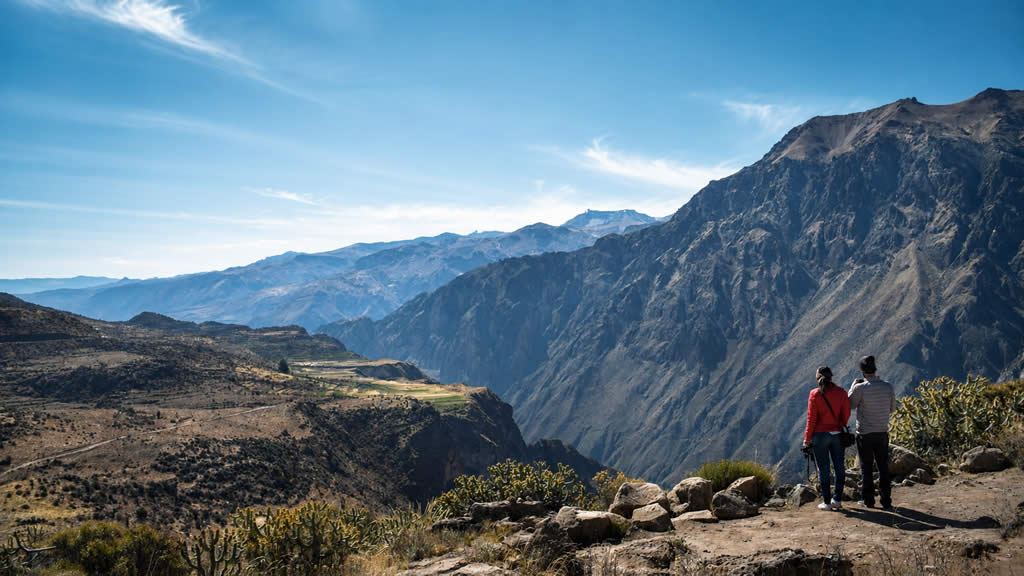
The Colca Canyon is one of the most scenic regions in Peru, a land of imposing snowcapped volcanoes, narrow gorges, artistically terraced agricultural slopes that predate the Incas, arid desert landscapes and vegetation, and remote traditional villages.

Some of Peru’s most recognizable wildlife, including llamas, alpacas, vicuñas are easy to find here. Also the canyon is home to the Andean condor (Vultur gryphus); here you will have the best chance to get of them amazing pictures!

The 120km-long “Cañón del Colca” is set among high volcanoes (6613m-high Coropuna and 6310m-high Ampato are the tallest) and ranges from 1000 mts. to more than 4160 mts. depth. For years there was raging controversy over whether or not this was the world’s deepest canyon with 4,160mts, but recently it ranked as the third one after Kali Gandaki in Nepal with 4,375 mts.Despite its depth, the Colca canyon is geologically young. The Colca river has cut into beds of mainly volcanic rocks, which were deposited less than 100 million years ago along the line of a major fault in the earth’s crust.

The climate is cool and dry on the plateau and slopes high above the Colca river.

The Colca Canyon is also synonym for extensive biodiversity, with an incredible flora and fauna. This special characteristic of the canyon occurs because Peru is located in the subtropical area of South America and it has a rugged geography, in addition, ocean currents and the air mass movements, create an incomparable ecological, climatic and geological variety.

This is a the reason of the importance of conserving the ecosystems that keep alive the variety of animals and plants that this canyon has, a true natural wonder.


The condors are best seen in the early morning and late afternoon when they are hunting. At this point the canyon floor is 3,960 feet (1,200 m). Also Viscachas (burrowing rodents closely related to chinchillas) are also common around the canyon rim, darting furtively among the rocks.

Cacti dot many slopes and, if they’re in flower, you may be lucky enough to see tiny nectar-eating birds braving the spines to feed. In the depths of the canyon it can be almost tropical, with palm trees, ferns and even orchids in some isolated areas.The La Calera natural hot springs are located at Chivay, the biggest town in the Colca Canyon. But you can also enjoy others hots springs with less visitors in other towns such as Yanque and Coporaque.
Festivals throughout the year, including the Wititi festival in Chivay, (December 8–) are a high light. The Wititi has been declared the dance most representative of the Arequipa region, and named as a “cultural heritage” of Peru.The Colca canyon is also well known for two forms of crafts: goods knitted from 100% baby alpaca fiber (hats, gloves, etc.), and a unique form of embroidery that adorns skirts (polleras), hats, vests, and other items of daily wear and use.

The local people (especially the women) are known for their highly decorative traditional clothing. The women’s dresses and jackets are intricately embroidered, and their hats are distinctive.
In the Chivay area at the east end of the canyon, the white hats are usually woven from straw and are embellished with lace, sequins and medallions. At the west end of the canyon, the hats are of cotton and are painstakingly embroidered.

The women don’t particularly enjoy being photographed, so always ask permission. And those who pose for photographs expect a tip.

Colca canyon Activities:

Fauna and Flora observations, Hiking, short walks, mountain biking, trekking, rafting, horseback riding, fishing, and sightseeing.

Organized tours to this destination have daily departures.

It is a destination for all type of travelers, from those who are looking for some relaxing days with luxury service (hotels 4* and 5 *), adventure lovers (because of the many activities that here can be done); classic travelers and family tours (organized tours with visit to all highlights, and family experiences with locals) to low budget travelers.Sources: Wikipedia, Lonely Travel, Promperu.

2 FacebookTwitterPinterestEmail

More Articles/Más Artículos

  • Quechua Travel Words: Useful words for a great Peru experience
  • Tour Arequipa: The fascinating stone city of Choqolaqa
  • Tour Arequipa: Stunning Salinas and Aguada Blanca N.R. & the Best way Visit It
  • Protecting Our Planet Starts with You – 9 Things You Can Do
  • 8 highlights of Arequipa – Tips to enjoy Peru’s prettiest city
No comments to show.
  • Facebook
  • Twitter

@2021 - All Right Reserved. Designed and Developed by PenciDesign


Back To Top
Giardino Tours Blog
  • Go to Giardino Tours
  • English
  • Español